
D
Oct 1 at 03:27 AM
MU: Without the AI melt-up, can LTAs sustain the memory supercycle?
 I'm LongbridgeAI, I can summarize articles.
Micron (MU.O) released its FQ4 FY2026 results (quarter ended Aug 2026) after the U.S. market close on Oct 1 Beijing time. Key takeaways:
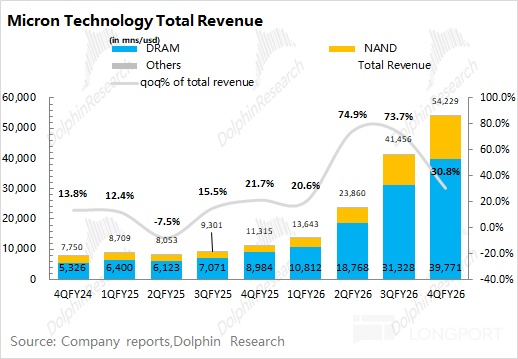
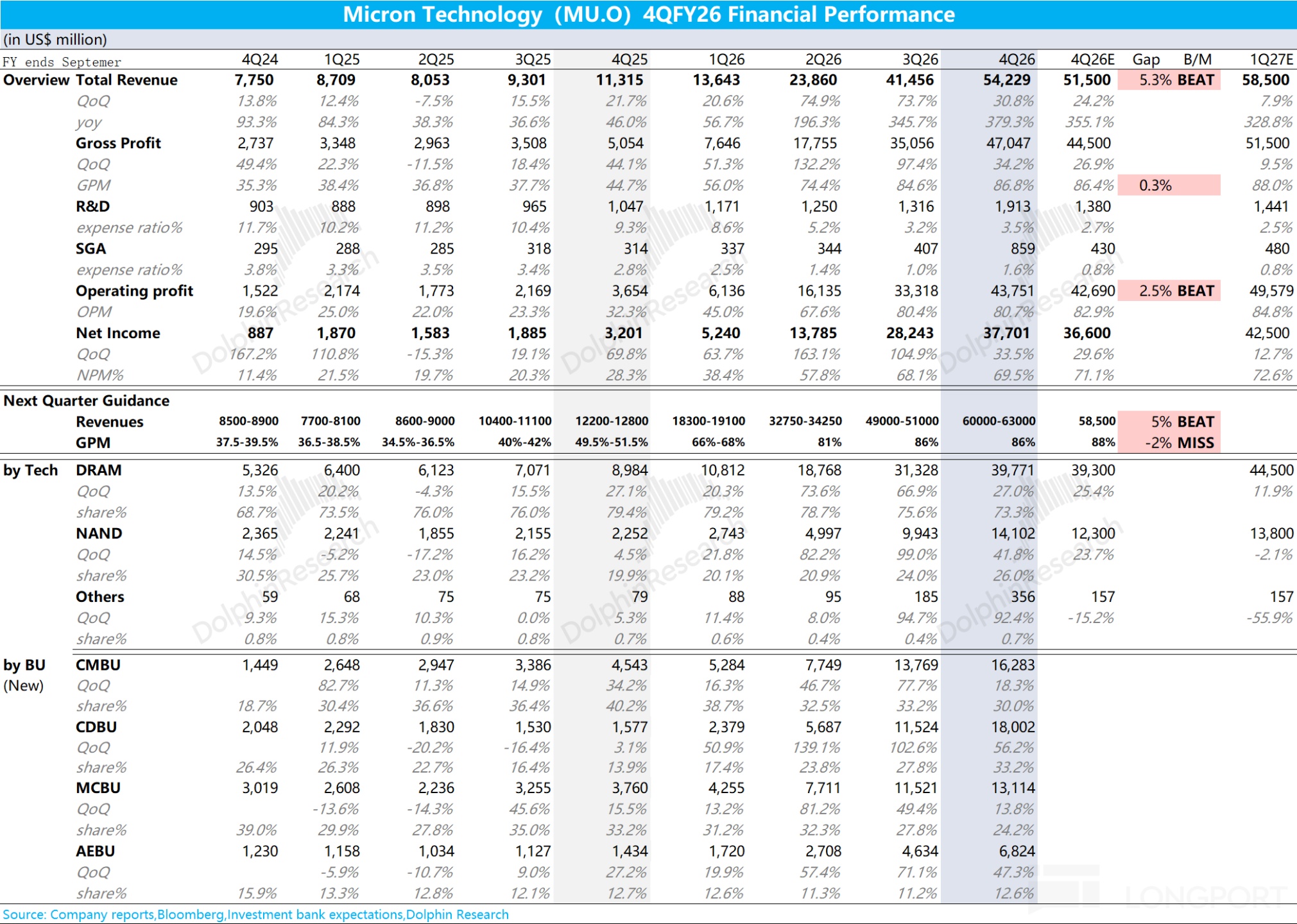
1. Overall results: $Micron Tech(MU.US) reported revenue of $54.2bn, up 31% QoQ. Growth decelerated visibly vs. the 70%+ QoQ prints in the prior two quarters. Revenue beat also narrowed, with a ~$4bn beat this quarter vs. ~$8bn last quarter.
When issuing guidance, volumes are largely locked; the upside comes mainly from pricing. With GPM already above 85% and more SCA (strategic long-term agreements) in place, memory pricing is unlikely to see another parabolic spike. Focus has shifted from 'how high' to 'how long'.
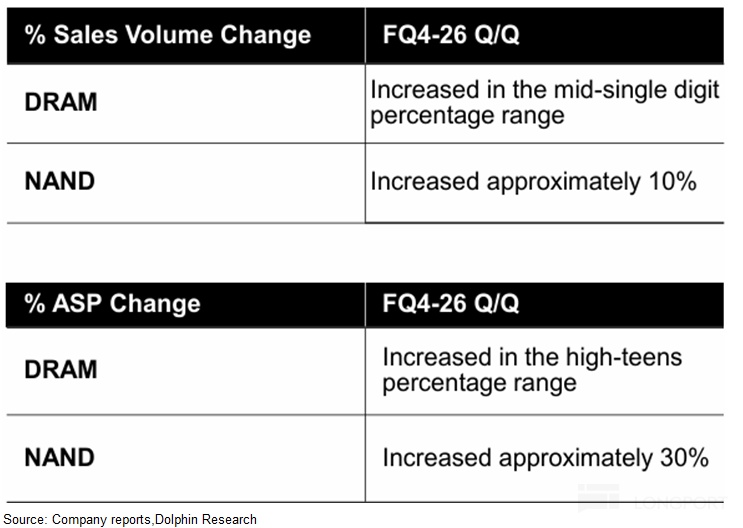
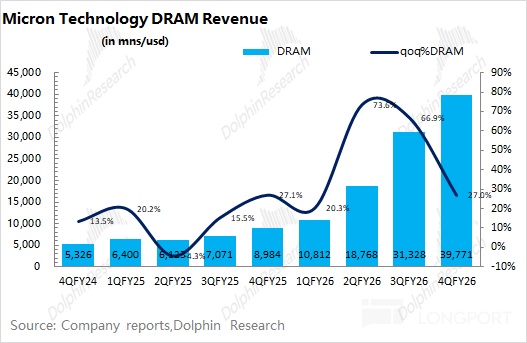
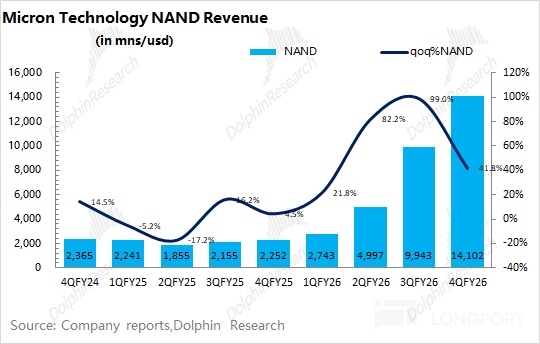
Volume/price mix: shipments — DRAM up low single digits QoQ; NAND up ~10% QoQ. Pricing — DRAM ASP up ~20% QoQ; NAND up ~30%. This is a clear slowdown versus the ~80% QoQ ASP jumps seen in the prior two quarters.
The core driver of this memory super-cycle is capacity, especially the sluggish DRAM shipment recovery; despite favorable pricing, DRAM shipments have risen by only single digits QoQ for four straight quarters. This is not about unwillingness to expand, but about cleanroom build times that typically take 2+ years, leaving supply unable to catch up.
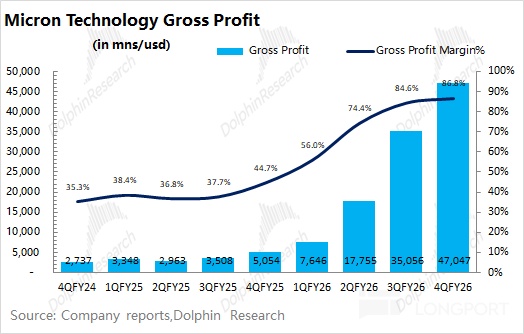
2. Gross margin: GPM reached 86.8%, up 2.2ppt QoQ and in line with market expectations (86.4%), primarily driven by pricing.
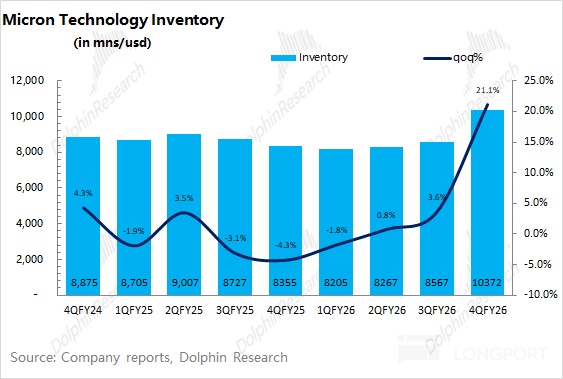
For next quarter, the company guided to ~86% GPM, pressured by higher-cost inventory from Q4 incentive accruals, startup costs, and other opex — a roughly $1.0bn headwind. Ex these items, adj. GPM would be ~87.6%.
3. Guidance: long-term matters more than near-term
1) Near-term: Micron guides next-quarter revenue to $61.5bn (±$1.5bn), implying a ~$7.3bn QoQ increase. While growth is slowing, it is still above buy-side expectations (~$58.5bn). GPM should be ~86%, or ~87.6% on an adjusted basis (ex inventory/one-offs), slightly below buy-side at ~88%.
This implies next-quarter memory ASPs rise only ~10–15% QoQ, a further deceleration. If ASP momentum keeps fading, it will be hard to drive multiple expansion.
2) Long-term: more important. The company believes memory and storage supply-demand will be much tighter in calendar 2027–2028 than in 2026. Versus last quarter’s stance that even if balance begins to ease in 2028, timing for supply to truly catch up remains uncertain, management now sounds more confident in cycle durability.
What underpins this confidence is the ramp in SCAs. SCA terms are typically 5 years (CY2026–end-2030), with auto contracts generally at 3 years.
To date, the company has signed 26 strategic agreements (vs. 16 last quarter), with remaining performance obligations (RPO) of about $150bn. All SCAs have take-or-pay volumes, and RPO includes only portions with defined pricing frameworks (fixed or with caps/floors).
Micron has also secured $32bn in performance guarantees under these SCAs (up $10bn QoQ), reinforcing its pricing power and risk protection within the contracts.
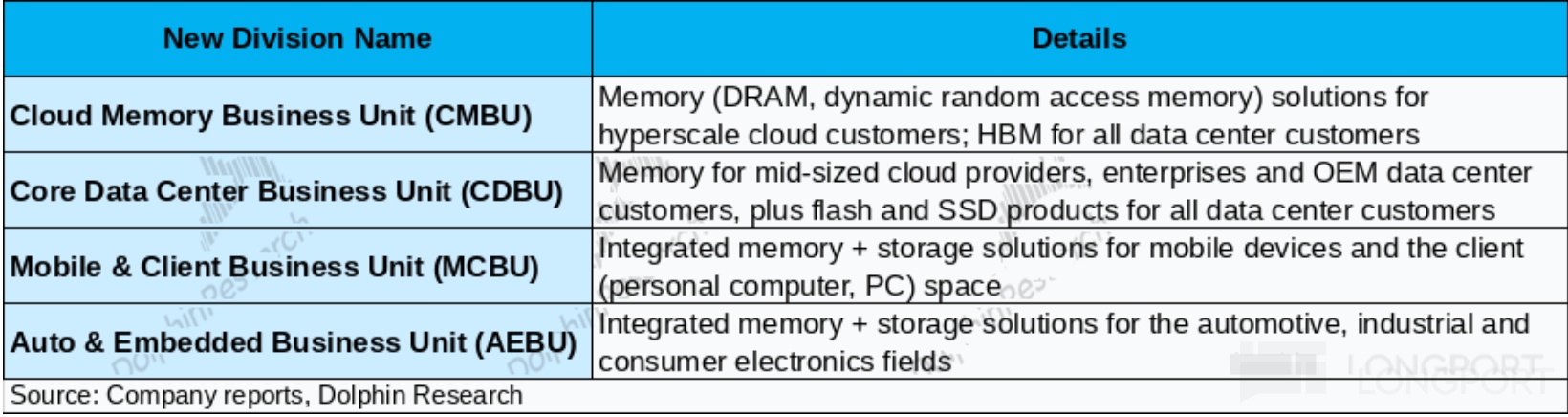
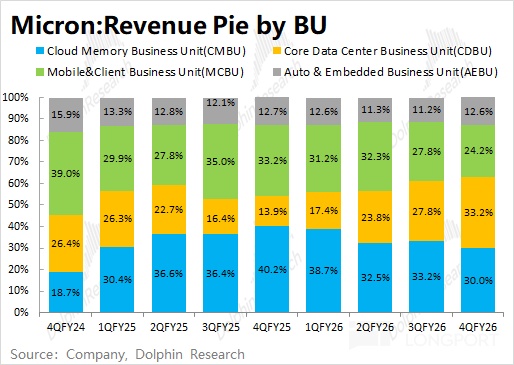
4. By end-market: data center now accounts for 63% of revenue. The Cloud Memory BU (CMBU), tied to hyperscaler memory demand (incl. HBM), has seen a marked QoQ slowdown. The fastest growth over the past two quarters came from the Core Data Center BU (CDBU), which serves SMB customers and includes data-center NAND/SSD products.
Viewed alongside the new SCAs, hyperscalers now face capped price elasticity as contracts roll in. SMB pricing remains more sensitive to market swings, offering greater elasticity, which has driven outperformance at CDBU.
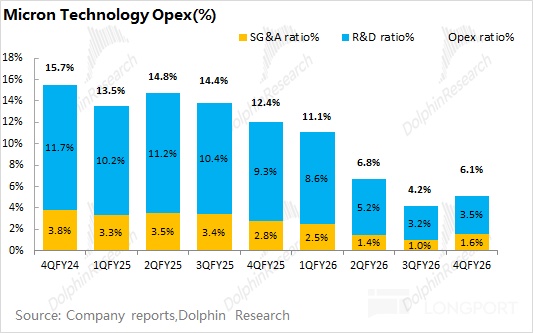
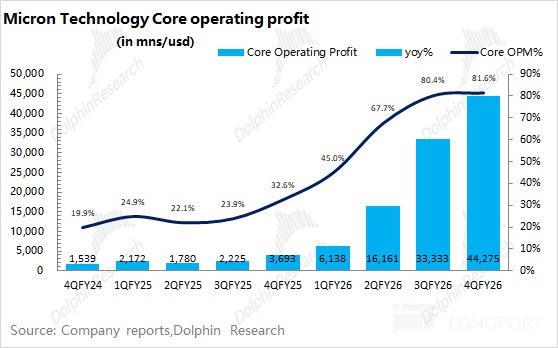
5. Operating leverage: with revenue surging, R&D and SG&A ratios fell to mid-single digits, highlighting strong operating leverage. The uptick this quarter reflects higher R&D and incentive comp. Core OP reached $44.3bn with OPM at 81.6%.
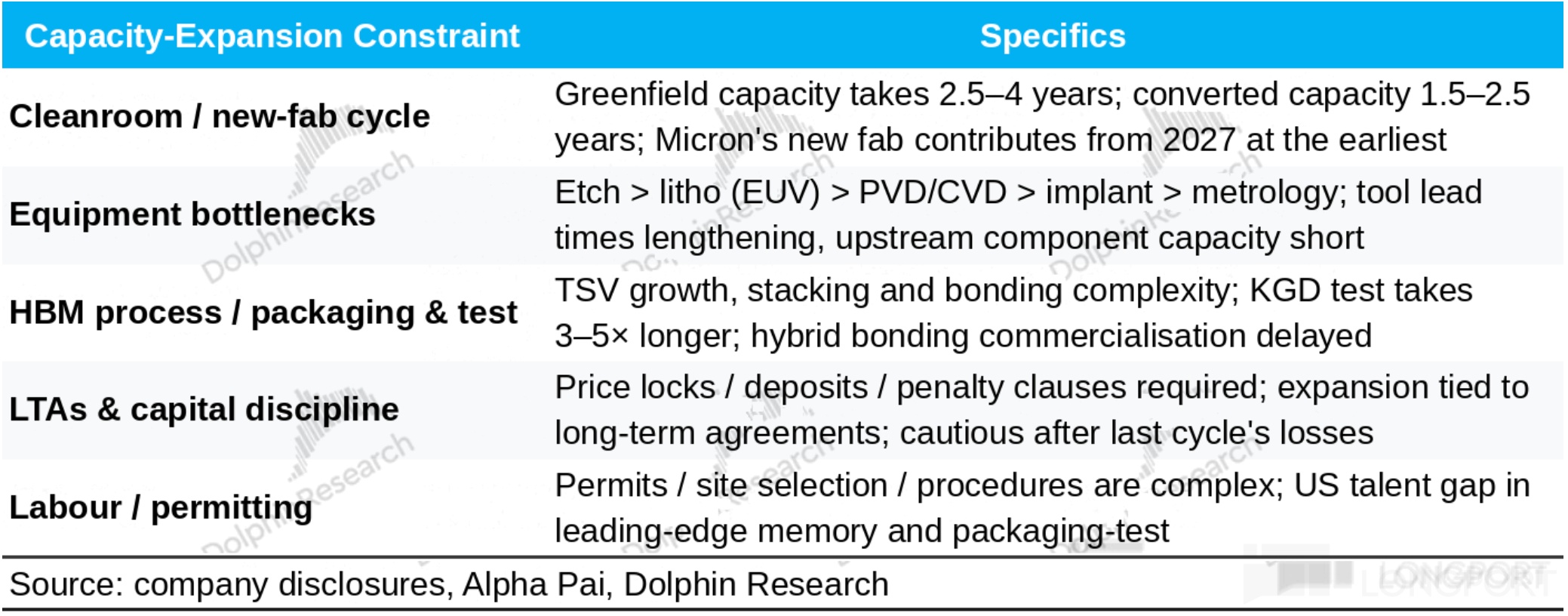
6. Capex: memory is cyclical, so markets often worry that rising capex will re-tip supply-demand. This time looks different: majors are minting cash, yet even if they want to expand, they struggle to spend due to hard constraints.
Capex this quarter was $10.8bn ex $0.3bn of Gov. subsidies (above the $10.0bn plan last quarter). FY2027 capex is guided higher vs. prior plans (previously expected to run above $10.0bn per quarter), with Q1 at ~$11.5bn, 1H at ~$25.0bn, and 2H higher.
The company emphasized that over half of incremental capex will go to factory construction, i.e., pulling forward cleanroom builds rather than just tools. This aims to accelerate cleanroom capacity for 2H CY2028 and beyond.
Meeting notes, please click. See the link for details.
Dolphin Research view: beats narrowing; memory feast enters its second half
Micron delivered a solid but less dazzling quarter. Revenue and GPM met expectations, but the beat was roughly half of last quarter. Volume and pricing gains are slowing, with DRAM/NAND ASP increases easing from ~80% QoQ to ~20–30%. Focus has shifted from 'how high' to 'how long'.
On durability, Micron sounds confident. Management sees tighter supply-demand in 2027–2028, underpinned by a growing stack of SCAs: 26 signed to date, locking in roughly $150bn of RPO. Price ceilings are set for hyperscalers, with more elasticity at smaller customers.
At its core, this cycle is about capacity. Cleanroom expansions take 2+ years, and even with cash on hand, spend is constrained. While capex is rising, more than half targets buildings, so meaningful supply additions likely land in 2H 2028 or later. Tightness is unlikely to break near term.
As attention shifts from 'how high' to 'how long', key areas for Micron are:
1) Cycle longevity: supported by AI demand, the memory market remains in an upcycle. TrendForce expects DRAM and NAND prices to post another double-digit QoQ increase in Q4. Note that SCA ceilings will temper the pace of price gains.
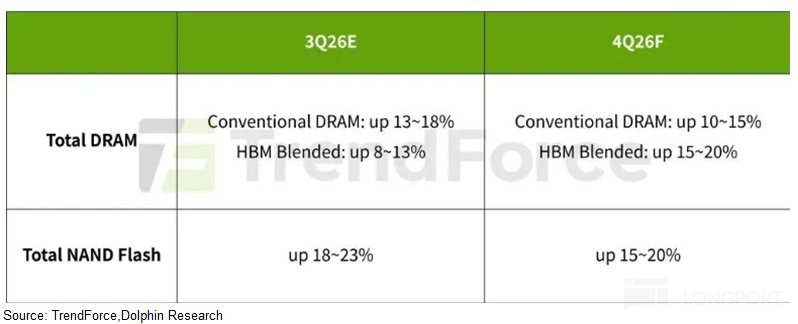
Versus recent spikes, the market now cares more about cycle length. Consensus among major houses is for memory prices to keep rising into 2H 2027, while views diverge for 2028 and beyond. With incremental demand from Agent AI, even the more cautious scenarios do not foresee a 2028 price collapse, given multi-year SCAs with floors from players like Micron.
Management reiterated that 2027–2028 will be tighter than 2026, offering a measure of reassurance for 2028.
2) SCAs: 26 signed (vs. 16 last quarter), including Google, Meta, Microsoft, and Amazon. Five-year take-or-pay structures apply, and customers post 20–30% deposits and pay even if they do not take delivery. Price caps and floors lock in volume certainty but also curb spot upside. As SCAs scale, ASP visibility rises and price hikes moderate, making outsized beats less likely; management will prioritize durability over peaks.
3) HBM progress: the market has flagged that HBM stack heights may be cut, sparked by reports that NVIDIA's next-gen Rubin Ultra initially targeted 16-hi, then 8-hi, and more recently 4-hi. Correspondingly, HBM capacity would drop from 768GB to ~192GB.
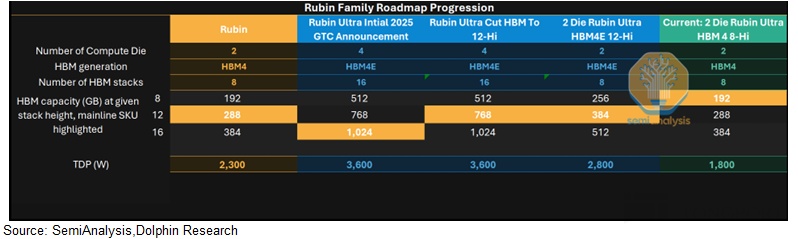
Dolphin Research views this as a supply-driven, passive choice. Wafer supply is tight, and existing volumes cannot support the 16-hi/12-hi needs for next year's GPUs. Shifting to 8-hi or 4-hi increases output per limited wafer supply, helping close the gap. On the workload side, inference increasingly faces bandwidth rather than capacity constraints (which can be mitigated via larger interconnects). 4-hi delivers the same bandwidth as 8-hi/12-hi because channels, not stack height, determine bandwidth. Thus, converting 12-hi to 4-hi triples bandwidth per HBM wafer; vs. 8-hi it doubles, with better packaging yields.
Micron is currently the only 4-hi partner. So far, only Micron is running compliance tests and validation for at least two customers. Samsung and SK hynix are cautious on 4-hi, but are expected to follow.
4) Buybacks: Micron received CHIPS Act funding, with the first tranche in Dec 2024. As consideration, capital allocation limits apply — for two years after receipt, Micron is restricted from large-scale buybacks. In Jul 2026, Micron said it would increase capital returns starting Dec 9, 2026 (the two-year anniversary), with a long-term goal to return 100% of excess cash to shareholders. With that date nearing, watch for management commentary on buybacks post-print.
At a ~$1.2tn market cap, Micron trades at ~5.7x FY2027 after-tax core OP on our framework (assumes +125% YoY revenue, 88% GPM, 15% tax). Sub-6x looks inexpensive, but multiple expansion may be capped.
DRAM and NAND ASPs have clearly cooled on a QoQ basis, and pricing looks increasingly stable. That suggests the phase for major multiple rerating has passed unless ASPs re-accelerate. At the same time, a sharp share-price drop would require negative price inflection, which seems unlikely near term. Shares may chop in a mid-range band.
If the stock and PE revisit the lower band, i.e., below ~4x PE, buybacks/dividends could step up and re-attract flows. Quarterly profit is around $40bn, and the Dec 9 CHIPS restriction sunset is approaching.
For a lower-band reference, we look at free cash flow using a 10% discount rate. Given still-high pricing in FY2027–FY2028, earnings power from FY2026 to FY2028 should be robust.
For post-FY2028 FCF, we reference the FY2023–FY2028 average (cycle trough to peak) at ~$60bn and treat it as a perpetuity. FCF estimate = FY2026–FY2028 FCF + perpetuity FCF = $322bn + $600bn = ~$922bn, broadly corresponding to ~4.3x FY2027 after-tax OP.
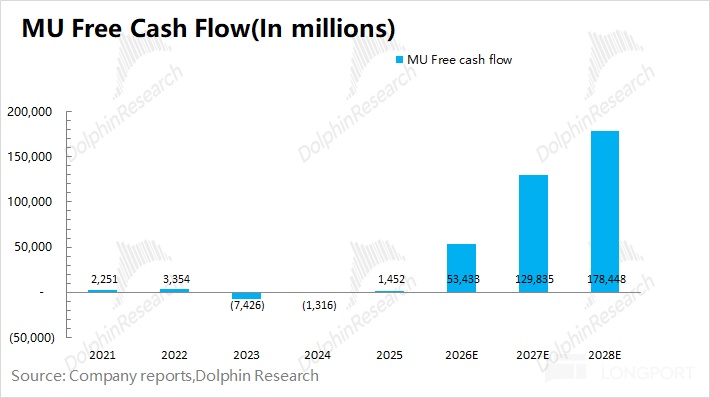
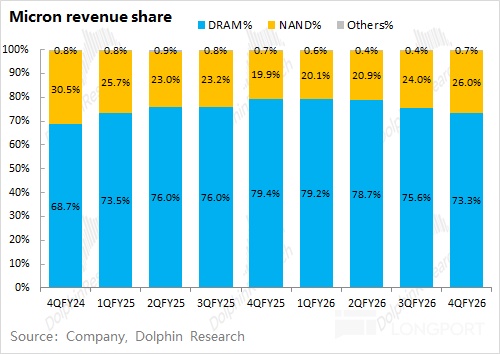
Below are Micron's reported figures and detailed charts:
<End here>
Micron article archive by Dolphin Research:
Recent AI memory analysis:
DRAM industry:
Memory to take the baton from compute: why HBM stands out
From HBM height limits to NAND spec bumps: NVIDIA vs. memory — who holds the reins
Single names:
Western Digital (Part I): AI inference boom: can the 'beleaguered' WDC rise from the ashes
Western Digital (Part II): NAND's prolific nature: how can WDC defend an 80% GPM
Micron earnings:
Jun 25, 2026 earnings take: Micron: on a tear — can the 'bleak cycle' turn into 'super growth'
Jun 25, 2026 call Trans: Micron (Trans): supply tightness to extend past 2027
Mar 19, 2026 call Trans: Micron (Trans): demand assurance unchanged; first 5-year SCA signed
Mar 19, 2026 earnings take: Micron MU: AI ignites memory; can it break the cycle curse
Dec 18, 2025 small group: Micron (analyst huddle): cash to expand first; HBM4 yields ramp faster
Dec 18, 2025 call Trans: Micron (Trans): GPM to keep rising, at a slower pace
Dec 18, 2025 earnings take: Micron MU: AI fuels memory; a new super-cycle
Sep 24, 2025 call Trans: Micron (Trans): across-the-board guidance raise — has AI wind reached legacy semis
Sep 24, 2025 earnings take: Micron: AI capex binge — is the memory super-cycle finally here
Risk disclosure and disclaimer: Dolphin Research disclaimer and general disclosure

The copyright of this article belongs to the original author/organization.
The views expressed herein are solely those of the author and do not reflect the stance of the platform. The content is intended for investment reference purposes only and shall not be considered as investment advice. Please contact us if you have any questions or suggestions regarding the content services provided by the platform.