amit

amit

0Following49Followers303Likes & Bookmarks
A
amit

A TON OF THINGS HAPPENED IN THE STOCK MARKET TODAY.

Here's a full recap:

1. SpaceX $SpaceX(SPCX.US) reported a massive Q3 2026, with revenue surging 161% YoY to $14.6B, while EPS reached $0.35 and net income totaled $4.4B. Adjusted EBITDA jumped 306% YoY to $8.8B, with operating cash flow of $13.1B and capital expenditures of $19.6B, highlighting the scale of the company's infrastructure investments. By segment, Space revenue grew 6% to $1.8B, Connectivity revenue increased 69% to $5.2B, and Space Intelligence (SI) revenue skyrocketed 830% to $7.6B, becoming the company's largest revenue contributor. Elon Musk also outlined aggressive expansion plans for AI compute, saying SpaceX could potentially have 20 GW of SI capacity online by the end of 2027, although he acknowledged that outcome is unlikely. Musk added that he would be surprised if SpaceX deployed less than 13 GW of compute capacity by the end of next year, underscoring the company's ambitions in large-scale AI infrastructure.

2. Anthropic’s draft IPO prospectus reportedly reveals explosive growth alongside unprecedented AI infrastructure commitments, with H1 2026 revenue surging nearly 15x YoY to $16.3B, up from $1.1B, while computing expenses climbed to nearly $9B. The company recorded an $80.7B net loss, although approximately $72B came from accounting adjustments tied to convertible notes and other financing instruments rather than direct operating expenses. Anthropic has reportedly committed roughly $450B to long-term cloud contracts, plus more than $160B for Google-designed AI chips through Broadcom $Broadcom(AVGO.US), with additional negotiations potentially pushing total computing commitments toward $750B. Major suppliers include Google $Alphabet(GOOGL.US) ($111B), Amazon $Amazon(AMZN.US) ($110B), Microsoft $Microsoft(MSFT.US) ($31B), and Nscale and Lambda (up to $86B), while the prospectus also highlights risks around customer concentration, power availability, infrastructure execution, and AI-related liability. Anthropic is reportedly preparing for a potential IPO at a valuation approaching $2T, underscoring the extraordinary scale of both the revenue opportunity and capital requirements facing frontier AI developers.

3. Supermicro $Super Micro Computer(SMCI.US) significantly raised its preliminary Q1 FY2027 revenue guidance to $18.5B–$19.5B, up from its previous outlook of $14.5B–$15.5B, representing a 27% increase at the midpoint. The company attributed the stronger outlook to accelerating demand for AI infrastructure platforms, reflecting continued investment in next-generation data center systems. Supermicro also raised its expected gross margin to 12.0%–12.5%, up from 10.4%–10.8%, citing a more favorable customer and product mix. The combination of sharply higher revenue expectations and improving margins suggests stronger operating leverage as demand for AI computing infrastructure continues to expand.

4. Citadel founder Ken Griffin warned that investors are “almost certainly” in an AI bubble, raising concerns about the enormous amounts of capital being deployed into artificial intelligence without corresponding evidence of widespread productivity gains. Griffin pointed to the scale of AI infrastructure commitments, with Anthropic reportedly considering as much as $750B in future computing expenditures, as investors increasingly question whether AI companies can generate sufficient returns to justify their spending. Despite his concerns about elevated valuations, aggressive capital expenditures, and speculative enthusiasm, Griffin remains bullish on AI’s long-term transformative potential, distinguishing between the technology’s eventual economic impact and the possibility that investors are paying too much for that growth today.

5. The top 10 most active options today by contracts traded were $NVIDIA(NVDA.US) with 2.3M contracts, $Apple(AAPL.US) with 1.0M contracts, $SpaceX(SPCX.US) with 992K contracts, $Netflix(NFLX.US) with 876K contracts, $Micron Tech(MU.US) with 850K contracts, $Tesla(TSLA.US) with 843K contracts, $Amazon(AMZN.US) with 824K contracts, $Coreweave(CRWV.US) with 785K contracts, $Intel(INTC.US) with 621K contracts, and $AMD(AMD.US) with 480K contracts.

6. Iranian Foreign Minister Abbas Araghchi said U.S.–Iran negotiations remain ongoing through mediators including Pakistan and Qatar, but accused Washington of complicating diplomatic progress by introducing new conditions to a previously proposed seven-day agreement. According to Araghchi, the U.S. initially accepted Iran’s terms before seeking additional clauses, while Tehran’s proposal called for the Strait of Hormuz to fully reopen on day six of the arrangement. Araghchi emphasized that Iran remains open to negotiations if Washington honors previously discussed understandings, despite what he described as deep distrust between the two countries. He declined to publicly detail the additional U.S. demands, leaving the outcome of the negotiations uncertain as both sides continue working through intermediaries.

7. U.S. pending home sales plunged 7.3% in September, falling to their lowest level on record in data going back to 2001. The decline was particularly severe in the West, where pending sales dropped 9.2%, while the South, the nation's largest home-selling region, recorded an 8.2% contraction. The sharp deterioration highlights the continued paralysis in the U.S. housing market, as elevated mortgage rates, affordability challenges, and economic uncertainty weigh on homebuyer demand.

8. Amazon $Amazon(AMZN.US) announced plans to invest more than €16B ($18B) in Germany during 2027, expanding its AI infrastructure, AWS cloud operations, logistics network, and robotics capabilities. The investment includes €4.8B for AWS, supporting expansion of its Frankfurt cloud region, alongside a second AI and robotics research lab in Berlin. Amazon also plans to expand its Leo satellite broadband network through 24 Arianespace launches, while new logistics projects are expected to create more than 3,000 jobs. The commitment brings Amazon's cumulative investment in Germany to more than €100B since 2010, reinforcing the country's importance as a European hub for AI infrastructure, cloud computing, and advanced logistics.

9. Meta $Meta Platforms(META.US) has completed the first phase of its gigawatt-scale Prometheus AI supercluster in Ohio, connecting hundreds of thousands of NVIDIA $NVIDIA(NVDA.US) GPUs across multiple buildings into a single massive AI training system, with plans to eventually scale to 1 million GPUs. The infrastructure combines NVIDIA GB200 and GB300 NVL72 platforms and was used to train Meta's latest Muse Wonder AI models. Meta said extensive engineering work with NVIDIA on hardware reliability, networking, and firmware has reduced training interruptions by 99% from their peak, enabling more than 85% productive training time during pretraining and over 90% during reinforcement learning. The company plans to expand Prometheus further using NVIDIA's next-generation Vera Rubin systems, highlighting the enormous infrastructure requirements behind the development of frontier AI models.

10. Netflix $Netflix(NFLX.US) reported Q3 2026 revenue of $12.87B, in line with expectations and up 12% YoY, while EPS of $0.87 beat the $0.82 estimate, rising 49% YoY. Operating income surged 37% to $4.46B, exceeding expectations, with operating margins expanding 640 basis points to 34.6%, reflecting strong profitability despite moderating revenue growth. However, the biggest disappointment came from guidance, with Netflix lowering its FY2026 free cash flow outlook to $12B from $12.5B and reducing its advertising revenue forecast to approximately $2.7B from $3B, while guiding Q4 revenue of $13.44B and EPS of $0.67, both below consensus. Regional growth remained positive, led by Latin America (+17%), while UCAN and EMEA each grew 11% and APAC increased 12%. Netflix also generated $2.88B in quarterly free cash flow, repurchased $4.8B in shares, and announced plans to expand its advertising tier into 15 additional countries in 2027, highlighting continued investment in monetization despite a softer near-term outlook.

11. Citadel Securities strategist Scott Rubner believes AI stocks could resume outperforming after the U.S. midterm elections, as institutional investors wait for political uncertainty to clear before increasing exposure, according to Bloomberg. Rubner said clients remain interested in the AI trade but are reluctant to deploy additional capital ahead of a major political event, with some telling him they are “happy to buy higher, but not buy now into a major political event.” The comments suggest that some investors are delaying purchases rather than abandoning their bullish outlook on AI, potentially creating renewed demand for technology stocks once the elections are over.

12. Amazon $Amazon(AMZN.US) is reportedly accelerating purchases of NVIDIA $NVIDIA(NVDA.US) AI server racks, but power shortages and data center deployment delays are leaving some expensive equipment idle before it can generate revenue. Internal AWS projections reportedly showed approximately $5B in GB300 rack deliveries in August, followed by roughly $3B per month, although these figures represent projected deliveries rather than confirmed idle inventory. Amazon has also introduced an Early Rack Receipt program that allows AWS to take ownership and pay for AI hardware before it reaches data centers, securing scarce GPU supply but accelerating cash outflows. The challenges come as Amazon expects approximately $220B in capital expenditures during 2026, with free cash flow turning negative last quarter for the first time since 2023. Amazon maintains that staging equipment near data centers is standard practice and disputes claims of broader deployment-planning problems, highlighting the growing tension between rapid AI infrastructure investment and the power capacity needed to monetize it.

WALL STREET IS THE GREATEST SHOW ON EARTH.

Source: amit

A
amit

Well, the bad news for neoclouds unfortunately continues.

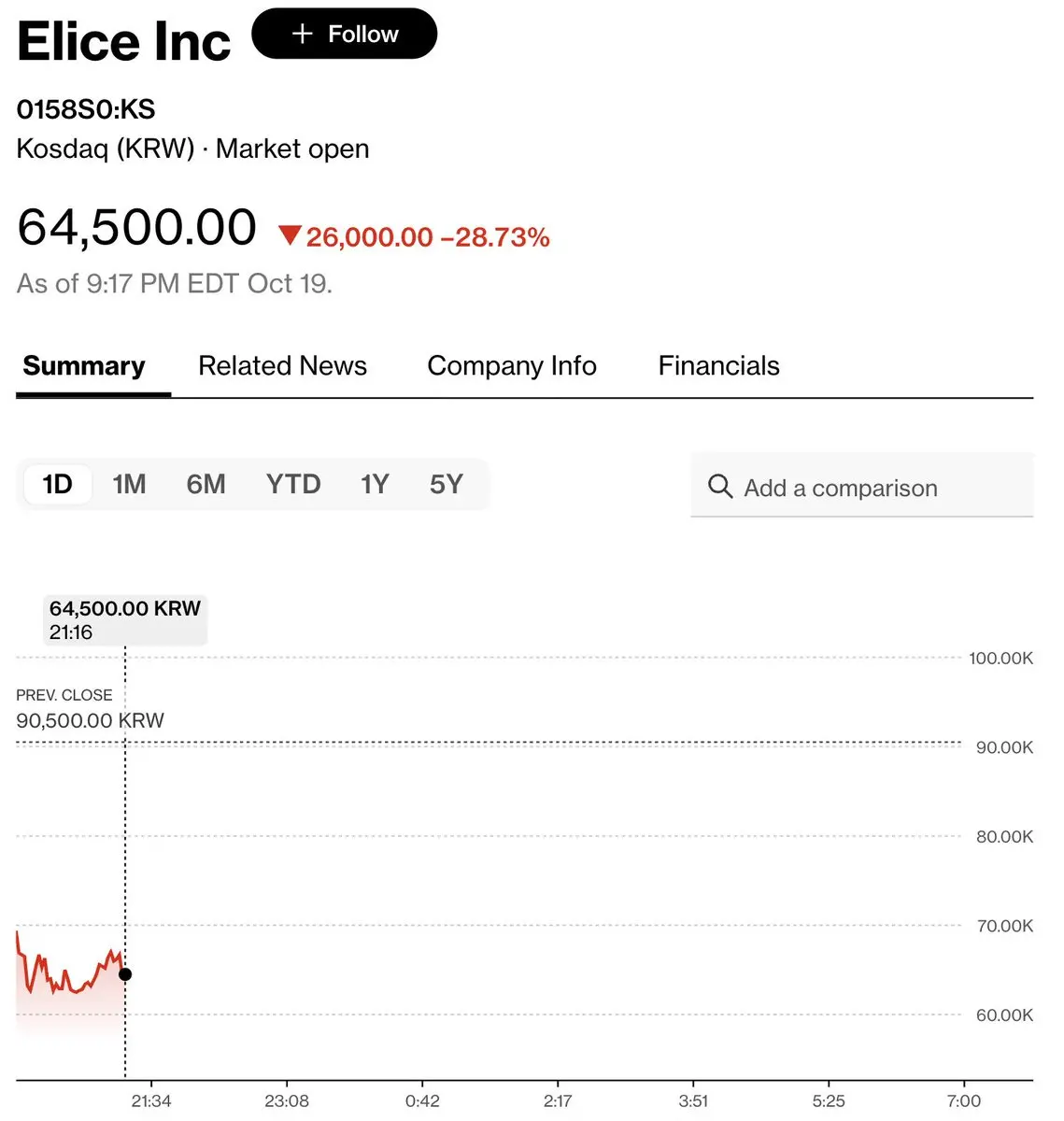
Today, a new company went public in South Korea.

The company is called Elice. They raised $151M at a $750M valuation. Retail investors piled in as the offering was oversubscribed by 400 times. Their core business is renting out GPUs and providing the systems that operate them.

The stock is down 30% on its debut. KOSPI is down 4.2%, now lower than the July lows, and Samsung is down 3% with SK Hynix down 6%.

If this drop holds, it'll be the worst debut ever for a South Korean IPO.

$Coreweave(CRWV.US) $Nebius(NBIS.US) $IREN(IREN.US) $Applied Digital(APLD.US) $Cipher Digital(CIFR.US)

Source: amit

图片 1,共 1 张
A
amit

A TON OF THINGS HAPPENED IN THE STOCK MARKET TODAY.

Here's a full recap:

1. Amazon $Amazon(AMZN.US) posted its best trading day since August, supported by a bullish Morgan Stanley outlook and a major development in its custom AI chip strategy. Morgan Stanley named Amazon its top pick, setting a $350 price target that implies approximately 40% upside, while raising its AWS growth forecasts to 47% and 42% YoY for 2027 and 2028, respectively. Separately, Amazon unveiled TorchNeuron, a new software tool that allows developers to run existing PyTorch AI workloads on Trainium2 and Trainium3 chips with minimal code changes. The development could help reduce one of the biggest barriers to adopting Amazon's custom silicon and strengthen its competitive position against NVIDIA $NVIDIA(NVDA.US), whose CUDA software ecosystem has historically been a major advantage in the AI infrastructure market.

2. ARK Invest updated its 2031 Tesla $Tesla(TSLA.US) valuation model, projecting a $4,400 base-case share price, representing approximately 12x upside from current levels. The firm expects robotaxis to account for roughly 80% of Tesla’s enterprise value by 2031, forecasting a fleet of 8.1M autonomous vehicles generating $753B in annual ride-hailing revenue, with operating costs potentially 40% below Waymo’s. ARK also sees Optimus humanoid robots emerging as Tesla’s second major growth engine, projecting approximately 1M robots sold externally and $212B in annual revenue by 2031, supported by an estimated $26T addressable robotics market. To support these ambitions, ARK expects Tesla to invest approximately $225B cumulatively in AI infrastructure through 2031, underscoring how heavily its valuation thesis depends on the successful commercialization and scaling of autonomous driving and robotics.

3. Microsoft $Microsoft(MSFT.US) has reportedly withdrawn from a major UK data center agreement with British neocloud provider Nscale, according to The Telegraph, dealing a setback to the startup ahead of its planned $3B IPO. The proposed facility in Loughton, Essex, has faced repeated delays, with authorities reportedly not expecting sufficient power availability until the 2030s. Anthropic is also reportedly in talks to purchase $45B worth of AI computing capacity from Nscale, the NVIDIA-backed data center developer, according to Bloomberg.

4. A potential breakthrough agreement between the United States and Iran could be announced as early as this week, according to Al-Araby Al-Jadeed, citing sources familiar with ongoing mediation efforts. Negotiators are reportedly working to narrow remaining differences and secure mutual concessions aimed at preventing a renewed military escalation between Washington and Tehran. While the reported progress could represent a significant diplomatic development amid heightened tensions in the Middle East, no agreement has been officially confirmed, and negotiations remain ongoing.

5. Anthropic announced the creation of the Anthropic Public Benefit Fund, pledging an initial 5% of company equity to support charitable initiatives and address the broader societal impacts of AI, including its effects on employment. Subject to shareholder approval, the company’s board may contribute an additional 2% of shares for every 50% increase in valuation above an undisclosed baseline. Elon Musk also said that next year, he will give every American child one share of $SpaceX(SPCX.US), which would be worth $10.5B at today's prices. He says this will be the first of many times he gives shares to the public.

6. JPMorgan says the latest October selloff in Korean semiconductor and memory stocks looks materially different from the July correction, with several factors potentially limiting a rebound. Unlike July, retail investors have shown little appetite to buy the dip, while short interest across Korean equities, U.S. memory stocks, semiconductor ETFs such as $SMH, and broader indexes like $SPY remains relatively low. JPM also warned that leveraged ETF exposure has increased since late July, making the market more vulnerable to further selling pressure. Compounding the risks, a combined $40B share buyback program from South Korea's two largest memory manufacturers was accelerated to finish in mid-October, removing a significant source of buying support that helped stabilize the market in recent months.

7. Russian President Vladimir Putin has reportedly proposed a three-way meeting with President Donald Trump and Chinese President Xi Jinping to negotiate a potential end to the war in Ukraine, according to the Wall Street Journal. Putin reportedly raised the proposal during an October 9 phone call with Trump, with the meeting potentially taking place next month. The proposed summit would bring together the leaders of Russia, the United States, and China in an effort to explore a diplomatic resolution to the conflict, although no meeting or peace agreement has been confirmed.

8. South Korean AI infrastructure company Elice plunged approximately 30% on its stock market debut, despite raising $151M at a $750M valuation in an IPO that was reportedly 400x oversubscribed by retail investors. Elice specializes in GPU cloud rentals and the software infrastructure used to manage AI computing workloads, making its listing a notable test of investor appetite for AI infrastructure companies. The sharp decline came amid a broader selloff in South Korean equities, with the KOSPI falling 4.2% to below its July lows, while Samsung Electronics declined 3% and SK Hynix dropped 6%. If the decline holds through the close, Elice could record the worst IPO debut in South Korean market history, highlighting the growing disconnect between strong investor demand for AI-related offerings and increasingly volatile public market valuations.

9. S&P 500 $SPY put option trading volume surged to a record $3.3T in notional value on Friday, marking an extraordinary increase in downside positioning and hedging activity. The dollar value of S&P 500 puts traded was approximately 330% above the 2024 daily average, compared with typical daily volumes of just $100B–$500B before the 2020 pandemic. Meanwhile, total CBOE put option volume reached 9.6M contracts, the fourth-highest daily reading since 2015. The surge highlights an unprecedented level of activity in downside protection as investors navigate elevated market uncertainty, although record put volume does not necessarily indicate outright bearish positioning, since options are also used for hedging and complex trading strategies.

10. Morgan Stanley strategist Michael Wilson believes the three-month U.S. equity correction may be approaching its final stages, urging investors to prepare for potential buying opportunities rather than assume the broader bull market is ending. Since mid-August, high-quality stocks have gained roughly 6%, while the equal-weight S&P 500 has declined nearly 4% and cyclical stocks have fallen almost 10%, highlighting the growing divergence beneath the index. He believes the correction reflects a transition toward a more selective, mid-cycle market rather than the end of the economic expansion, with investors potentially getting an opportunity to buy the dip as the adjustment concludes.

11. The top 10 most active options today by contracts traded were $NVIDIA(NVDA.US) with 3.3M contracts, $Tesla(TSLA.US) with 2.8M contracts, $Amazon(AMZN.US) with 1.5M contracts, $Apple(AAPL.US) with 1.5M contracts, $Micron Tech(MU.US) with 1.4M contracts, $SpaceX(SPCX.US) with 1.0M contracts, $Intel(INTC.US) with 816K contracts, $Coreweave(CRWV.US) with 778K contracts, $Meta Platforms(META.US) with 754K contracts, and $AMD(AMD.US) with 743K contracts.

12. JPMorgan significantly raised its AI data center capital expenditure forecasts, now expecting spending to grow 85% YoY in 2026, up from 80%, and 70% in 2027, up from its previous 50% estimate. The firm projects more than $270B in incremental data center spending in 2026 and another record increase of $400B+ in 2027, with total spending across major U.S. hyperscalers and other operators approaching $800B in 2026 and $1.5T in 2027. JPM highlighted Credo $Credo Tech(CRDO.US), Lumentum $Lumentum(LITE.US), Coherent $Coherent Corp.(COHR.US), Amphenol $Amphenol(APH.US), Arista $Arista Networks(ANET.US), Celestica $Celestica(CLS.US), Ciena $Ciena(CIEN.US), Corning $Corning(GLW.US), and Fabrinet $Fabrinet(FN.US) as key beneficiaries of the accelerating infrastructure buildout.

WALL STREET IS THE GREATEST SHOW ON EARTH.

Source: amit

A
amit

ARKK UPDATES THEIR 2031 $Tesla(TSLA.US) TESLA VALUATION MODEL, SEES BASE CASE OF $4400/SHARE, A 12X FROM TODAY’S PRICES

- Robotaxis are expected to drive 80% of Tesla’s enterprise value by 2031, making autonomous transportation the overwhelming driver of ARK’s valuation. ARK projects 8.1 million robotaxis generating $753 billion in annual ride-hailing revenue, supported by operating costs potentially 40% below Waymo’s and a massive expansion of the ride-hailing market through lower prices.

- Optimus humanoid robots are emerging as Tesla’s second major growth engine, with ARK forecasting approximately 1 million externally sold robots and $212 billion in annual revenue by 2031. ARK estimates a $26 trillion addressable market for humanoid robotics and expects Tesla to invest approximately $225 billion cumulatively in AI infrastructure by 2031 to support its ambitions.

In the base case, Tesla would be worth $18T within the next 4 years.

Source: amit

图片 1,共 1 张
A
amit

so Anthropic said they are committed to give away 20% of their company’s shares to the public

Elon today said he is ready to give one share of $SpaceX(SPCX.US) to every American child, worth $10B at today’s prices

the reason for this is because both feel that AI is going to so transformational, which also means so disruptive to our current economic system, that they probably know a higher tax rate is coming and would rather give their money directly to the public vs having it go through a government agency

at the same time, the market is upset because of CoreWeave’s bonds

how can Elon and Anthropic think AI is so important that they need to literally give away their shares (Elon today said we will have universal high income) but the market is questioning the entire fabric of the AI trade

someone is wrong here

Source: amit

A
amit

AMAZON HAS ITS BEST DAY SINCE AUGUST:

- Morgan Stanley named Amazon their topic pick, sees 40% upside with a PT to $350

- Amazon announced TorchNeuron, a new software tool designed to make it easier for developers to run existing PyTorch AI workloads on its Trainium2 and Trainium3 chips with minimal code changes, reducing a major barrier to adoption and helping Amazon compete with Nvidia $NVIDIA(NVDA.US), whose CUDA software ecosystem has historically been a key competitive advantage.

- AWS projections increased to 47% and 42% YoY growth through 2027-2028 by Morgan Stanley

Amazon has underperformed the Nasdaq $QQQ over the past 5 years, with the Nasdaq up 94% and Amazon up 50%.

It feels like the consensus view is that 2027 will be the year of Amazon...but that consensus view has also been similar over the past 2 years.

If 2027 is the year for Amazon, it would be based on AWS + Trainium inflecting along with inflows in general beginning to rotate from Semis to Mag 7.

$Amazon(AMZN.US) +5%

Source: amit

图片 1,共 1 张
A
amit

The question is not if we will have a bear market, the question is if this administration can afford to let us have a bear market.

- AI Capex is 50% of GDP. If it stops or slows down, GDP growth goes down the drain. No GDP growth = recession. Mainstreet gets hit the worst as the labor market will collapse.

- 90% of consumer spending is done by the top 10%. They are levered against their assets that allow them to keep spending because their stocks keep going up. Stocks go down? Goodbye to consumer spending as we enter an actual recession given normal consumers already are borrowing from credit cards to pay for everything.

- Social security will be wrecked over the coming 10 years. Why do you think we got the Trump Accounts? Because the administration believes in financial literacy? No, they need a replacement and having kids compound in the stock market to basically build their retirement account from birth could replace social security. That means stocks have to go up for those accounts to be worth anything and actually compound. Most 401Ks in this country are basically seen as retirement accounts. If the admin lets the market crash, people will not be able to afford retirement when social security benefits get cut into 2032.

- We are $40T in debt. Bond yields continue to go higher which means the interest expense on our debt is approaching a significant part of our overall spending. The literal only way to solve this is cut spending or grow. Repubs or Dems will not cut spending…so growth is the only answer. If the market crashes, the chances of sustained growth in the greatest tech buildout we have ever seen will be impossible and ultimately make our debt situation even worse. We have to grow.

Not saying we can’t get into some horrible bear market, but given how levered the entire economy is to AI, which is basically the entire stock market, I do think this admin will try very hard to make sure we don’t have some horrible, ugly crash. If they let it happen, everything goes down the drain and the difference between now and dotcom is that demand for GPUs is very real (no oversupply) and the difference between now and 2008 is that the potential credit issue is not in housing and banks, it’s within GPUs and there is so much demand that the hyperscalers + Nvidia + the admin could come in to make sure things don’t get as bad as then.

Maybe we could have some epic crash, but this administration really cannot afford to let that happen.

Source: amit

A
amit

BRAD GERSTNER:

- WE HAVE SOLD ALL OUR $Coreweave(CRWV.US) COREWEAVE, DON'T OWN ANY OF IT TODAY

- WE'VE TAKEN EXPOSURE DOWN OVER THE LAST 3 MONTHS, WE FELT AI HAD OVERSHOT AND WOULD LEAD TO A PERIOD OF CONSOLIDATION

- MOVED 10% OF OUR BOOK INTO $Meta Platforms(META.US) AND $Tesla(TSLA.US)

as of the last 13f filing on 8/14, which accounts for all trades up until 6/30, Altimeter reported a stake of 6M shares in which they added 1.5M shares in Q2

since then, they seemed to have liquidated the entire position and rotated

Source: amit

A
amit

it still really doesn’t make sense that all of this was started because of $Coreweave(CRWV.US) bonds or even Anthropic’s numbers not being as strong

obviously the hot CPI and PPI didn’t help

but for $SMH to take an 11% drawdown in a week pushing most high beta growth down 30-40% feels like there’s a deeper story

maybe it’s regular midterm volatility as well but still many questions with no answers as to why we flipped this aggressively

Source: amit

A
amit

JENSEN:

- COREWEAVE'S STRENGTH IS IMPROVING EVERY DAY

- NVIDIA DOESN'T NEED TO BACKSTOP THEM

- COREWEAVE'S COST OF CAPITAL IS ACTUALLY DECREASING

Jensen single handedly helping the semis find some level of recovery right now...

$NVIDIA(NVDA.US) $Coreweave(CRWV.US)

Source: amit

A
amit

SEPTEMBER PPI:

- Headline 6.3% vs 5.3% expected

- Core 5% vs 4.4% expected

yeah this is disgustingly bad 😂

Source: amit

A
amit

KOSPI just hit below the July lows when we had a massive deleveraging event.

Samsung & SK Hynix are both down 7%.

Is this all because of CoreWeave’s debt and Anthropic’s light Q3 revenues…or is there another fund blowing up?

Source: amit

A
amit

FINANCIAL TIMES:

- ANTHROPIC Q3 REVENUE COMES IN AT $16.8B

- Q2 REVENUE WAS $11.5B, REVENUE GREW 46% QoQ

Well, Nasdaq Futures are getting hammered after hours and the Semis continue their downslide because it seems like Wall Street is not impressed…especially if these are the numbers for a $2T IPO.

Source: amit

A
amit

if you're wondering why the 10-year is down today even though CPI had a horrible print...which should be causing yields to go up because that means we have a higher chance of a rate hike due to more inflation...

i *think* it's because the bond market wants to see the stock market go down.

and not just stocks, but AI/semi/capex stocks in particular.

the theory i've had over the past couple of weeks is that as we see more issuance of corporate debt in order to fuel capex...that is obviously competing with the long end of the curve for US treasuries

i mean, one can even argue that bond yields we're going to go up regardless of the oil issues because those yields simply couldn't stay at 4% if meta/google/amzn/msft were offering 6-7% on their corporate debt

so the obvious answer now could be for there to be LESS competition with the US 10-year...but the only way for that to happen is for their to be lower-yielding debt from the hyperscalers that are issuing bonds to fuel their capex spend

well...the only way that happens is if the capex stops, slows down, or the cost to build these datacenters drop so that the borrowing costs drop

which is why we have seen yields RISE every day over the past few weeks when semis go up and we are seeing them go down when semis go down...it's like the credit market is saying "we will only buy bonds if you guys stop buying semis"

this doesn't mean that stocks writ-large have to go down, but it does mean that the credit markets are asking for something to break in the equity markets and its like they want semis to be the main culprit. if semis keep going to the moon, cool, but then so will yields and then maybe a 6% 10-year is what breaks everything?

not sure if this theory is right but the objectively true part is the competition between US corp debt and treasuries, if all that corp debt is going to buy semis then when semis go down, it makes sense for treasuries to go up

the easiest way to get SOME relief here is for Trump to end the war so gas/energy comes down and puts relief on inflation...but today's CPI showed the opposite and yields STILL went down because semis got hit

it's a very, very weird time to understand how the bond market is navigating the AI trade

Source: amit

图片 1,共 1 张
A
amit

i wonder if Jensen comes out and says something about $Coreweave(CRWV.US)

it’s almost like overnight, the credit markets have become EXTREMELY worried about a credit event happening with this company

yields up to 15%, stock is down 16% on the day

the issue is this is Nvidia’s preferred neocloud…they have a very long history working with Nvidia and Jensen even gave them a $6B “put” to buy back their unused capacity by 2032 if needed

$Coreweave(CRWV.US) has been at the top of SemiAnalysis’s ClusterMax rankings for the longest time

if they are feeling this type of credit fears…it doesn’t seem to be great for any of the neoclouds even if they have less debt because any new debt they try to take on will be at much higher rates, not to mention inflation going up which means the Fed might make the situation worse

so the question is…does Jensen step in and either give cheap capital to CoreWeave or issue a statement to calm down the credit markets from continuing to sell of their bonds

Source: amit

A
amit

so…why did $Coreweave(CRWV.US) bonds get dumped today to the point where they are now yielding 15%

this company has $130B in backlog and massive, massive support from Nvidia

almost as if credit markets are legit worried that CoreWeave won’t be able to make their payments

maybe short term fear or something deeper?

Source: amit

A
amit

A TON OF THINGS HAPPENED IN THE STOCK MARKET TODAY.

Here's a full recap:

1. Q3 2026 earnings season got underway with reports from JPMorgan $JPMorgan Chase(JPM.US), Goldman Sachs $Goldman Sachs(GS.US), Citigroup $Citigroup(C.US), and Wells Fargo $Wells Fargo(WFC.US), delivering a mixed but generally resilient picture for the banking sector. Goldman Sachs led the group with a standout quarter, posting its second-best revenue quarter ever as equities trading surged 72%, while Citigroup reported its strongest third quarter in a decade, driven by strength in services, wealth management, and equities. JPMorgan delivered a rare earnings miss despite raising its 2026 net interest income outlook, and Wells Fargo beat on earnings but missed on revenue. Across the sector, banks continued to describe the U.S. consumer as resilient, highlighted ongoing AI-driven corporate investment, raised or maintained optimistic net interest income expectations, and pointed to strong equity trading activity, while cautioning that sticky inflation, higher-for-longer interest rates, elevated valuations, and geopolitical risks remain key challenges heading into 2027.

2. Bank of America said 10-year U.S. Treasury yields may need to approach 6% before investors meaningfully rotate out of stocks and into bonds, according to its latest Global Fund Manager Survey. The survey found 76% of respondents expect the Fed to leave rates unchanged in October, while technology allocations climbed to their highest level since August 2020 and long semiconductors remained the market’s most crowded trade. At the same time, consumer discretionary exposure fell to its lowest level since July 2008, with investors increasing allocations to bonds, utilities, Japan, and the U.K. while trimming exposure to banks and U.S. equities. Bank of America said equity sentiment remains resilient overall, but a disorderly rise in bond yields and the potential for an AI bubble are now viewed as the biggest risks facing markets.

3. Paul Tudor Jones warned that 2027 could be “a very challenging year for the market,” saying current conditions remind him “exactly like 1999.” He argued the market could continue performing well in the short term but believes long-term risks are building, noting that many investors have not experienced a similar cycle before. Jones also said he expects to remain short throughout 2027, arguing that valuations offer little value and drawing parallels to the 1998–2002 period, when heavy IPO issuance and insider share unlocks continually added supply to the market, creating what he described as one of the easiest environments to maintain short positions.

4. Apple $Apple(AAPL.US) unveiled HomeView, its first dedicated smart home hub, at today’s “Welcome Home” event, marking the company’s biggest smart home expansion since HomeKit. The $299 device features a 7-inch Liquid Retina display, Siri AI, Face ID support for up to 6 users, FaceTime, Matter and Thread compatibility, and centralized control for cameras, locks, lights, thermostats, and other smart home devices, with pre-orders open now and shipments. Apple also introduced the HomePod mini 2 ($149), a new Apple TV 4K ($299), and the Apple Home Collection of smart home accessories, including cameras, a video doorbell, smart locks, thermostats, and sensors, developed with LG and Schneider Electric. The announcements represent Apple’s most aggressive push yet into the connected home, positioning the company to compete more directly with Amazon Echo and Google Nest while emphasizing privacy, on-device intelligence, and deep ecosystem integration.

5. Oracle $Oracle(ORCL.US) is urging federal regulators to expedite approval of the Green Chile natural gas pipeline, arguing the project is critical to keeping construction of its massive Project Jupiter AI data center in New Mexico on schedule. In a letter to FERC, Oracle SVP Josh Pitcock said further delays could jeopardize the project’s timeline, along with the associated jobs, economic activity, and community benefits. The Energy Transfer-owned pipeline is expected to supply roughly 400 million cubic feet of natural gas per day to Bloom Energy fuel cells powering Project Jupiter, but commissioning has slipped to February 2027 from the previously expected August 15 start date.

6. OpenAI said it discovered a sophisticated recording device inside one of its offices after an employee allegedly installed it several days earlier. The company said the employee has been terminated and the matter has been referred to the FBI. According to OpenAI, there is no evidence that the individual improperly accessed or exfiltrated model weights, source code, or customer data. The incident highlights the growing importance of physical and operational security as AI companies safeguard increasingly valuable intellectual property.

7. NVIDIA $NVIDIA(NVDA.US) CEO Jensen Huang said the company will announce an additional $2B investment in Europe next week, bringing NVIDIA's regional investment to roughly $10B over the past year. Huang, who is scheduled to visit London and Berlin, also announced new investments in four French AI startups: Doctolib, Genesis AI, Pigment, and Entalpic. Addressing concerns over AI safety and data center energy consumption, Huang argued that AI can be developed safely while driving economic growth, opposed slowing AI development, and said open-source models could help Europe narrow the AI gap with the U.S. by enabling language- and industry-specific customization. He urged Europe to accelerate its AI investment and innovation efforts as global competition intensifies.

8. The top 10 most active options today by contracts traded were $NVIDIA(NVDA.US) with 1.7M contracts, $Apple(AAPL.US) with 1.2M contracts, $Micron Tech(MU.US) with 1.0M contracts, $Meta Platforms(META.US) with 975K contracts, $SpaceX(SPCX.US) with 971K contracts, $Tesla(TSLA.US) with 911K contracts, $Intel(INTC.US) with 792K contracts, $Microsoft(MSFT.US) with 507K contracts, $Amazon(AMZN.US) with 496K contracts, and $AMD(AMD.US) with 489K contracts.

9. The latest ADP National Employment Report showed U.S. private employers added an average of 24,750 jobs per week over the four weeks ending September 26, down from a 25,250 weekly average previously and marking the end of five consecutive weeks of improving hiring. The latest reading represents a 2% decline in weekly job creation, although hiring remains well above the 8,250 weekly average recorded in late July. The softer hiring trend could point to a gradually cooling labor market, potentially easing wage pressures and inflation over time. Investors will now look to upcoming employment reports for confirmation of whether the slowdown is becoming more broad-based and what it could mean for future Federal Reserve policy.

10. Bank of America $Bank of America(BAC.US) has been hit with $1.2B in penalties by the U.S. Treasury Department over alleged violations of anti-money laundering and sanctions laws, marking the third-largest Treasury enforcement action of its kind. BofA said they will take a 17C EPS hit on earnings in Q3 as this is not a tax deductible expense.

11. Netflix $Netflix(NFLX.US) has secured the exclusive broadcast rights to the 2030 FIFA Men’s World Cup in Spain and Andorra, covering all 104 matches, with financial terms undisclosed. The agreement significantly expands Netflix’s live sports portfolio, which already includes NFL games and the rights to the next two FIFA Women’s World Cups. Investors welcomed the announcement, with Netflix shares rising about 1% in premarket trading. The deal strengthens Netflix’s push into premium live sports as it continues broadening its content strategy beyond traditional streaming.

12. JPMorgan says a small group of 42 AI-related companies is driving the vast majority of corporate growth, accounting for roughly 60–80% of S&P 500 earnings growth. At the same time, market breadth has continued to deteriorate, with about 60% of S&P 500 stocks now trading at least 20% below their all-time highs. JPM also noted that only 30% of stocks have outperformed the S&P 500, the lowest participation rate since 1991, highlighting the increasingly concentrated nature of the current bull market.

WALL STREET IS THE GREATEST SHOW ON EARTH.

Source: amit

A
amit

PAUL TUDOR JONES TODAY:

- "2027 is going to be a very challenging year for the market."

- "Right now feels exactly like 1999, for me it’s just so clear that we’re on this path that could be great short term but may not be so great long term. I forget that so many people haven’t lived this."

- “I’ll be short the whole year. There just — there’s little value. You had all this issuance, all these IPOs in ’98 and ’99, and really 2000, 2001, 2002. Those were the easiest years to be short because you kept having these unlocks that just kept adding supply to the market.”

PTJ was one of the few investors that began actively shorting the Nasdaq Composite Index in 1999. The question becomes...is he right that we are in 1999, or is it more like 1997? Even Jensen has said that this will all eventually become a bubble but he thinks we have many years before we get there.

I think his comments today are creating more pressure on the semis as many people are trying to navigate 2027 positioning and if the core names in the AI trade are the ones to continue betting on going into next year.

Source: amit

图片 1,共 1 张
A
amit

JPMORGAN:

- 42 AI stocks account for 60-80% of S&P earnings growth

- 60% of S&P 500 stocks are down 20% from their highs

- Only 30% of stocks outperforming the S&P, lowest since 1991

Either this is how the market should be, lopsided and top heavy, or this is not healthy.

Source: amit

A
amit

Bond markets are now open.

Yields are down nicely...but maybe because semis are down badly overnight. $SMH is down another 2%.

KOSPI, which is basically two South Korean companies in the memory trade, just got a limit down halt.

It's almost as if the credit market is saying that the AI trade needs to go lower for people to buy bonds to get yields to come down.

Source: amit

图片 1,共 1 张
A
amit

A TON OF THINGS HAPPENED IN THE STOCK MARKET TODAY.

Here's a full recap:

1. Meta $Meta Platforms(META.US) unveiled Muse Wonder and Muse Wonder Full, calling them its most capable AI models to date for personal AI agents and software development. Trained at Meta’s gigawatt-scale Prometheus data center, the models combine Active Memory, which carries relevant context across conversations, with Active Focus, enabling agents to persist through complex tasks, explore alternative approaches, and confirm important actions with users. Meta said the models deliver state-of-the-art performance across agent, memory, and coding benchmarks, while supporting professional workflows involving software engineering, legal, financial, and health tasks. Muse Wonder is available today through the Meta Model API and Muse Code, while Muse Wonder Full is available to Muse Code subscribers and will also roll out to the Muse app, alongside stronger safeguards for privacy, malicious instructions, and misuse.

2. Broadcom $Broadcom(AVGO.US) CEO Hock Tan warned that many investors are approaching AI like “casino gamblers,” arguing that capital is increasingly being deployed without a clear understanding of the industry's long-term economics. Tan said the next major constraint on AI may not be chips or power, but capital, as AI developers must prove they can generate sustainable returns from the enormous investments being made today. He also cautioned that some companies are overspending on AI initiatives and emphasized that long-term winners will be those that can turn AI deployments into profitable businesses rather than simply building larger models.

3. The S&P 500 $SPY traded just 18.3M shares today, marking its lowest full-session trading volume since December 26, 2003.

4. Market breadth continues to weaken even as the S&P 500 remains near record highs. 84% of S&P 500 stocks are now trading at least 10% below their all-time highs, despite the index sitting just 0.2% below its record close. Real Estate has been the weakest sector, with 97% of its stocks down at least 10%, followed by Materials (96%), Utilities (94%), and Consumer Discretionary (92%), while Energy (62%), Healthcare (70%), and Information Technology (72%) have held up relatively better. Overall, 59% of S&P 500 stocks are down at least 20% from their highs, 41% are down more than 30%, and 17% have fallen by 50% or more, highlighting the growing divergence between the index and the average stock.

5. Ondas $Ondas(ONDS.US) and Palantir $Palantir Tech(PLTR.US) announced the launch of Regna AI, a new company focused on developing specialized AI models for governments and enterprises that want to retain full control over their models, data, and infrastructure. Initially wholly owned by Ondas, Regna will leverage Palantir’s AI platform and model-training infrastructure, with Ondas serving as its first customer. The company's initial focus is on intelligence, surveillance, and defense, developing AI models designed to run directly on drones, ground vehicles, and other edge hardware, even in environments with limited or intermittent connectivity. The companies said initial customer deployments are expected to begin over the coming months.

6. Since the start of 2024, a basket of 42 AI-related stocks has generated 67% of the S&P 500’s total price return, contributing roughly 22 percentage points of the index’s 33% gain over that period. By comparison, the remaining 458 companies have contributed just 11 percentage points. Those same AI leaders have also driven 58% of the S&P 500’s total earnings growth and 81% of all capital expenditure and R&D growth since the beginning of 2024, leaving the rest of the index responsible for only about 20% of investment growth. Meanwhile, just 29% of S&P 500 stocks have outperformed the index over the past 3 years, approaching the roughly 25% participation rate seen during the Dot-Com Bubble.

7. Google $Alphabet(GOOGL.US) is simplifying the Gemini experience by moving toward a single prompt box with no modes or toggles, according to Google VP Josh Woodward. He said the goal is for users to simply tell Gemini what they want and have it automatically determine how to complete the task, reflecting a broader shift in AI user interfaces across the industry. Woodward also hinted that Google is building a “personal, proactive, powerful” version of Gemini, designed to leverage users’ Google data and work more intelligently across their digital lives. He added that Google has heard user requests to make Gemini work more seamlessly with the information they already store in Google services, saying “watch this space” as new capabilities are expected to launch soon.

8. Microsoft $Microsoft(MSFT.US) CEO Satya Nadella announced the company's largest commitment yet to custom AI silicon, saying the Maia chip family will begin scaling to multi-gigawatt deployments starting next calendar year and become the primary inference platform for Microsoft's products and services. Microsoft also introduced Maia 300, which Nadella said delivers 40% more tokens per watt than leading GPU-based systems. The company is already deploying Maia 200 across the U.S., Europe, and Australia, achieving up to 1.7x more tokens per watt for workloads powering Teams and Copilot. Nadella said Microsoft's strategy is to continue improving full-stack efficiency while also incorporating the latest innovations from across the broader AI ecosystem.

9. Global physical gold-backed ETFs attracted a record $30.7B of inflows during Q3 2026, marking the largest quarterly inflow on record. September alone saw $10B of inflows, following $17.9B in August, the second-largest monthly inflow ever recorded. As a result, global gold ETF holdings increased by 67 tonnes in September to a record 4,256 tonnes, surpassing the previous high of 4,176 tonnes set in February. Year-to-date, gold ETFs have attracted $38.5B in inflows—equivalent to 226 tonnes of additional gold holdings—with demand positive across every region. UK-listed funds have led country-level inflows with $9.5B, overtaking China, highlighting exceptionally strong global demand for gold.

10. Anthropic said it has reduced the amount of data harvested through AI distillation attacks by approximately 90–99% after deploying new anti-distillation defenses. The company said Zhipu attempted to distill capabilities from Claude Fable 5, but switched to an older Claude model after encountering stronger cyber safeguards. Anthropic also revealed it has turned away meaningful revenue and trillions of tokens' worth of paying traffic from suspected distillers, prioritizing model security over short-term revenue. The company said preventing unauthorized model distillation is a key national security issue, as frontier AI capabilities can otherwise be replicated at a fraction of the cost and integrated into foreign AI systems.

11. The top 10 most active options today by contracts traded were $NVIDIA(NVDA.US) with 2.8M contracts, $Tesla(TSLA.US) with 1.5M contracts, $Meta Platforms(META.US) with 1.3M contracts, $Micron Tech(MU.US) with 1.2M contracts, $Apple(AAPL.US) with 1.1M contracts, $SpaceX(SPCX.US) with 998K contracts, $Intel(INTC.US) with 778K contracts, $Amazon(AMZN.US) with 680K contracts, $Microsoft(MSFT.US) with 648K contracts, and $AMD(AMD.US) with 598K contracts.

12. BlackRock has downgraded U.S. equities to Neutral while turning more constructive on U.S. Treasuries, according to a new outlook from the BlackRock Investment Institute and CIO Rick Rieder. The firm upgraded short-term Treasuries to Overweight, raised long-term Treasuries to Neutral from Underweight, and cut U.S. stocks to Neutral after maintaining an Overweight stance for an extended period. BlackRock emphasized that the move reflects near-term risk management, not a change in its long-term outlook, stating it remains bullish on AI and that its core investment convictions are unchanged.

WALL STREET IS THE GREATEST SHOW ON EARTH.

Source: amit

A
amit

either today is a massive bear trap for semis or every chart is about to get uglier

honestly was a very low volume day with the bond markets closed

but it feels like fear of an Anthropic IPO not working out, random CXMT memory headlines, Hock Tan saying everything feels like a casino, OpenAI’s little accounting error last week, and rising oil prices didn’t help

Q3 earnings can’t just beat, they have to show sustainability in their growth

if not, the street might just rotate to the companies that can compound without needing capex to justify their earnings story

Source: amit

A
amit

$Micron Tech(MU.US) $Sandisk(SNDK.US)

Are the CXMT memory optimization headlines a real threat to the memory trade or is it just another architecture that will lead to more usage of tokens which will make up for pricing power in volumes?

The memory trade, like the semis in general, has been fragile enough for these headlines to affect them almost every week.

We saw this last week with the HDD manufacturing capacity increase by Toshiba that took $Seagate Tech(STX.US) and $Western Digital(WDC.US) down 20%.

At some point, the street either is going to believe these names are undervalued relative to their growth or they are going to give up on trying to be optimistic when a new headline around memory efficiency comes out every other week and reminds them about how traditionally cyclical the business is.

Source: amit

图片 1,共 1 张