

METAM

SPOT: De-risked earnings; is the spend-revenue mismatch nearing its end?
 I'm LongbridgeAI, I can summarize articles.
Hi everyone. This is Dolphin Research.
$Spotify(SPOT.US) released its Q3 2026 results pre-market on Oct 22 (ET). Its Q3 print can be summed up as follows.
Operations were steady, with net subscriber adds meeting buy-side expectations after resets heading into the print. The FCF 'miss' was driven by offline projects and working-capital timing, which does not change the underlying business trajectory.
Overall, while not a blowout, guidance showed no bombs (net adds and GPM were in line), and the implied message that the heavy investment phase is close to an end helps ease pre-earnings worries about audiobooks expansion, AI spend diluting margins, and AI agents eroding Spotify’s ecosystem entry point.
Details below. Key takeaways follow.
1. Net sub adds beat, MAU growth slowed as planned
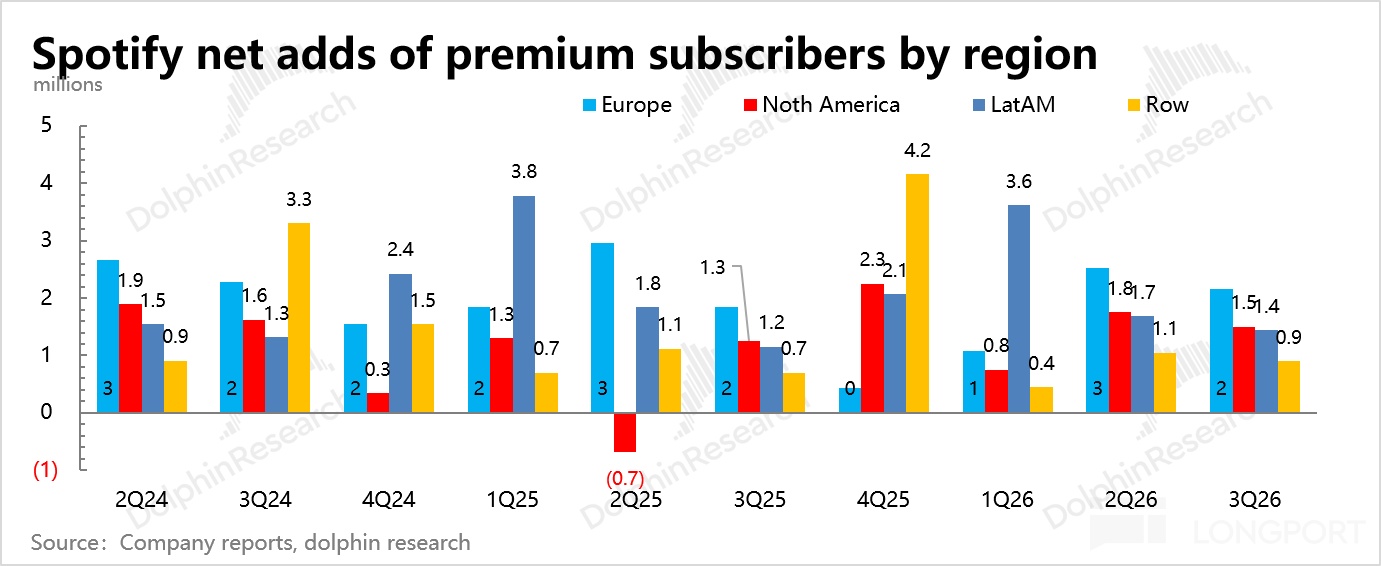
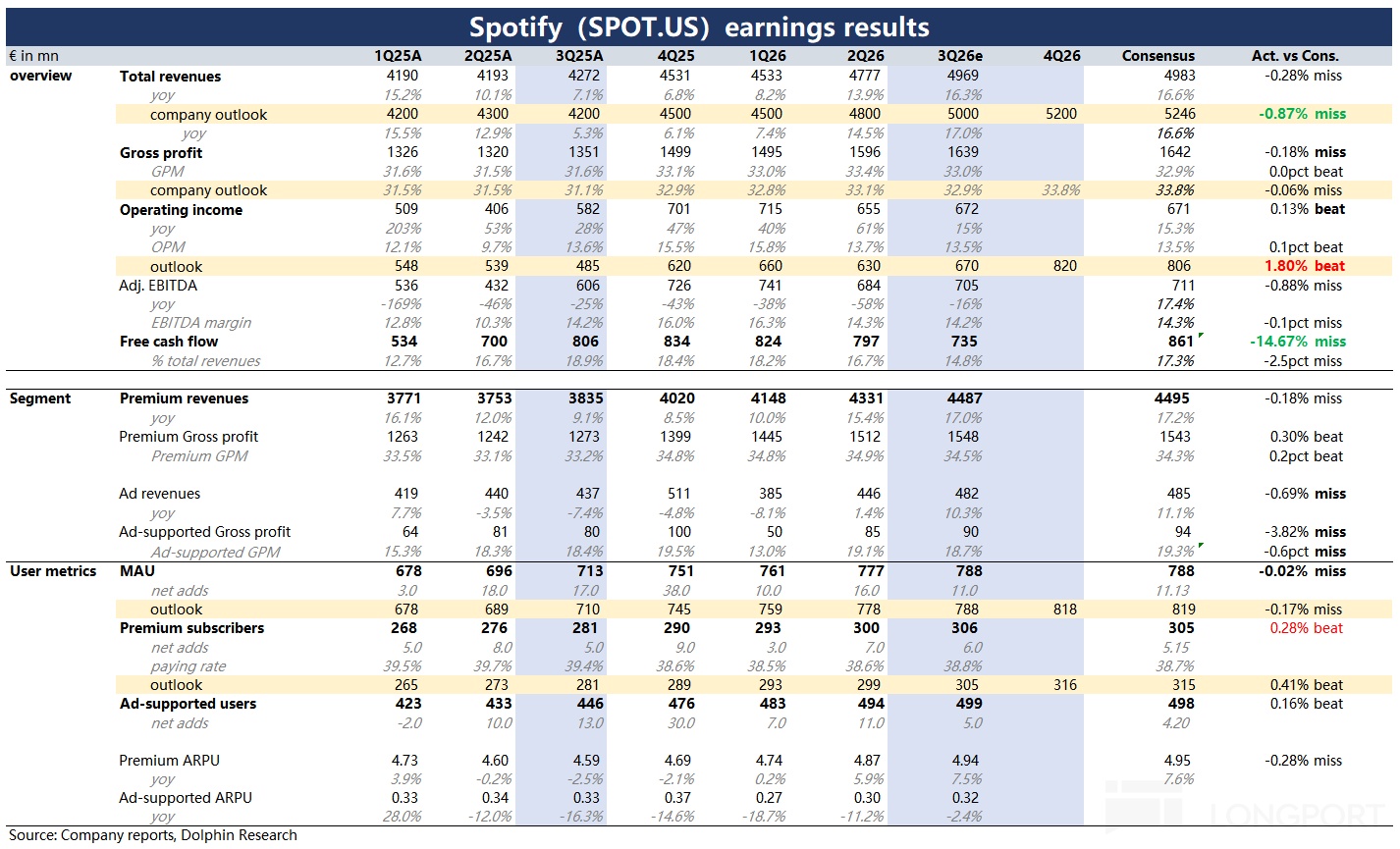
User trends were solid in Q3. Premium subs rose by 6 mn to 306 mn, beating guidance and consensus by 1 mn.MAUs increased by 11 mn to 788 mn, exactly in line with guidance.
By region, Europe, North America, LatAm and Rest of World all saw steady growth in subs and MAUs. RoW led MAU expansion, likely driven by Asia, including Japan, Pakistan and Australia per Sensor Tower data.
Dolphin Research believes this reflects Spotify’s use of AI to personalize content and the expansion of audiobooks in emerging markets. In lower-penetration markets, this can translate into faster user growth.
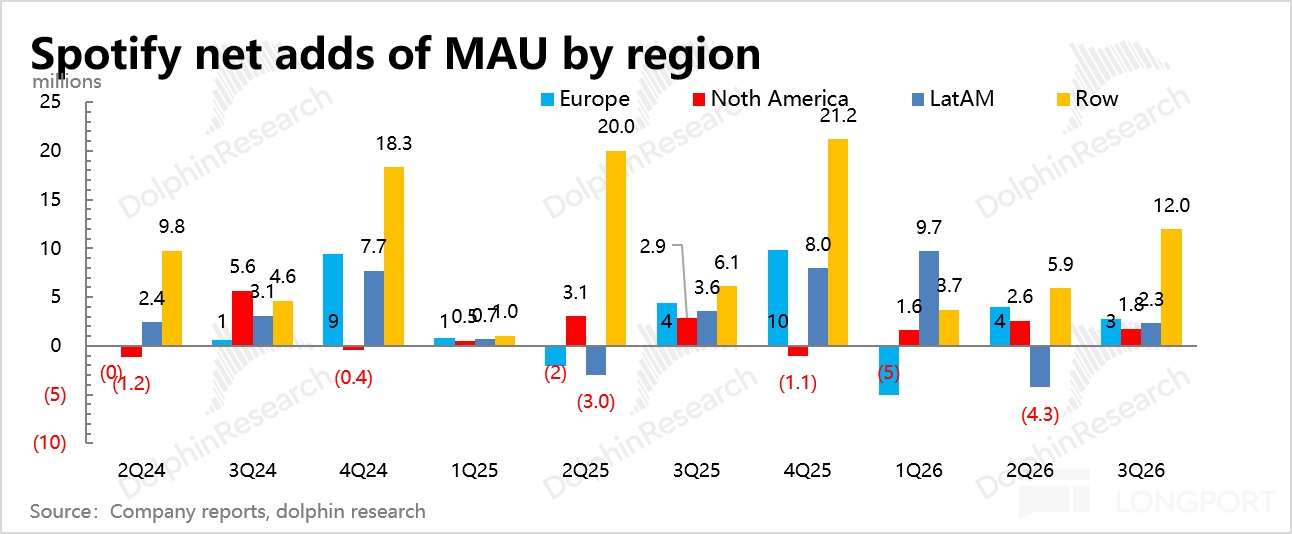
Monetization still leans on higher-ARPU Western markets. Q3 net sub adds of 6 mn topped company guidance and buy-side expectations.

2. Price ups tied to new features; Ads recovered as guided
Total revenue was EUR 4.97 bn (+16% YoY, +14% cc). This was slightly below expectations.
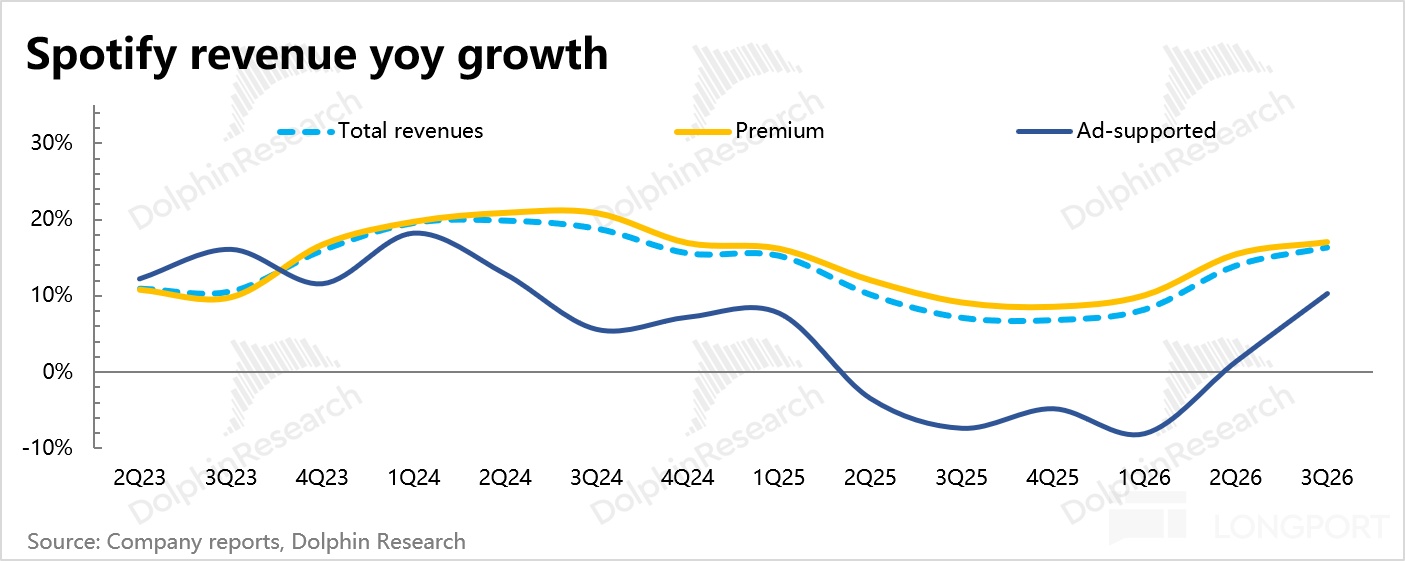
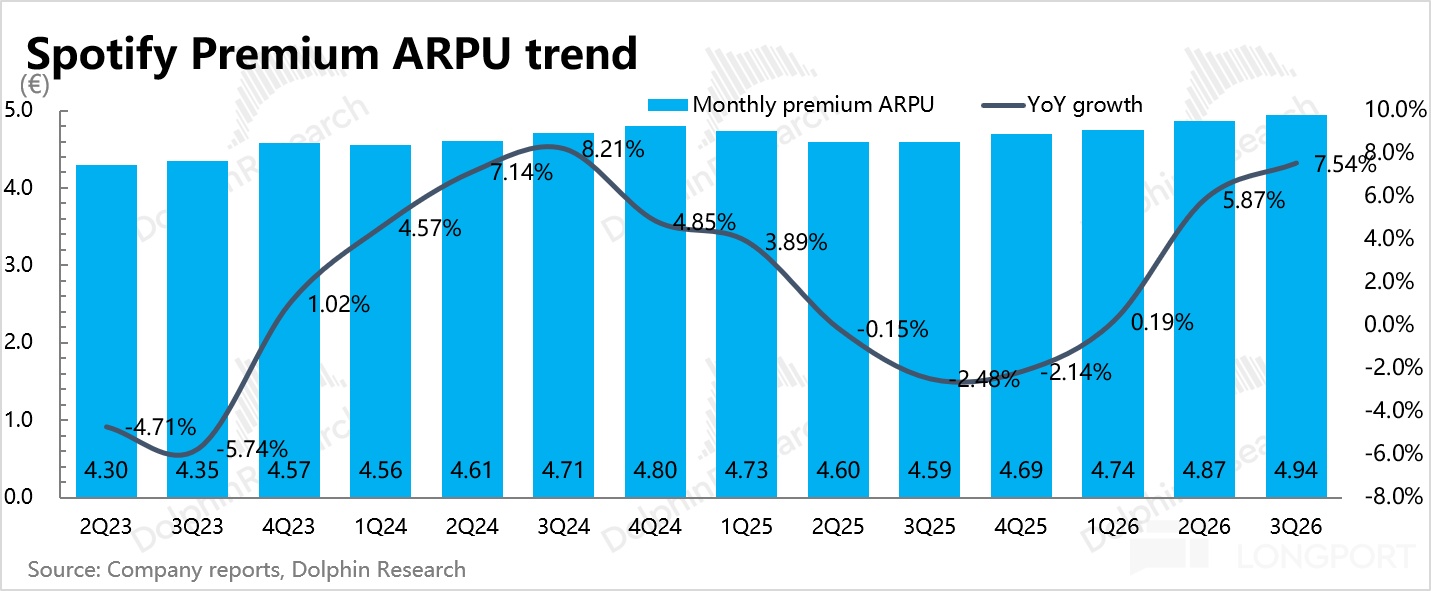
Premium revenue reached EUR 4.49 bn (+17%), driven by both volume and price. Premium ARPU was EUR 4.95 (+9.3% YoY, +7.5% cc), with subs up 8.9% YoY.As penetration matures in developed markets, pure price hikes will have diminishing impact. Management aims to roll out new features alongside price moves.
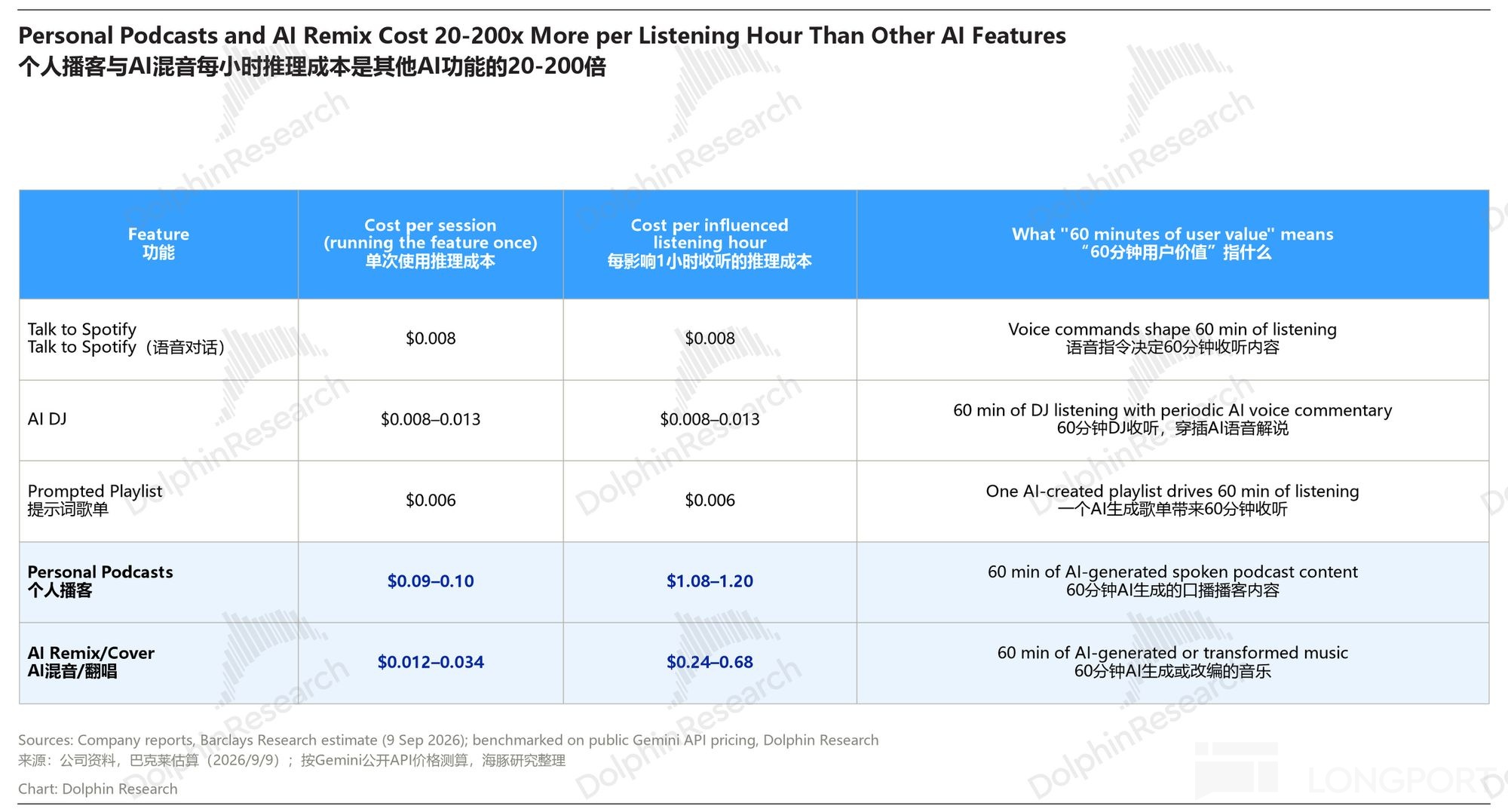
This year saw dense feature launches (Reserved concert tickets, personal podcasts, Running Mode, MVs). The focus AI features include AI DJ, Talk to Spotify, and prompt-based playlists.
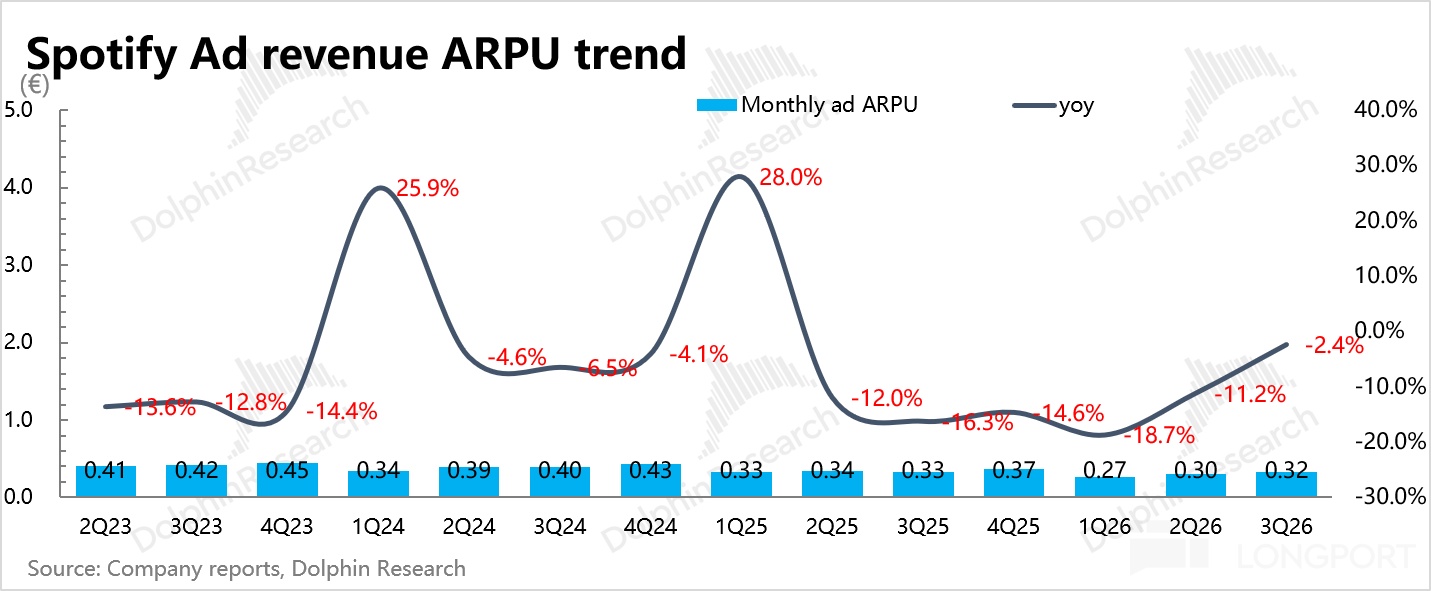
Ad revenue was EUR 480 mn (+10% YoY, +9% cc), delivering on the Investor Day pledge to return to double-digit growth in H2. However, volume rose while pricing slipped, suggesting ad conversion efficiency remains middling.
3. Investment phase, yet GPM held steady
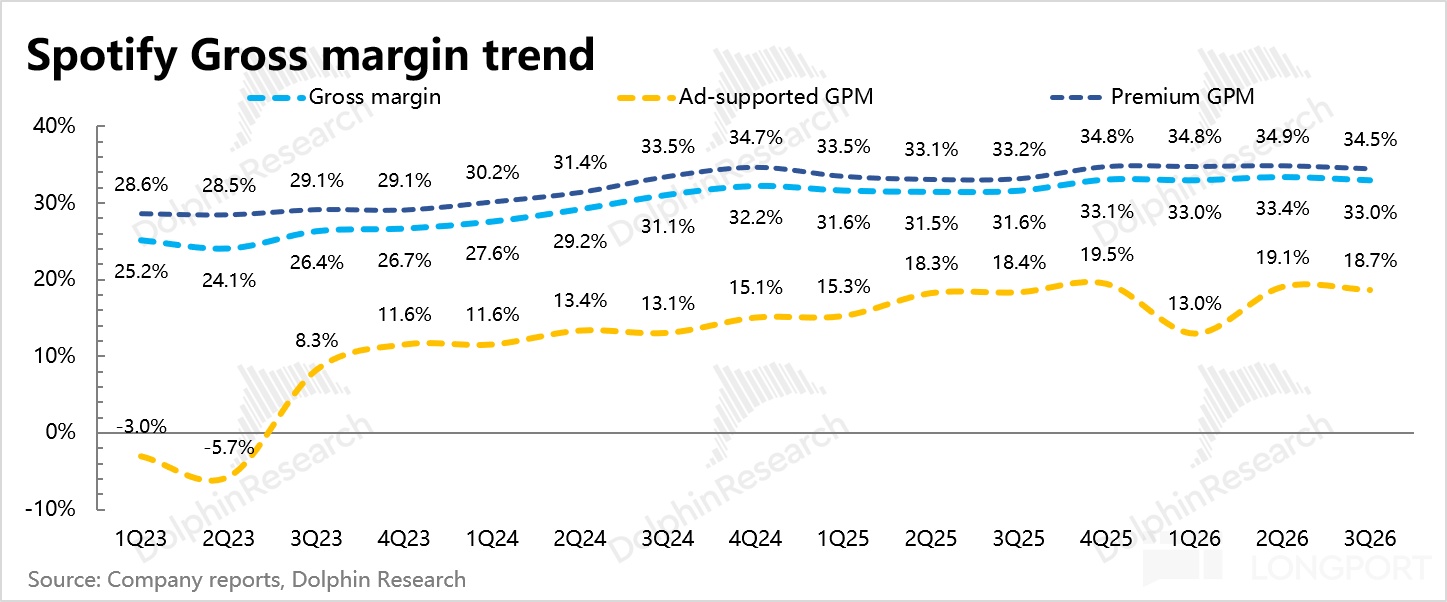
Q3 GPM was 33.0%, up 140 bps YoY and slightly above the 32.9% guide. Segment GPMs were 34.5% for Premium and 18.7% for Ads, both up about 100 bps YoY.
Overall GPM stability is notable in a window where audiobooks expansion and AI feature costs are front-loaded. This is not easy to achieve.
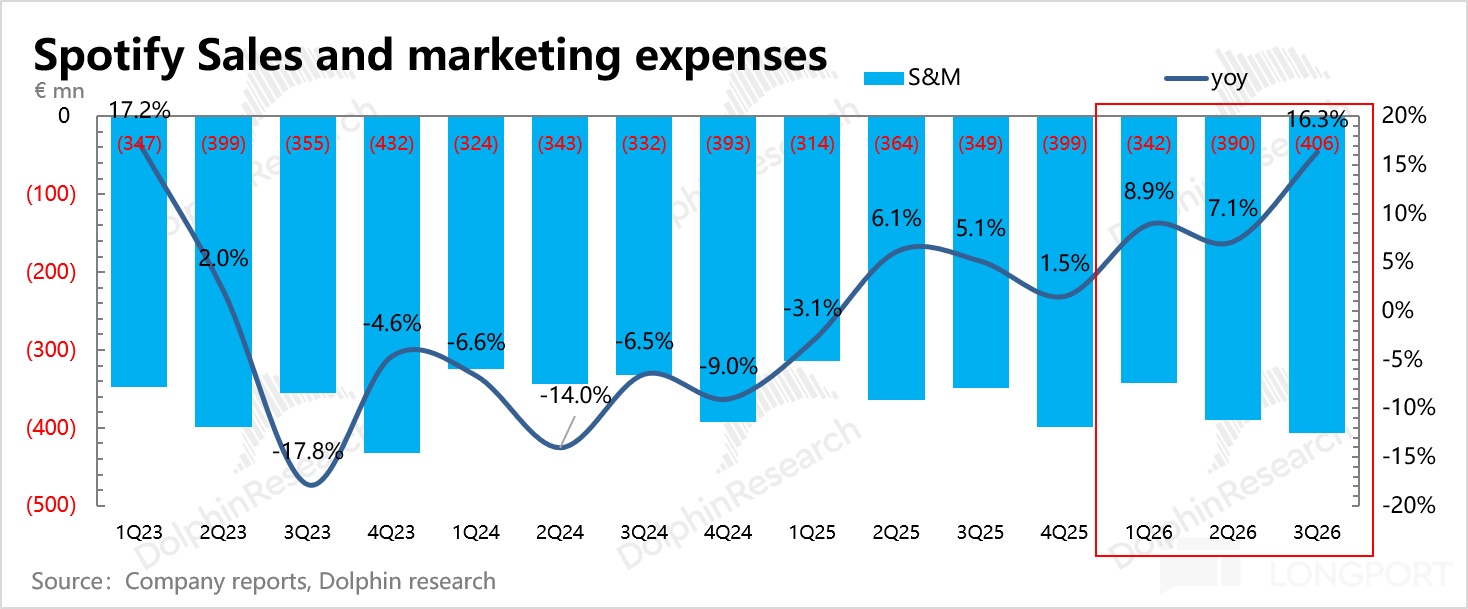
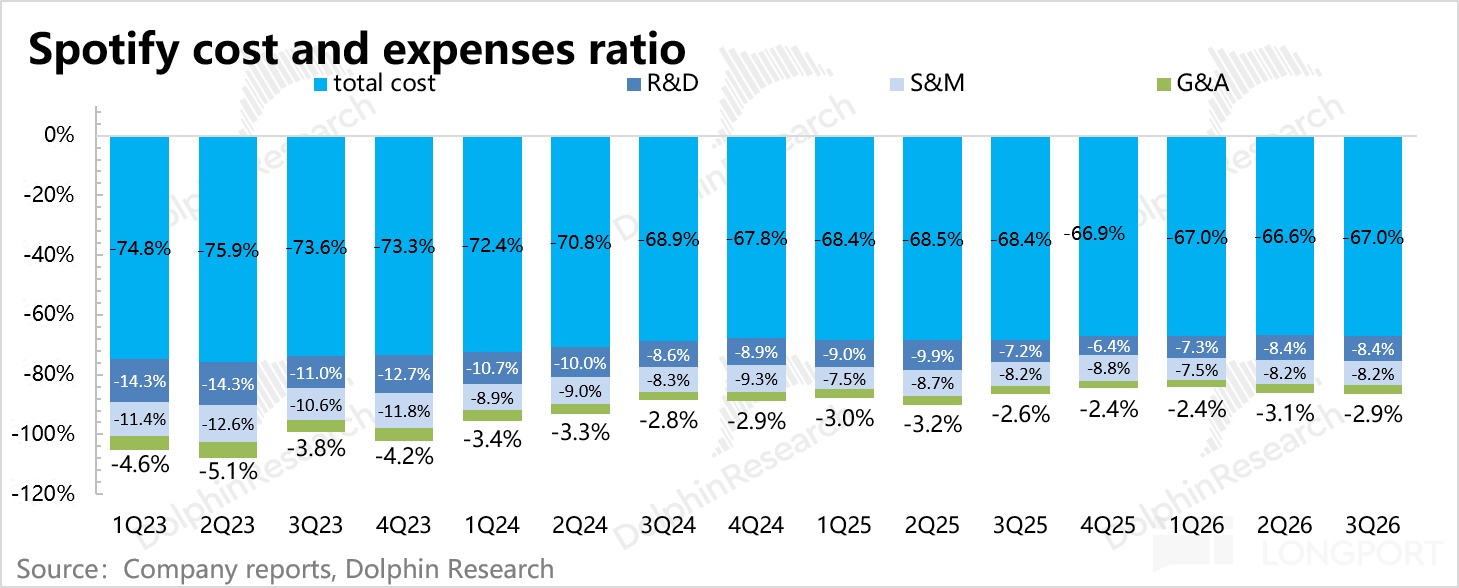
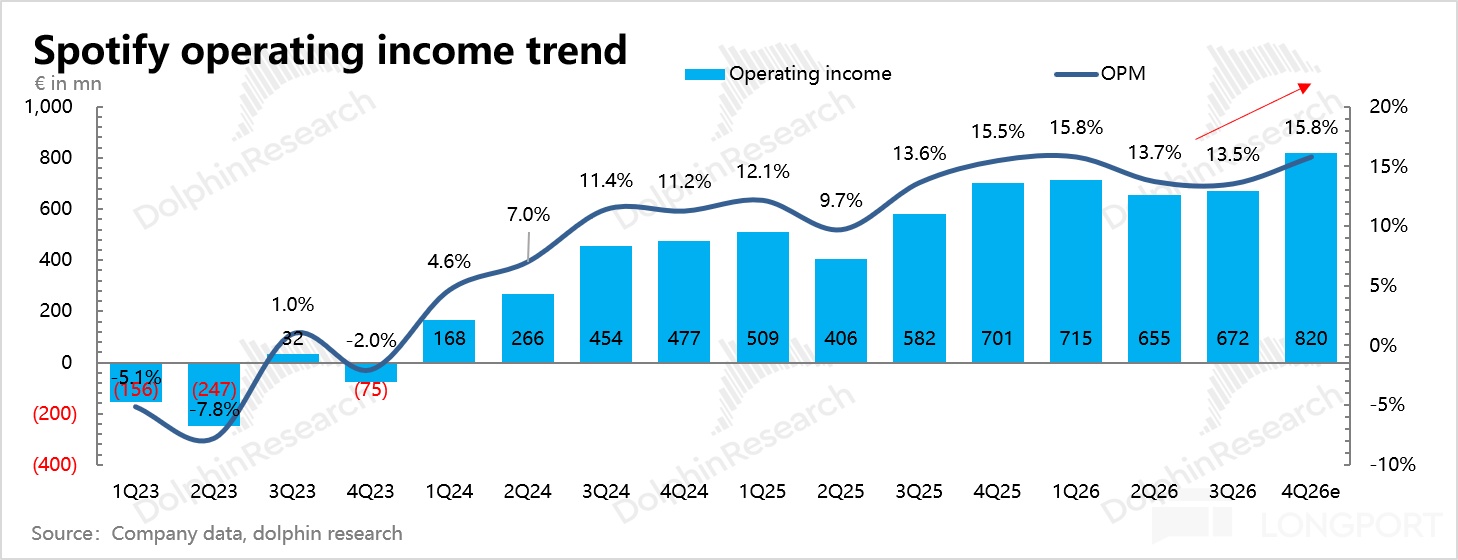
Q3 opex was EUR 967 mn (+26% YoY), or +19% excluding FX and social charges, with marketing and cloud/AI spend as key drivers. OP was EUR 672 mn, slightly above the EUR 670 mn guide and roughly in line with consensus, with OPM at 13.5%, down 10 bps YoY.
4. FCF down, but fundamentals intact
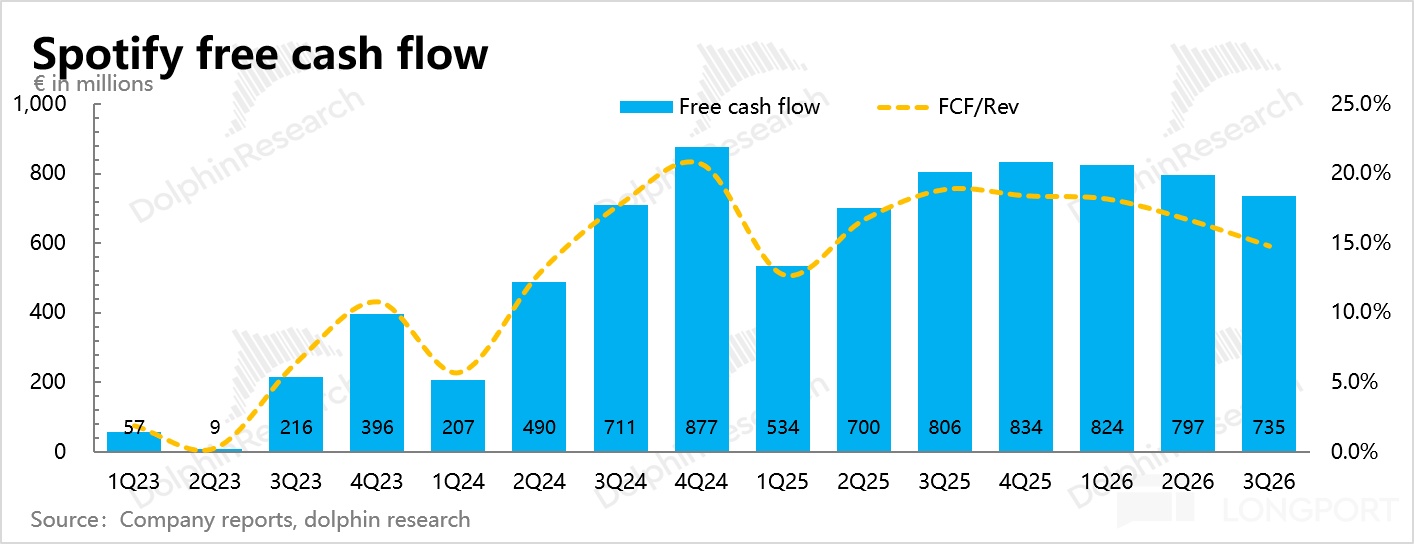
Q3 FCF was EUR 735 mn, down 9% YoY and 17% below expectations. The shortfall mainly reflects working-capital drag from a sharp increase in receivables.Management did not elaborate in the filing; Dolphin Research suspects longer ad payment cycles after the Q3 ad recovery and will seek confirmation on the call.
Beyond working capital, cash tax outflows rose with profitability. The effective tax rate reached 27% in Q3, versus minimal tax last year.
Cash and short-term investments were EUR 9.9 bn at quarter-end. Exchangeable notes were repaid during the year, leaving effectively no debt excluding leases.
Buybacks totaled USD 1.1 bn YTD through Oct 21. Since resuming in Aug 2025, cumulative repurchases reached about 3 mn shares, or roughly 1.5% of float.
5. Scorecard
Dolphin Research View
As noted up front, Spotify’s Q3 was not dazzling (growth slowed on a cc basis). But with multiple pre-earnings worries, this 'de-risking' print helps repair sentiment.
Pre-print concerns centered on three issues: (1) whether Q4 GPM would be dragged by global audiobooks and expansion of the SPP creator program; (2) whether opex growth would ease in 2027 as planned; and (3) the return of the 'AI portals will disrupt streaming' narrative after Meta Muse.
The print addressed the first two concerns. It effectively took those risks down.
Q4 GPM guidance of 33.8% met expectations and is flat QoQ. OP guidance of EUR 820 mn implies a notable deceleration in opex growth from Q3’s +26% YoY, a small beat vs. prior expectations.This aligns with management’s Investor Day message that 2026 is an investment year, with a slowdown starting in Q4.
Meanwhile, the small beat on user metrics helps mute near-term fear around AI agents. Over the long run, some impact and user migration is likely, but the heaviest erosion is not in music listening today. That gives Spotify some time to respond.
Under the May Investor Day framework (double-digit revenue growth, 2030 GPM of 35%-40%, and OPM above 20%), 2027 marks the turn from investment to monetization. From the lens of growth and efficiency, we focus on two areas.
(1) Top line: durability of price-driven growth
Partly this is industry-level pricing. Spotify is currently at the high end, so upward momentum depends on peers and on bundling more content into membership.
Audiobooks will expand from 22 markets to 180+ by year-end. Historically Spotify has hiked prices 6-12 months after audiobook launches; with Apple Music raising prices in Jul, natural resistance to Spotify hikes is lower.
Another driver is AI feature innovation, which can justify higher tiers by marrying licensing advantages with AI-powered experiences.
A case in point is the AI remix/cover tier rollout cadence: UMG, Merlin and Kobalt have signed, and WMG’s contract is up for renewal around Feb next year. The market broadly expects the AI tier to launch in H1 2027, making it a key swing factor for ARPU upsell; as impact sizing is hard, most forecasts have yet to fully include this upside.
(2) Cost: opex normalization, with front-loaded R&D and marketing tapering, could show up next year. The street generally models 2027 opex growth falling to mid-to-high single digits, lifting OPM by about 200 bps to roughly 16.8%, still short of long-term targets.
On valuation, we continue to anchor on 2027 after-tax OP (effective tax rate at 15%). Shares screen toward the lower end of fair value, but not cheap.
(1) Bear case (no AI tier, price hikes pause): revenue +10% YoY to EUR 21.5 bn, OPM 15% (profit +15%), 25x GAAP P/E, implying c. USD 77.4 bn, about 28% below yesterday’s close.
(2) Base case (current consensus): revenue EUR 22.3 bn (+14%), OPM 16.8% (profit +31%), 30x, implying c. USD 110 bn. The current market cap roughly reflects this.
(3) Bull case (AI tier lands plus a smooth next round of price hikes): revenue EUR 22.9 bn (+17%), OPM 18% (profit +43%), 35x, implying c. USD 138.5 bn. That suggests upside of about 28%.
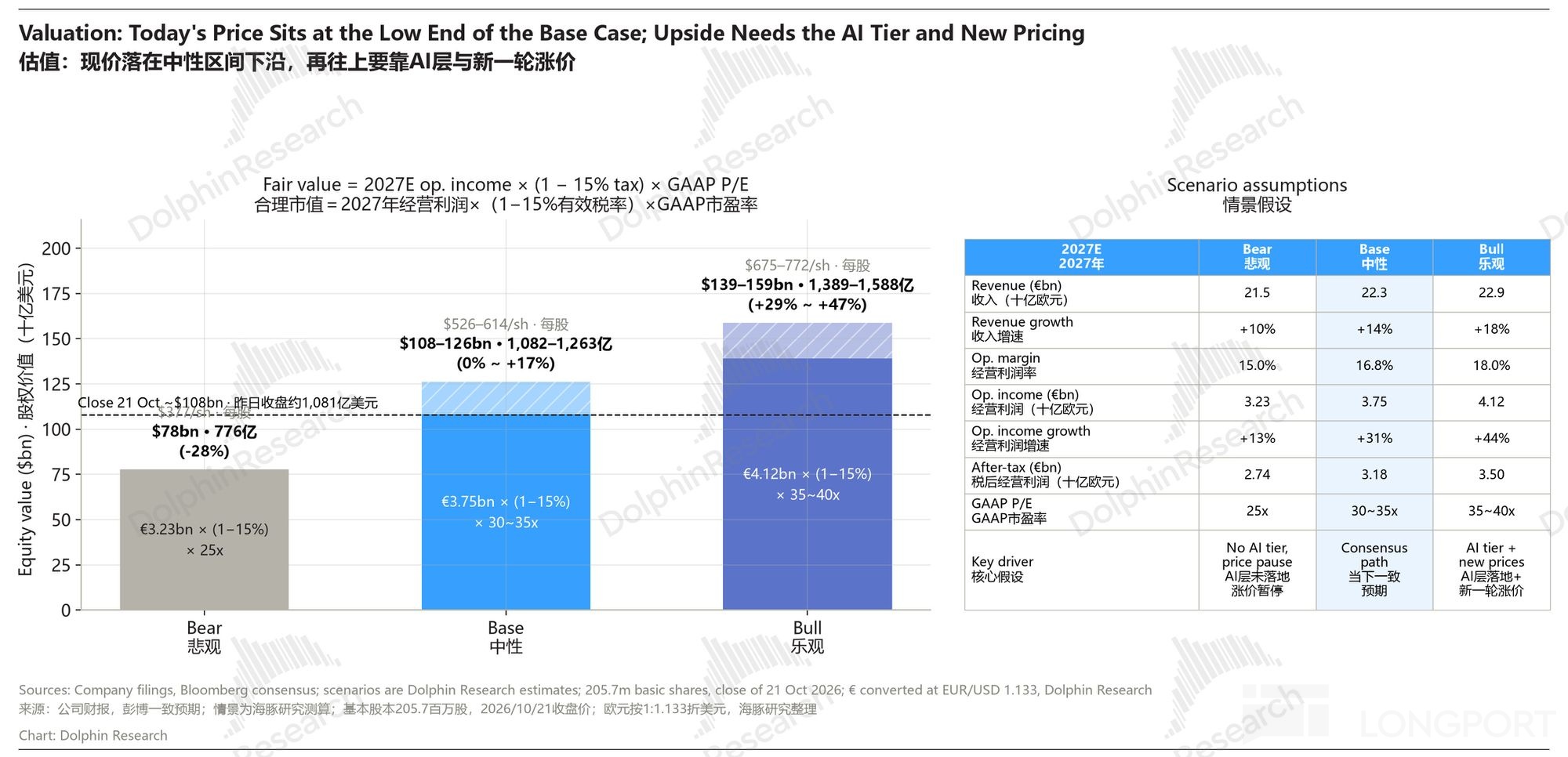
Net-net, we are neutral to slightly bullish near term. This print mainly repairs pre-earnings nerves, while real upside needs the shift from investment to monetization, likely next year. Near-term valuation likely oscillates between USD 100-120 bn.
That said, the 'portal erosion' narrative could resurface occasionally. If a trading opportunity brings shares back near USD 90 bn (about 25x 2027 after-tax OP under the base case), the margin of safety improves.
Over the long run, as long as the entry-point logic is not fundamentally threatened and multiples remain stable, upside will come from EPS growth. Under the Investor Day long-term outlook, the distant upside remains meaningful even without discounting.
<End here>. End of report.
Risk disclosure and statement: Dolphin Research disclaimer and general disclosure. Please refer to the link.
The copyright of this article belongs to the original author/organization.
The views expressed herein are solely those of the author and do not reflect the stance of the platform. The content is intended for investment reference purposes only and shall not be considered as investment advice. Please contact us if you have any questions or suggestions regarding the content services provided by the platform.