Prepared for today's market opening with last night's strategy. The effort paid off.

Vista GLD
VGZ----
Vista GLD (VGZ)
Vista Gold Corp., together with its subsidiaries, operates as a development-stage company in the gold mining industry. Its flagship asset is the 100% owned Mt T...
- Open
- --
- High
- --
- Low
- --
- Prev. Close
- --
- Volume
- --
- Turnover
- --
- Avg Price
- --
- Bid/Ask Ratio
- --
- Amplitude
- --
- 52wk High
- --
- Volume Ratio
- --
- Turnover Ratio
- --
Vista GLD Analyst Rating
View MoreForecast & Rating
May 20, 2026Price forecast
$4.50162.54%
Forecast & RatingStrong buy
1analysts
- Strong buy100.00%
- Buy0.00%
- Hold0.00%
- Sell0.00%
- Strong sell0.00%
Daily Events
- Jul, 2
Vista Gold rallied during regular trading, closing up approximately 5.1% at $1.955, driven by recent investor presentations detailing the Mt Todd gold project's development plan and economics, which boosted sentiment. The stock hit an intraday high of $1.99 in pre-market before opening at $1.86, then steadily climbed, bouncing from a low of $1.89. Q1 net loss widened to $3.145 million, up 16.1% YoY, with no revenue, while the stock trades at a PB of 5.35x, below its 20-day ($2.158) and 60-day ($2.181) moving averages, with a YTD gain of ~8% but still 37.5% off its 52-week high of $3.13. The company's inclusion in the Russell 2000 and progress toward a 2027 detailed engineering start provide longer-term catalysts, though near-term execution risks remain.
News
- Global Report · 2 days ago, 04:13 AM
Capital Flows Highlight Spin-Offs and Niche Equities Amid Mid-Year Market Rotation
- PUBT · Jul 8 at 05:39 PM
Vista Gold publishes investor presentation outlining Mt Todd gold project development strategy and economics
- PUBT · Jun 26 at 02:38 PM
Vista Gold publishes investor presentation outlining Mt Todd gold project development plan and economics
- PUBT · Jun 19 at 12:38 PM
Vista Gold publishes investor deck outlining Mt Todd gold project development plan and economics
- StockTitan · Jun 8 at 08:01 AM
Vista Gold Announces Inclusion in the Russell 2000® Index and Russell 2000® Growth Index | VGZ Stock News
- StockTitan · May 13 at 08:01 AM
Vista Gold Strengthens the Mt Todd Project Execution Team with the Appointment of Julie Jones as General Counsel and Company Secretary and Advances Search for a Managing Director | VGZ Stock News
Posts
View MoreBullish vs. Bearish — Last 3 Months
1.0k followers · 0 opinions
▲Bullish50%
50%Bearish▼
- D

Tariffs slashed, great news to celebrate!
On May 12, the results of the US-China trade negotiations in Geneva were announced today: significant tariff reductions!
Original news quote:
Foreign media reported that the US reduced tariffs on China from 145% to 30%, with another 24% temporarily suspended for 90 days. China reduced tariffs on the US from 125% to 10%, with another 24% temporarily suspended for 90 days.
However, Chinese media stated that in the reciprocal tariffs, the US cut to 10%, China cut to 10%, and both sides temporarily suspended another 24%.
Contradictory? How to understand?
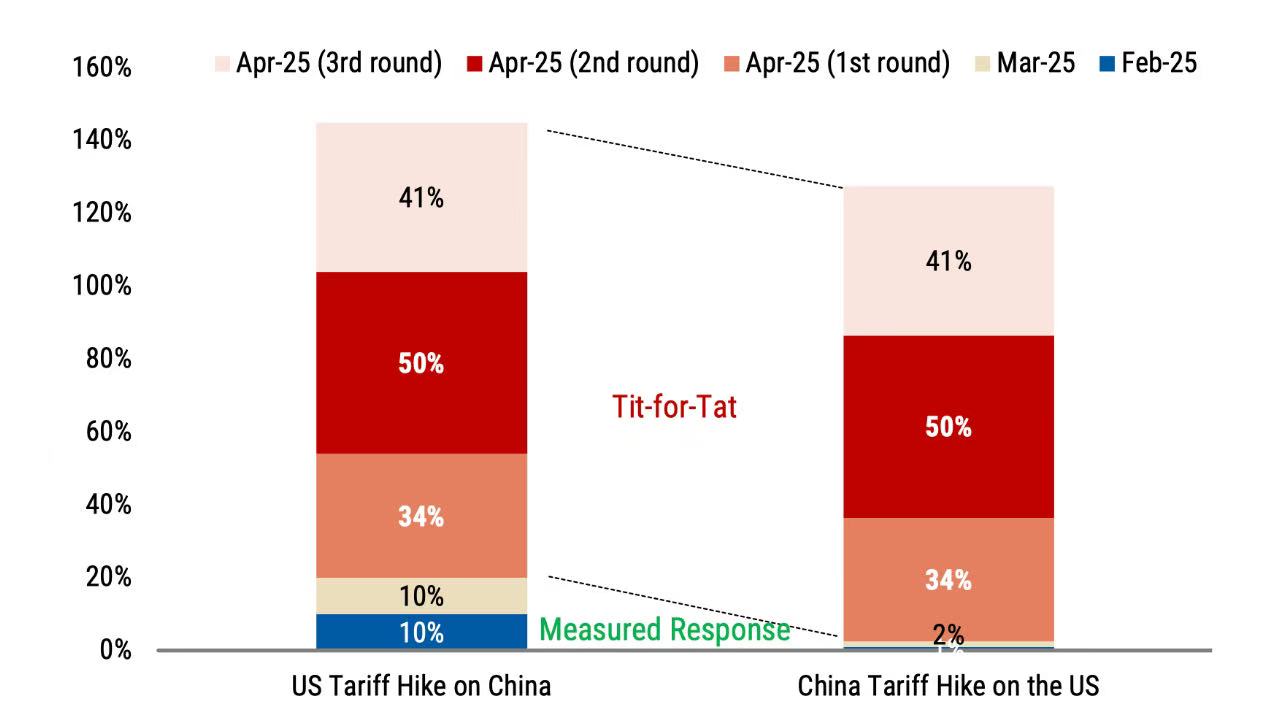
Note that this is not contradictory. After Trump took office, the tariffs imposed on us were divided into multiple rounds:
a. February this year: Initially, using fentanyl as an excuse, a 10% tariff was imposed on Chinese exports to the US.
b. By March, another 10% was added, bringing the cumulative tariff rate to 20%.
This was the 20% tariff Trump imposed separately on China using fentanyl as an excuse before universally imposing "reciprocal tariffs" on global trade partners. Dolphin Research here briefly refers to it as the "fentanyl tariffs."
Then, in this wave of uniform global trade war, reciprocal tariffs were first imposed on China:
April 2: A 34% tariff was imposed on China (the one allegedly exported with one click in Excel)—bringing it to 54%.
April 8: Both sides retaliated, and the US added an additional 50% tariff, bringing the reciprocal tariff portion to 84% and the total tariff to 104%.
April 9: Escalation continued, with an additional 41% added to the reciprocal tariff on top of the 84%, bringing it to 125%. Combined with the fentanyl tariffs, the total reached 145%.
What is the actual negotiation result?
The current negotiation result is:
a. US to China: 1) Reciprocal tariff portion: The 40% and 50% retaliatory tariffs added on April 8 and 9 are completely canceled. Of the 34% tariff exported with one click on April 2, 10% remains, and 24% is temporarily suspended for 90 days to leave room for negotiation. 2) Fentanyl portion: The full 20% remains.
b. China to the US: Since it’s mainly reciprocal tariffs, China’s response is a one-to-one replication of the US’s actions. China has no other substantive universal tariffs on the US.
The final temporary result is, counting from Trump’s second term, the US imposes 30% + 24% (suspended) on China, and China imposes 10% + 24% (suspended) on the US.
How to interpret?
Clearly positive: With overall tax rates kept relatively low, the key is the 90-day suspension period. This is undoubtedly great news for global markets.
Of course, there will be ongoing tug-of-war, but in today’s globalized division of labor: rare earths vs. semiconductors, both sides still have cards to play.
The capital market will definitely celebrate with a rally. $Vista GLD(VGZ.US) $HSTECH ETF(03032.HK)