Former Senior Director, SoC Design & Development, Data Centre & AI Group at Intel:
"USD 120bn server CPU TAM forecast by 2030 is considered conservative, with physical AI, edge inference and agentic orchestration potentially driving 30-40% upward revision within one year."> Market Split & AMD's Rise: The x86 server CPU market is currently split roughly 60/40 between x86 and Arm. Within x86, AMD commands nearly 50% of the server segment following years of historical Intel dominance. > Agentic AI & CPU-to-GPU Ratios: Agentic AI workloads and mixture-of-experts models are dramatically reversing the historical training-phase GPU-to-CPU ratio (which favored GPUs heavily at 4:1 up to 8:1) back towards a 1:1 or 1:2 ratio, with expectations to hit 1:8 in favor of CPUs within a year due to intensive reasoning and orchestration demands. > Conservative TAM Forecasts: The USD 120bn server CPU Total Addressable Market (TAM) forecast by 2030 is viewed as conservative. Physical AI, edge inference, and agentic orchestration could potentially drive a 30-40% upward revision within a year. > Competitive Landscape (Venice vs. Diamond Rapids): AMD's Venice architecture (reaching 256 cores) provides it with an unofficial 12-month head start over Intel's Diamond Rapids, making AMD breaching a 50% x86 server share by the end of 2027 a realistic possibility. > Intel's Structural Advantage: Despite operating as two distinct business entities, Intel’s tight internal coupling between design and manufacturing provides an inherent 20-30% architectural advantage once foundry execution and the 18A node stabilize.> Arm's Core Demand Impact: Arm's CEO, Rene Haas, noted that Agentic AI is scaling CPU core demand up to 4x higher, pushing up to 120 million cores per gigawatt. > Supply Constraints: Current severe shortages—with AMD sold out through the end of 2026 and lead times hitting 30-plus weeks, while Intel underships true demand by roughly 20%—are tied to the entire integrated ecosystem of advanced front-end logic wafer capacity and tied-in packaging capacity rather than memory. > Volume vs. ASP Strategy: About 66% of AMD's server CPU growth comes from unit volume increases rather than Average Selling Price (ASP) expansion, contrasting with Intel's historical high-ASP strategy.$Intel(INTC.US) $AMD(AMD.US)
AMD 2X Long ETF
AMDG----
Share your thoughts
Write something you'd like to share with our community...
- H
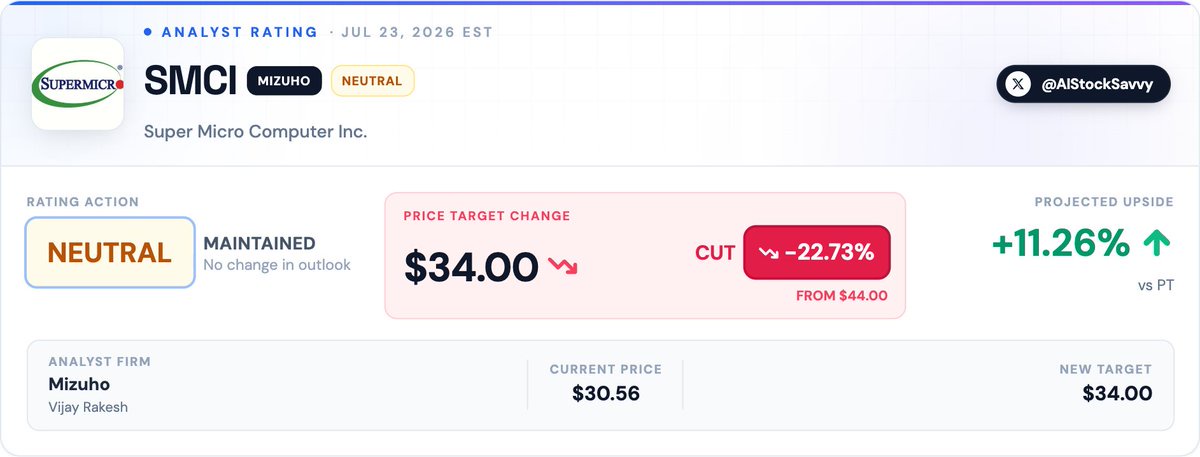
$Super Micro Computer(SMCI.US) | Mizuho 𝐜𝐮𝐭𝐬 𝐏𝐓 on 𝐒𝐮𝐩𝐞𝐫 𝐌𝐢𝐜𝐫𝐨 𝐂𝐨𝐦𝐩𝐮𝐭𝐞𝐫 to $𝟑𝟒 from $𝟒𝟒, maintains 𝐍𝐞𝐮𝐭𝐫𝐚𝐥
- D

$AMD(AMD.US)
AMD is going places. She has joined Nvidia and the others in the circular financing scene with the latest Anthropic deal.
Talking about circular financing, it has been catching on such that even the Premier league teams use it to bypass regulations. Chelsea overpaid for a player from Aston Villa. Villa conveniently bought a player from Chelsea as a loan to buy and the amount offsets. Off course they term it properly so as to make it permissible.
So back to AMD, they invest in Anthropic and Anthropic buys their chips. Everyone is happy. Yay!
@Captain's Treasure
 Trade Showcase: Trade, Show & Earn Rewards!
 - M
62. The moat of Nvidia's CUDA is being rapidly eroded. On one hand, with the advent of AI, building this ecosystem has become much easier than before because AI can write code. — Liang Sheng from Deepseek.
From this perspective, it is very logical that $AMD(AMD.US) remains largely unscathed in this round. $NVIDIA(NVDA.US) needs a more comprehensive moat, including supply chain, communications, etc.
- S
$Intel(INTC.US) and $AMD(AMD.US) to sign CPU LTAs with Chinese customers for AI DCs (Reuters).
- Prices of some CPU products have risen more than 40% in China since the start of the year from sources. - Month-on-month increases topping 10% for some productsCPUs were already a bottleneck, following CPU ratios due to AI inference... But the broader trend of LTAs seems to be appearing from: - Memory, with $Micron Tech(MU.US), Samsung, $Sandisk(SNDK.US), and SK Hynix signing DRAM/NAND LTAs.- Photonics, with $Lumentum(LITE.US), $Coherent Corp.(COHR.US) signing EML LTAs. And recent Trendforce reports that $AMD(AMD.US) and hyperscalers are now pursuing CW LTAs. And I'm sure there's many more from MLCCs to all the way to substrates. +1 for the bottleneck investors... hard to be a "bubble that pops" if you have take or pay demand spanning multiple years.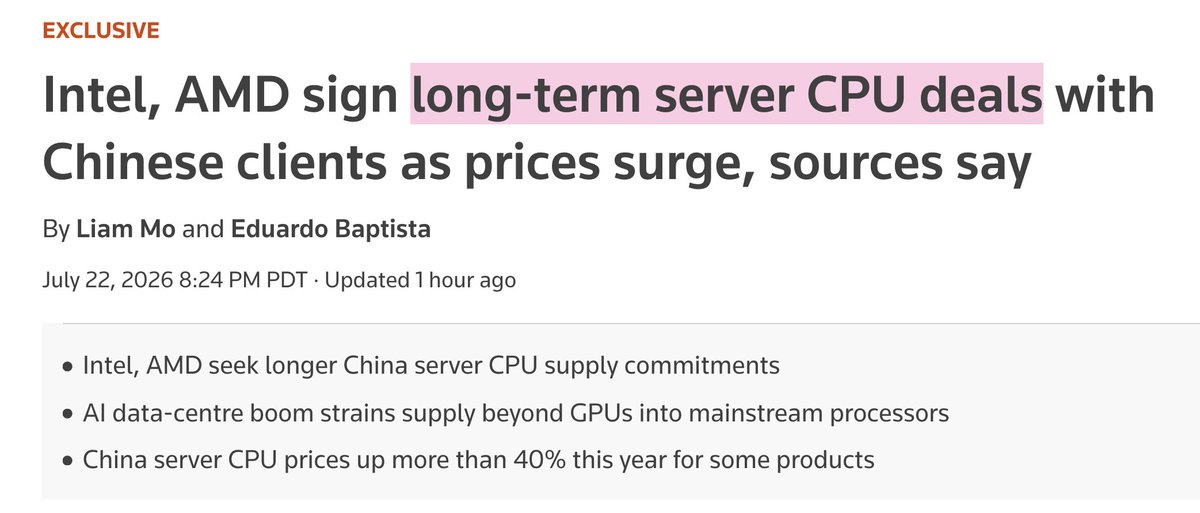
- P
BofA & UBS are advising clients to buy AI momentum stocks:
BofA - August is historically the best month for their basket of momentum names such as $AMD(AMD.US), $Sandisk(SNDK.US) and $Micron Tech(MU.US).UBS - "Improving AI fundamentals are a signal to buy the dip."According to UBS' brokerage data, hedge funds have cut long positions in US semis by ~5% of gross market value (one of the biggest reductions on record).Which has resulted in net positioning in semis at Q1 levels, leading to both BofA and UBS positioning themselves as more bullish than earlier on. Probably because of the downside momentum unwind / profit taking easing up now.Cool to see institutional trading desks broadly align with retail sentiment on X.With many AI names now back at more compelling levels.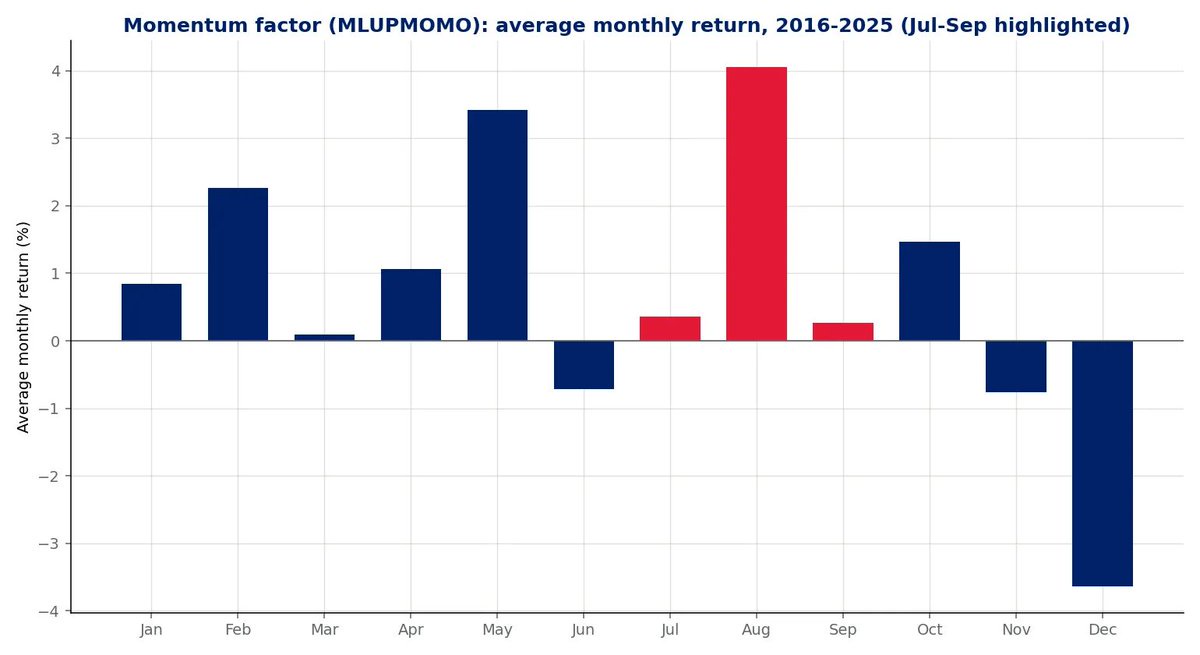
- E
BofA: Anthropic & AMD Deal
Key Takeaways from the Anthropic Partnership> Partnership Details: AMD announced a partnership with Anthropic to deploy up to 2GW of AMD MI450 Series AI GPUs starting in the first half of 2027. > Financial Commitments: AMD committed to a $5 billion strategic equity investment and will use Anthropic's Claude in research and development (R&D) projects. > Expanded Engagements: This deal expands AMD's MI engagements to four major customers: Anthropic, OpenAI (likely via Microsoft cloud), Oracle, and Meta. > Financial Upside: The engagement indicates at least a $10 billion to $15 billion upside to current consensus expectations of $35 billion to $40 billion for CY27 MI sales. Analyst Event & Product Outlook> Advancing AI Event: Pre-announcements involving Microsoft and Anthropic serve as incremental positives ahead of AMD's analyst event. > Server CPU Roadmap: The event is expected to spotlight the server CPU roadmap (specifically upcoming Venice CPUs) and how they compete against NVIDIA's Vera in the agentic AI era. > CoWoS Supply & Sales Potential: Latest TSMC Chip-on-Wafer-on-Substrate (CoWoS) supply estimates point to roughly 1.4 million MI450 Series GPU units in CY27, which could surpass $40 billion in sales assuming a $30k average selling price (ASP).$AMD(AMD.US)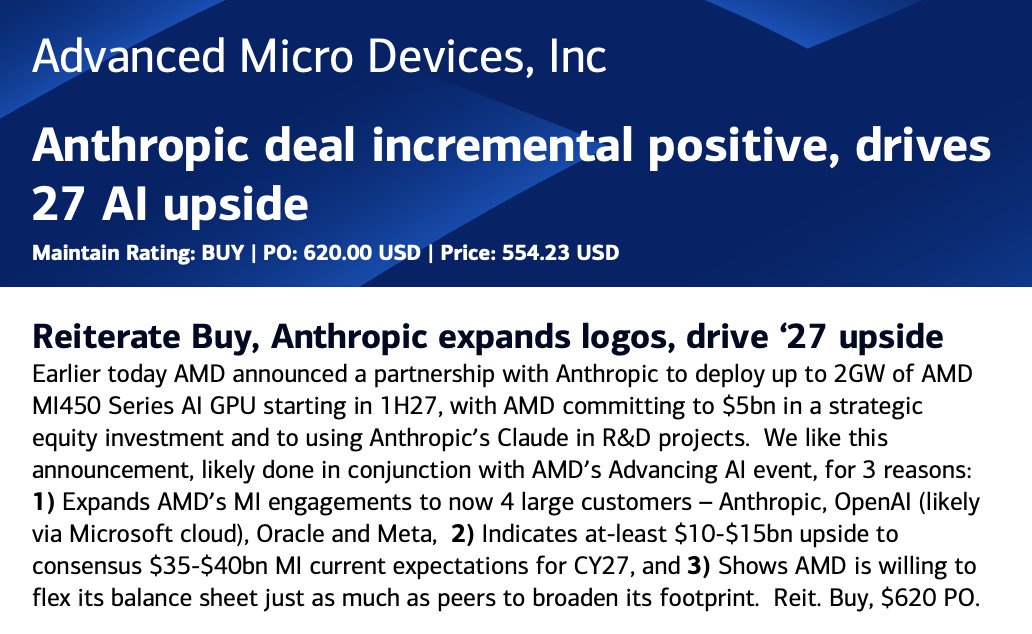
- H
📊 𝐈𝐍𝐕𝐄𝐒𝐓𝐎𝐑 𝐍𝐎𝐓𝐄: 📢 𝗝𝗨𝗦𝗧 𝗜𝗡: BofA Sees Server CPU Market Reaching $𝟭𝟳𝟬 𝗕𝗶𝗹𝗹𝗶𝗼𝗻 by 2030 - $AMD(AMD.US) $Intel(INTC.US) $NVIDIA(NVDA.US)
👉 𝗞𝗲𝘆 𝗛𝗶𝗴𝗵𝗹𝗶𝗴𝗵𝘁𝘀:➤ 𝗕𝗮𝗻𝗸 𝗼𝗳 𝗔𝗺𝗲𝗿𝗶𝗰𝗮 projects the server CPU market at $𝟭𝟳𝟬 𝗯𝗶𝗹𝗹𝗶𝗼𝗻 by 2030.➤ BofA reiterates a 𝗕𝘂𝘆 rating and $𝟯𝟱𝟬 price target on 𝗡𝗩𝗜𝗗𝗜𝗔.➤ 𝗡𝗩𝗜𝗗𝗜𝗔's 𝗩𝗲𝗿𝗮 CPU intensifies competition with 𝗔𝗠𝗗 in AI infrastructure.➤ BofA says the key debate is 𝗹𝗮𝘁𝗲𝗻𝗰𝘆 versus 𝘁𝗵𝗿𝗼𝘂𝗴𝗵𝗽𝘂𝘁 for agentic AI.➤ Vera features 𝟴𝟴 𝗔𝗥𝗠-based cores and 𝟭.𝟮𝗧𝗕/𝘀 memory bandwidth.➤ BofA says AMD estimates 𝗘𝗣𝗬𝗖 𝟵𝟵𝟲𝟱 delivers about 𝟮.𝟰𝘅 rack-level throughput.➤ AMD projects next-generation 𝗘𝗣𝗬𝗖 𝟲 could deliver roughly 𝟯.𝟯𝘅 throughput.➤ 𝗔𝗠𝗗 𝗔𝗜 𝟮𝟬𝟮𝟲 𝗗𝗮𝘆 is seen as the next key catalyst.➤ BofA says 𝘅𝟴𝟲 software incumbency could remain a long-term advantage for AMD and Intel.👉 𝗘𝘅𝗽𝗲𝗿𝘁 𝗦𝘁𝗮𝘁𝗲𝗺𝗲𝗻𝘁𝘀:𝗩𝗶𝘃𝗲𝗸 𝗔𝗿𝘆𝗮, Analyst at Bank of America:"The key question for investors is whether agentic AI is primarily constrained by time-to-complete an agent or number-of-agents-per-rack.""NVDA's framework is rooted in latency, per-thread progress, and GPU utilization. AMD's framework is rooted in concurrency, throughput, and service density.""Our expectation is that AMD's Thursday event will be less about benchmark comparisons and more about establishing the industry's preferred metric." - N


$Super Micro Computer(SMCI.US) Smci jumped higher, fueled by a robust update that it expects to nearly double its gross margins in upcoming quarters. The company highlighted a staggering new order intake of more than $60 billion in the fourth quarter of fiscal 2026, pushing its backlog to an all-time high. Such volume underscores strong demand for Supermicro's customized server solutions amid the ongoing AI hardware surge. Smci's servers integrate chips from industry heavyweights like Nvidia, Intel, and AMD. The company recently teased big projects, including a new gigawatt-scale AI data center for SpaceX and XAI, highlighting its role in powering next-generation AI infrastructure. I believe this is currently one of the better stocks for swing trading if you are patient enough. @Captain's Treasure
 Trade Showcase: Trade, Show & Earn Rewards!
 - H
📢 𝗝𝗨𝗦𝗧 𝗜𝗡: $Hewlett Packard Enterprise(HPE.US) HPE Selected for Multiple U.S. DOE Genesis Mission AI Projects
👉 𝗞𝗲𝘆 𝗛𝗶𝗴𝗵𝗹𝗶𝗴𝗵𝘁𝘀:➤ 𝗛𝗣𝗘 selected for multiple 𝗨.𝗦. 𝗗𝗢𝗘 𝗚𝗲𝗻𝗲𝘀𝗶𝘀 𝗠𝗶𝘀𝘀𝗶𝗼𝗻 R&D projects.➤ Projects span 𝗔𝗜, networking, cybersecurity, weather, and scientific discovery.➤ HPE will deliver the 𝗟𝘂𝘅 AI supercomputer with 𝗔𝗠𝗗 and 𝗢𝗮𝗸 𝗥𝗶𝗱𝗴𝗲.➤ 𝗟𝘂𝘅 is expected to be the first dedicated AI system for science.➤ Genesis Mission integrates 𝗔𝗜, supercomputing, quantum, and scientific instruments.➤ HPE will develop an 𝗮𝗴𝗲𝗻𝘁𝗶𝗰 𝗳𝘂𝘀𝗶𝗼𝗻 AI co-pilot for fusion research.➤ 𝗦𝘄𝗮𝗿𝗺𝗦𝗹𝗶𝗰𝗲𝗿 targets AI-powered robotics on next-generation 𝟲𝗚 networks.➤ 𝗦𝗽𝗼𝘁𝘁𝗲𝗿-𝗔𝗜 focuses on cybersecurity for scientific AI workflows.➤ HPE will also advance AI for weather forecasting and distributed scientific workflows.👉 𝗘𝘅𝗽𝗲𝗿𝘁 𝗦𝘁𝗮𝘁𝗲𝗺𝗲𝗻𝘁:𝗔𝗻𝗱𝗿𝗲𝘄 𝗪𝗵𝗲𝗲𝗹𝗲𝗿, Deputy CTO, Senior Vice President and Director of HPE Labs:“We have a deep, decades-long R&D partnership with the U.S. Department of Energy and its national laboratories that has ushered in world-leading innovation in scientific computing. We’re proud to expand our R&D collaboration, on top of delivering cutting-edge integrated AI systems, to contribute to the Genesis Mission and accelerate the nation’s AI-driven science and engineering initiatives.” - A
amd advancing ai is today and tomorrow, helios rack systems going to msft meta openai oracle. lisa su basically challenging nvidia head on. stock +4% riding it. i want to hear the mi450 roadmap before i size up but the setup looks good
- D
It is difficult to tell if this recovery in chip stocks is a dead cat bounce. My gut feeling says no as the AI infrasture demand is real but the market is moved by smart money and what we can do is size our positions according to our risk appetite and set stop losses.
☕️ [Task Coins Giveaway] Daily Market Talk — Chips Explode, Tesla & Google Tonight
Memory stocks went vertical (MU +12%, SNDK +14%) on UBS's buy call, while Nvidia declared Vera Rubin in full production. Next up: Tesla and Alphabet report tonight, the first real test of whether AI capex is turning into cash.
- L

memory stocks still got room to up as previous week drop.
just try buy on dip or hold it if already brought.
☕️ [Task Coins Giveaway] Daily Market Talk — Chips Explode, Tesla & Google Tonight
Memory stocks went vertical (MU +12%, SNDK +14%) on UBS's buy call, while Nvidia declared Vera Rubin in full production. Next up: Tesla and Alphabet report tonight, the first real test of whether AI capex is turning into cash.
- H
📢 𝐉𝐔𝐒𝐓 𝐈𝐍: White House to Redirect Billions in Research Funds Toward AI, Away From Colleges - WSJ
$NVIDIA(NVDA.US) $AMD(AMD.US) $Intel(INTC.US) $Microsoft(MSFT.US) $Alphabet(GOOGL.US) $Palantir Tech(PLTR.US) $Meta Platforms(META.US) - @
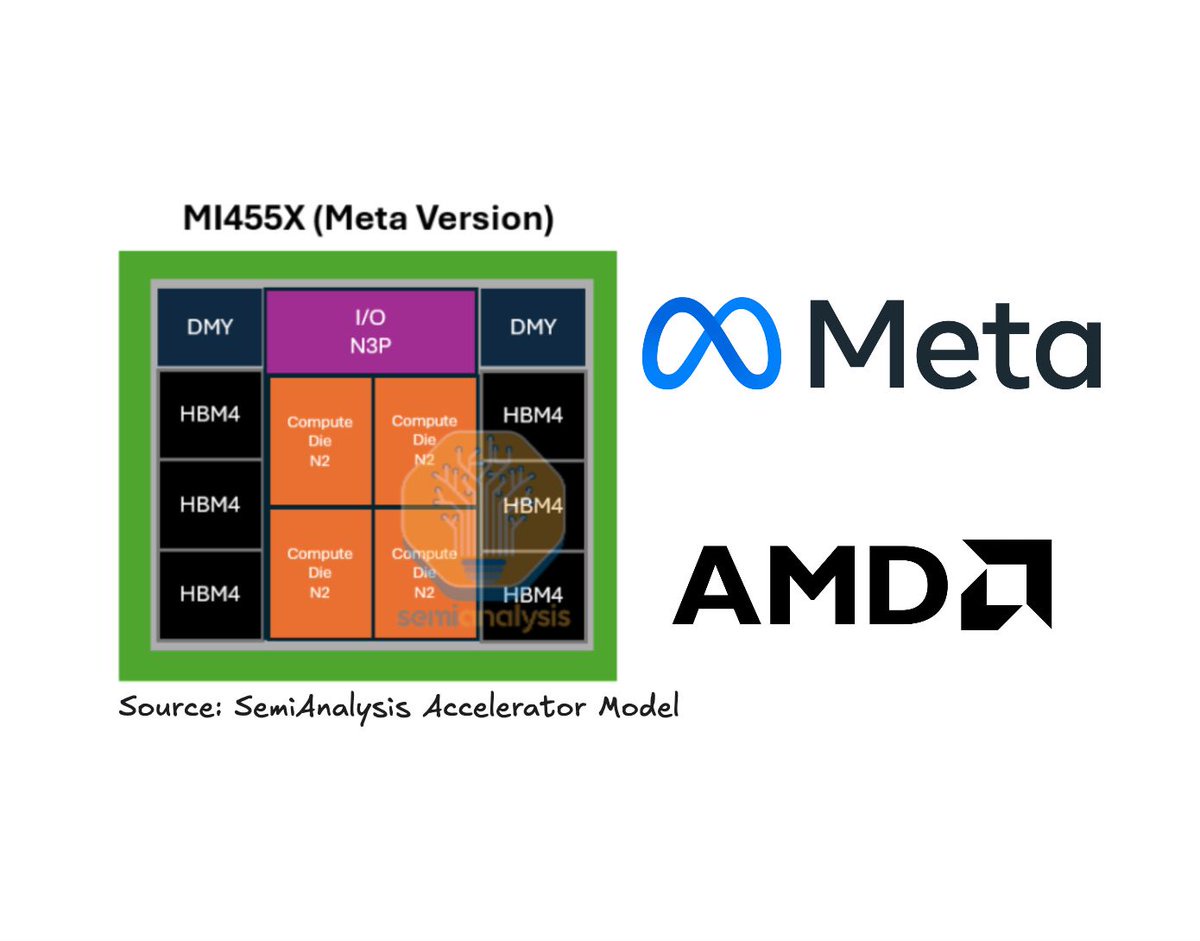
ALERT🚨🚨: META's CUSTOM AMD MI400-series chip will be half the size of a normal MI455X chip. It is "optimized" for recsys workloads and $/Memory Bandwidth. It will use ~144GB of HBM instead of 432GB. We break it down below👇️ 1/7🧵
- L
Oil will return to $90+ again and stay for quite a while...until Trump decides to drop another bomb shell of a ceasefire and peace talks resumption.
☕️ [Task Coins Giveaway] Daily Market Talk — AMD Lands Microsoft for Helios
Anti-Nvidia silicon war heats up: AMD-Microsoft Helios deal + Google's "Frozen v2" chip open two new fronts against Nvidia the same day. STI takes a breather while DBS eyes S$1T wealth AUM by 2030.
- H
📢 𝗝𝗨𝗦𝗧 𝗜𝗡: $Astera Labs(ALAB.US) Astera Labs Expands Taurus Family With 3.2T Smart Signal Conditioners for AI Infrastructure
👉 𝗞𝗲𝘆 𝗛𝗶𝗴𝗵𝗹𝗶𝗴𝗵𝘁𝘀:➤ 𝗔𝘀𝘁𝗲𝗿𝗮 𝗟𝗮𝗯𝘀 expands its 200G Taurus connectivity portfolio.➤ New family includes 𝗧𝗮𝘂𝗿𝘂𝘀 𝟯.𝟮𝗧 Smart Signal Conditioners.➤ Devices support 𝟮𝟬𝟬𝗚-𝗽𝗲𝗿-𝗹𝗮𝗻𝗲 Ethernet, UALink, and ESUN connectivity.➤ Portfolio adds footprint-compatible 𝟭𝟲-𝗹𝗮𝗻𝗲 Smart Retimers and Smart Redrivers.➤ 𝗦𝗺𝗮𝗿𝘁 𝗦𝘄𝗮𝗽 enables component changes without board redesigns.➤ Unified 𝗖𝗢𝗦𝗠𝗢𝗦 software supports design, monitoring, debugging, and deployment.➤ Smart Redrivers add telemetry, diagnostics, and intelligent link management.➤ Observability includes channel estimation, eye monitoring, and temperature-compensating EQ.➤ Open 𝗢𝗖𝗣 footprint supports flexible multi-vendor signal-conditioner sourcing.➤ New products target denser, efficient 𝘀𝗰𝗮𝗹𝗲-𝘂𝗽 and 𝘀𝗰𝗮𝗹𝗲-𝗼𝘂𝘁 AI clusters.👉 𝗘𝘅𝗽𝗲𝗿𝘁 𝗦𝘁𝗮𝘁𝗲𝗺𝗲𝗻𝘁𝘀:𝗔𝗱𝗶𝘁 𝗡𝗮𝗿𝗮𝘀𝗶𝗺𝗵𝗮, senior vice president & general manager of Signal Connectivity Group at Astera Labs:“AI infrastructure is entering a phase where flexibility becomes a competitive advantage,” said Adit Narasimha, senior vice president & general manager of Signal Connectivity Group at Astera Labs. “As 200G-per-lane signal conditioners become critical for on-board connectivity, customers need the freedom to optimize reach, power, and cost later in the design cycle. By expanding the Taurus family with footprint-compatible x16 Smart Retimers and Smart Redrivers, we are giving customers a more flexible path to scaling denser AI infrastructure with stronger economics.”𝗥𝗼𝗯𝗲𝗿𝘁 𝗛𝗼𝗿𝗺𝘂𝘁𝗵, corporate vice president, Architecture and Strategy, AMD:“Open, standards-based technologies and ecosystem collaboration are core to AMD’s AI strategy to deliver customer choice, interoperability and flexibility at every layer,” said Robert Hormuth, corporate vice president, Architecture and Strategy, AMD. “Our collaboration with Astera Labs on open connectivity helps customers build efficient, adaptable rack-scale systems, and the expanded Taurus family shows how standards-based design can preserve flexibility as infrastructure evolves.”𝗠𝗮𝘁𝘁 𝗞𝗶𝗺𝗯𝗮𝗹𝗹, vice president and principal analyst at Moor Insights & Strategy:“The physical layer is becoming a more visible constraint on cluster design, deployment timelines, and long-term platform flexibility as hyperscalers and neoclouds build denser AI systems,” said Matt Kimball, vice president and principal analyst at Moor Insights & Strategy. “Astera Labs’ Taurus family is well aligned with that shift by giving customers a standards-based way to balance reach, power, observability, and supplier optionality as they move into 200G infrastructure.” - B
Nvidia's Moat in the Age of Custom Silicon
In one single day the market handed Nvidia two new challengers. Microsoft signed on to deploy AMD's Helios rack in Azure, and a report surfaced that Google is baking its Gemini architecture directly i...
- A
AMD advancing AI event is tomorrow and thursday, helios rack already landed microsoft and analysts bumped targets to 655 and 700. stock only closed +1.6% cos oil ate the whole tape. this is the catalyst week and im positioned long into it
