

AMDY
52.1601.32%
D
21 hours ago
Muse went viral, is META at a real inflection or just a head fake?
 I'm LongbridgeAI, I can summarize articles.
$Meta Platforms(META.US) went live in the U.S. App Store on Sept 8 and has been out for over two weeks. Dolphin Research shared an earlier first take, and user reviews have since surged. Interest remains high, with Muse still ranked No. 1 among free iOS apps in the U.S. as of today.
This momentum has stirred Muse's backend supply chain, the front-end commercial ecosystem, and related equities. Today, Dolphin Research focuses on the product side for a deeper dive. A breakdown of backend supply-chain changes will follow.
I. Muse's breakout is no surprise
2C Agents are a hot AI application theme, but unlike 2B Agents that are already monetizing well, consumer lifestyle agents still lack a proven business model. That gap has been the key bottleneck so far.
Over the past six months, big tech has quietly pivoted their 2C Agent efforts toward C-end workflow scenarios. Broad lifestyle 2C agents were visibly de-prioritized due to monetization constraints. Their rollout cadence has slowed.
Meta, however, has consistently emphasized building a personal AI life assistant. The management mantra of 'an AI assistant for everyone' has been repeated on earnings calls for at least two years. Muse has been a top-priority program for core teams, and it is a key product initiative for Meta this year.
This is also the strategic bet Meta must make, given its limited productivity scenarios. Otherwise, a new billion-user gateway like ChatGPT will keep siphoning user attention. That would be a structural headwind to its social ecosystem.
So why did Muse resonate on day one? Where does its edge lie?
1. Reframing user perception: Q&A chatbots vs. proactive task agents
As a task-oriented personal assistant, Muse is designed differently from how users perceive ChatGPT. While ChatGPT can handle tasks and, paired with Codex, run longer workflow executions, most non-work users still default to treating it as a chatbot. Interaction tends to stay within Q&A.
Muse’s life-assistant positioning was never about being a chatbot. In marketing, Muse showcases capabilities through task examples to clarify its functions and positioning. As the features below show, Muse goes beyond simple prompt-and-reply use.
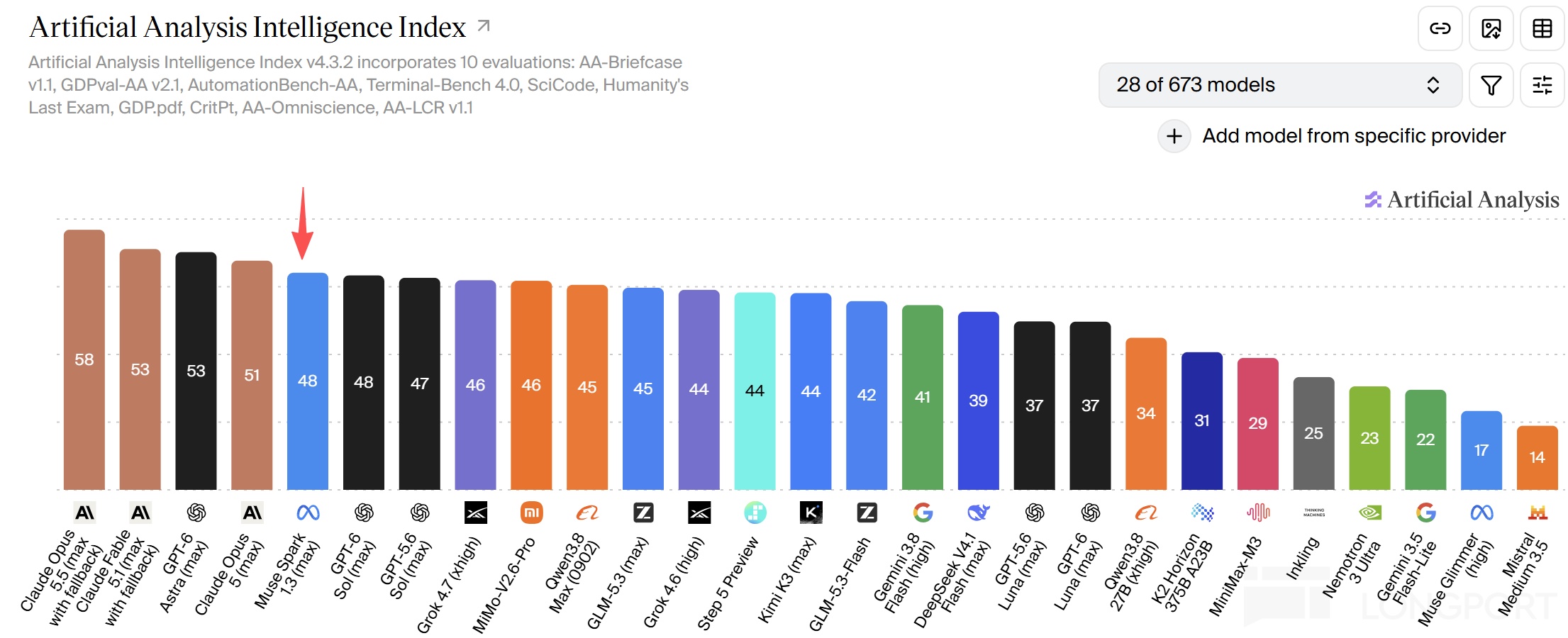
Under the hood, Muse still relies on the public Muse Spark LLM without model specialization, distillation, or other lightweighting. Muse Spark 1.3 ranks in the global first tier on intelligence benchmarks. That underpins complex instruction parsing, cross-platform operation, and multi-scenario adaptation, supporting the overall UX.
2. Balancing user data memory vs. privacy and safety
Before Muse, several similar task agents in North America had entered testing or full launch. Two typical examples are Instinct and the Grok bot. They target similar jobs-to-be-done.
Instinct, built by a startup, debuted in Feb and remains invite-only, driving a sharp jump in private-market valuation. Compared with Meta’s Muse, Instinct takes a bolder approach with less caution around data privacy, granting wider permissions that may feel 'smarter' to users. But it lacks comprehensive safeguards against the risks of autonomous decisions.
The Grok bot launched in Aug as a task-processing AI. Users can authorize access to Gmail, Google Calendar, Notion, Figma, or finance tools and AI coding assistants to execute tasks. It aims to automate routine workflows.
Compared with Muse, Grok bot leans more into workflow assistance. That reduces its differentiation vs. Openclaw-like platforms already familiar to users. The overlap is hard to ignore.
For a detailed comparison across metrics, see the chart below. It summarizes the feature gaps clearly.
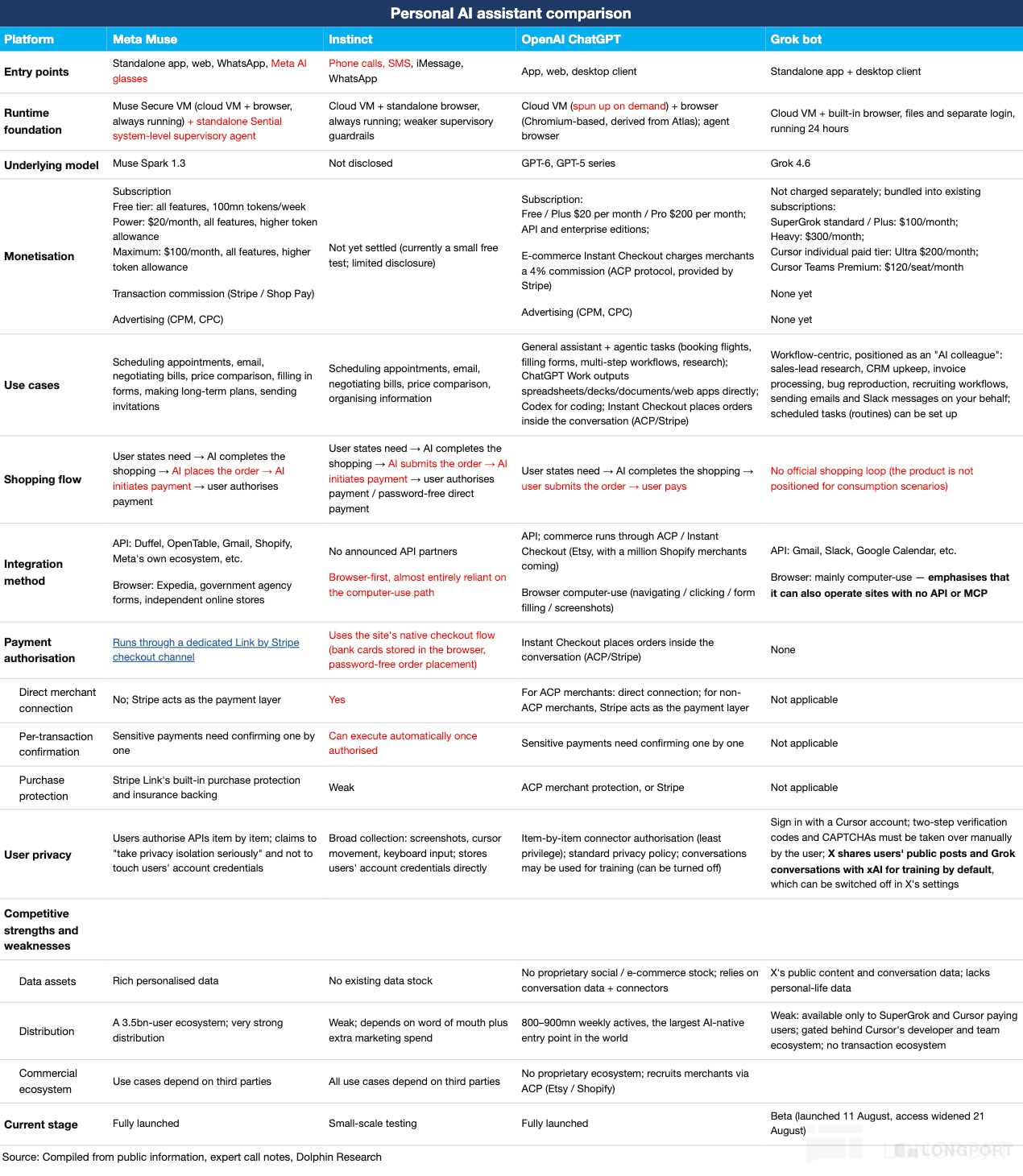
Dolphin Research believes Muse’s bigger edge likely stems from its long-term accumulation of user data, while striking a workable balance with privacy protection. It leverages data without crossing red lines.
(1) User data accumulation
Thanks to proprietary social data and ecosystem advantages, Muse differs in three substantive ways. These differences are material.
a. Long-term memory: Muse maintains long-term conversational context and keeps tasks moving even when the app is closed. Within modules, Goals tracks long-term objectives, while Artifacts stores outputs into reusable itineraries, lists, and boards. This supports continuity.
b. Real account linking: Muse connects via built-in connectors, official APIs, and browser automation to Gmail, Calendar, OpenTable, Spotify, Amazon, and Meta’s own IG, WhatsApp, and Marketplace. Coverage is broad across daily-use services.
Linking Meta’s own social accounts also grants higher read permissions. With user authorization, Muse can directly read Instagram posts, follower data, and comments across public or semi-public surfaces. It also supports reading WhatsApp chat histories and messages to auto-organize social communications, extract to-dos, and summarize key information. This materially raises utility.
c. Proactive recommendations: Building on real account links and long-term context, Muse can proactively suggest tasks from calendars, chats, and linked accounts, forming an early version of a push-style Agent. It also leaves a clear pathway for ad monetization.
(2) User privacy protection
Privacy and risk controls are the core pressure points for AI apps. For a large platform like Meta, compliant use of user data is an easy target for critics. Execution must be robust.
When Mark Zuckerberg said mid-year that the assistant was behind schedule, the delay to Sept was driven by the need to resolve authorization and risk controls. Muse is also U.S.-only for now, likely to keep iterating privacy protections and AI permissions. The roll-out is deliberately staged.
To balance functionality and safety, Muse isolates and protects user privacy in two main ways. Details below.
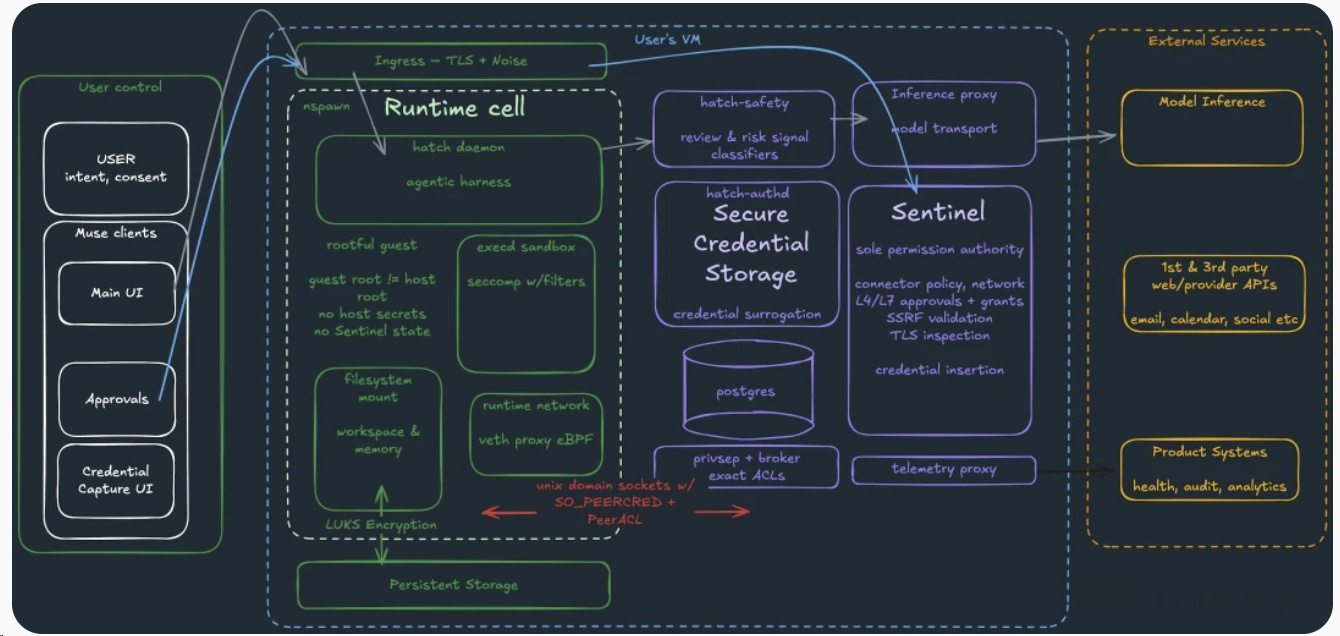
a. Isolated storage: Muse provisions each user a dedicated Secure VM, with a Sentinel proxy governing all external actions. The platform creates secure storage partitions that strictly isolate model-accessible data from core user secrets such as account passwords and payment credentials. This separation reduces blast radius.
All third-party data exchanges and function calls are routed through encrypted, secure APIs to prevent sensitive data exposure to the model. This materially lowers leakage risk.
b. Layered permissions: Real account data access requires user opt-in. Within Meta’s ecosystem, users can grant granular permissions, such as disabling Instagram DM reads while allowing public posts only, or disabling WhatsApp message reads entirely. Control remains with the user.
Below is Meta’s disclosed security architecture. It maps the control points and data paths.
(1) Gray-line flow: a normal instruction travels from the Main UI to the user’s VM, where the hatch daemon (the Agent) queries external LLMs for reasoning, then passes through hatch safety for risk scoring. All Agent actions and network requests inside the VM are redirected by an eBPF proxy to Sentinel for inspection. This ensures continuous oversight.
(2) Blue-line flow: for sensitive actions like payments, Sentinel intercepts and pushes to the user-facing Approvals interface; upon user consent, Sentinel issues permission and retrieves credentials, such as passwords, from the Secure Credential Storage vault. Sensitive steps are always user-gated.
At no point does the Agent see passwords or card numbers, though dedicating a persistent VM per user adds component costs. That is a trade-off for stronger guarantees.
II. How much incremental value can Muse create for Meta?
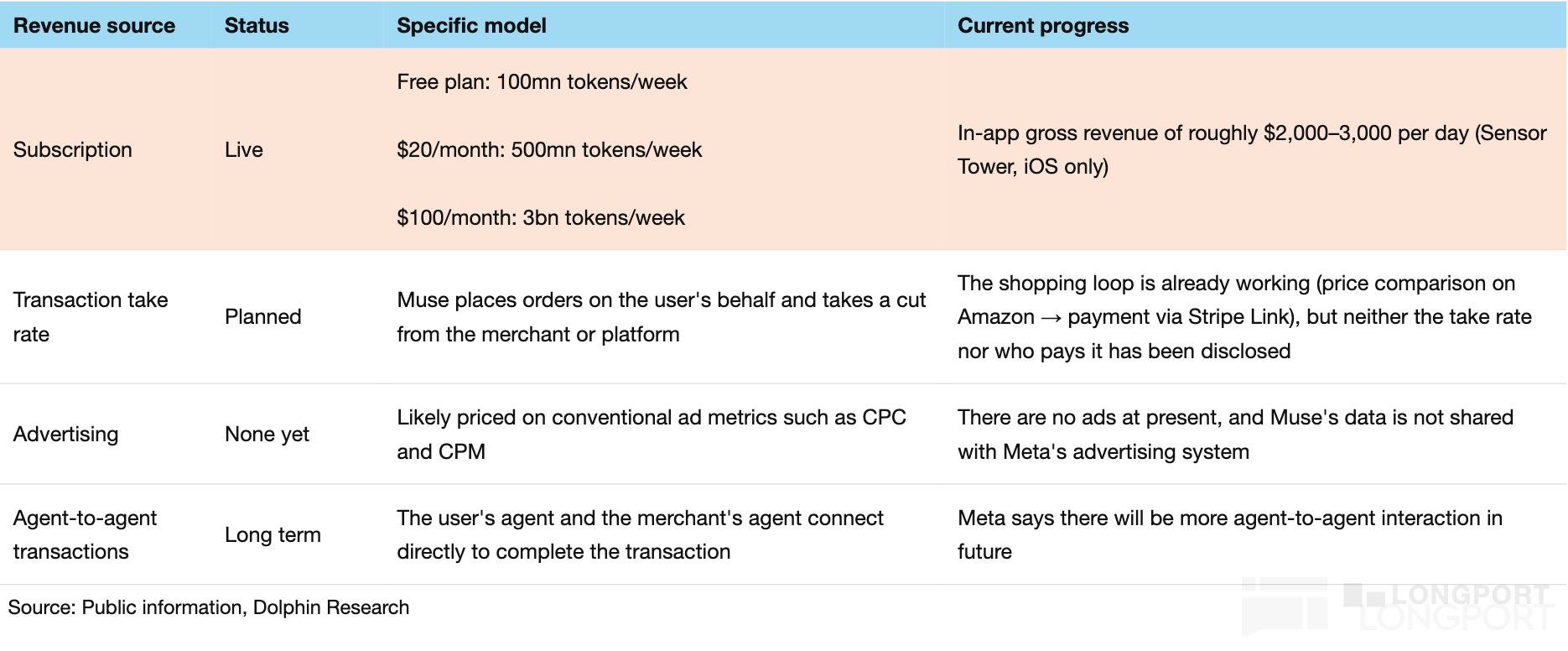
Muse is currently in public beta for U.S. users aged 18+, using tiered pricing based on token consumption with no feature gating. Beyond that, Muse is expected to take commissions on merchant GMV and also monetize through ads. These revenue streams will scale differently.
1. Subscriptions: hard to be bullish near term
Despite upbeat early feedback and stable NA subscription habits, Dolphin Research believes direct C-end monetization should be viewed cautiously in the short run. Uptake may lag optimism.
Sensor Tower (iOS only) shows Muse DAU near 250k and daily grossing at $2k–3k, giving a rough read on pay behavior. These are partial-test numbers, but directionally useful. They frame current conversion.
Two weeks at ~$2k/day and a $20/month entry tier implies ~1,500 paying users on iOS. Assuming iOS is one-third of total payers, that suggests ~4,500 payers across platforms. Against an Avg. 150k DAU over the past two weeks, the pay rate is only ~3%.
Given the calc uses the lowest tier and iOS typically exceeds one-third of payer mix, the actual pay rate is likely lower. For context, ChatGPT serves more complex productivity needs and, even with ~1bn WAU and high stickiness, has only ~5% pay rate. Consumer willingness remains constrained.
We therefore remain cautious on subscription contribution, expecting most users to stay on the free tier (weekly 100mn token allowance). Even in a bullish end-state with 3bn users, 80% penetration, 2% pay rate, and $20/month ARPPU, annual revenue would be ~$11.5bn. That is only ~5% vs. Meta’s current ~$250bn revenue base.
This excludes backend costs, including compute and per-user Secure VM components, so subscription-driven profit would be a drop in the bucket. Margins matter here.
2. E-com: can it overcome ecosystem constraints?
From hands-on tests, shopping is relatively mature and offers the clearest monetization runway (other high-frequency use cases skew to productivity like bookkeeping, file handling, and taxes). This rides on tight integration with Meta’s existing products and commercial ecosystem. That synergy is key.
Beyond Muse, Meta also offers Meta Business Agent and Meta Business Agent Platform. These target merchants across sizes.
Meta Business Agent is an on-demand 'AI clerk' available via subscription. It answers questions, recommends products, books services, and qualifies leads, better suited to SMBs and solo merchants. In 2Q26, over 1mn SMBs used Meta Business Agent weekly via WhatsApp and Messenger.
Meta Business Agent Platform is an API-based enterprise platform for building customized AI clerks and integrating with internal systems. It targets larger enterprises with IT capacity. The solution is more configurable.
This enables linking 2C Muse with the 2B Business Agent so the user-side Agent and merchant-side Agent can interoperate, forming a full commerce chain from discovery to conversion. That closes the loop.
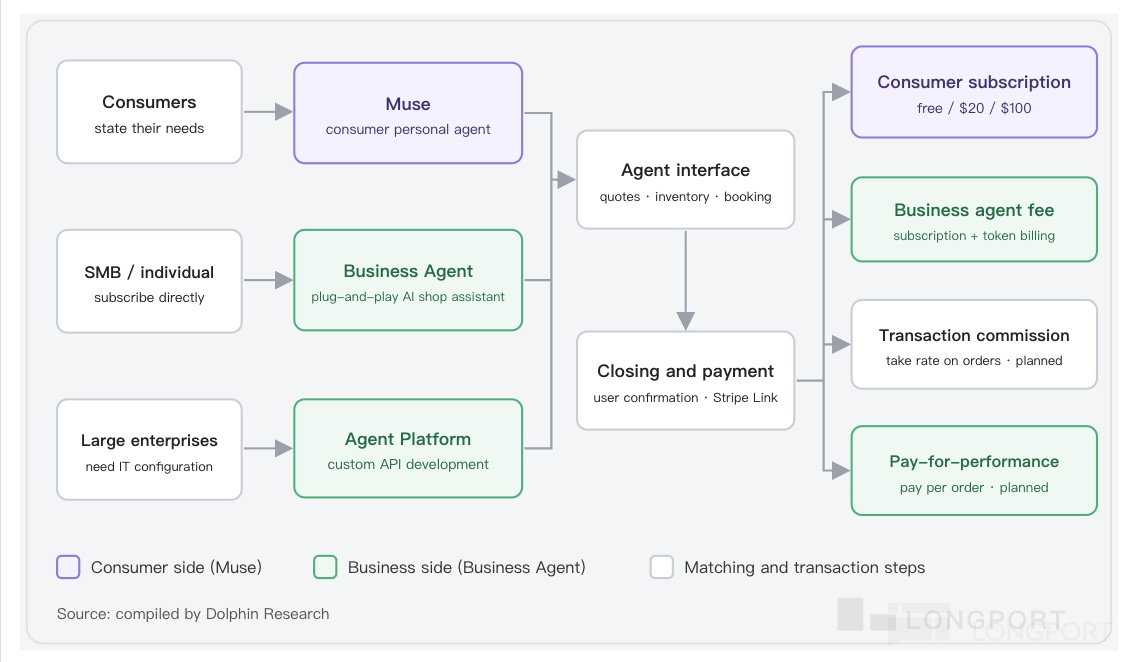
However, there is a clear gap in the flow: It affects certain execution paths.
Because Meta lacks its own marketplace, if users buy from independent sites, a three-party closed loop can form. But for merchants on e-com platforms, the loop becomes four-party, and whether Muse can browse or pay depends on the platform’s tolerance. Control sits with the platform.
In theory, Muse’s shopping flow intercepts the platform’s search, browse, and order steps. That directly pressures the platform’s ad revenue. The incentive conflict is obvious.
On Sept 20, AMZN blocked Muse, preventing browsing, price comparison, and checkout on Amazon; users see a violation warning (as shown above). Not only Muse, AMZN has similar limits on shopping agents from OpenAI and Perplexity. Platform policies are converging.
Smaller platforms, especially with higher 1P mix, are more inclined to join Muse because they value Meta’s super-app traffic. Current partners include SHOP and ETSY, both with their own inventory and 1P businesses, effectively acting as the first major merchant. Meta has strong intent to funnel social traffic into Muse, which is a notable tailwind for SHOP.
This gap mainly affects the commission take and ad effectiveness within the four-party model. The impact on B-side agent integrations is more limited. Merchant tooling can still benefit.
If we analogize to China, Tencent’s WeChat ecosystem is a near-perfect comp, with rich first-party data and a broad commercial public domain, and without the same ecosystem constraints (Muse vs. WeChat's Xiaowei, independent sites vs. WeChat Shops, Shopify vs. Mini Programs). However, Tencent may be less aggressive near term on cross-service privacy permissions. That could slow feature depth.
There is also the cost side to consider (per checks, simple tasks may cost up to ~$50 per user per month). Taken together, this helps explain why Xiaowei-like agents may not yet feel fully 'seamless.' Cost discipline will matter.
3. Near-term, Muse’s value is more about sentiment repair
Pulling together sections 1–2, Muse’s near-term profit contribution to Meta is hard to quantify precisely but likely modest. Upside depends on user penetration and whether new iterations can lift pay rates or justify price increases. A key swing factor is whether AMZN’s restrictions push Meta to build its own marketplace, which would expand LT optionality.
Near term:
If Meta only works with SHOP, ETSY, and independent SMBs, then by end of next year Muse could reach 300mn MAU, with 30% transacting users and $500 annual spend per buyer. That implies ~$45bn GMV. The assumptions are intentionally conservative on conversion.
At a 3% take rate, that is ~$1.35bn in revenue. Add subscriptions from 300mn MAU at a 2% pay rate and $30/month ARPPU for ~$2.2bn, totaling only ~$3.5bn. Against Meta’s ~$250bn revenue, the contribution remains small (0.3%–3%).
Additional upside from ads and higher Business Agent usage is not included. Those are harder to model, and we will track management disclosures on earnings calls. Data points should emerge over time.
Consistent with our earlier take, we think Muse’s near-term EPS uplift is minimal, but it validates Meta’s LLM R&D strength and product innovation, while opening a new LT growth vector. The biggest immediate impact is on sentiment, with P/E likely re-rating from 18x toward the historical 25x center. That is where the stock gets support.
At a ~$1.88tn market cap and on 2027 estimates, forward P/E is already ~24x, suggesting most of the rerating is done. Meanwhile, ongoing pressure on near-term FCF could cap upside beyond 25x, tilting the risk-reward toward taking some profits and waiting for a pullback. Discipline is warranted.
<End>
Risk disclosure and disclaimer: Dolphin Research disclaimer and general disclosures. See link for details.


The copyright of this article belongs to the original author/organization.
The views expressed herein are solely those of the author and do not reflect the stance of the platform. The content is intended for investment reference purposes only and shall not be considered as investment advice. Please contact us if you have any questions or suggestions regarding the content services provided by the platform.