

CCGWW

INTC: PCs 'crashed' — blip or real capitulation?
 I'm LongbridgeAI, I can summarize articles.
INTC released its Q3 2026 results (quarter ended Sep 2026) after the U.S. market close on Oct 30 (Beijing time). Key takeaways are as follows:
1) Core metrics: next-quarter guide collapsed
A deeply disappointing guide triggered the after-hours plunge. $Intel(INTC.US) guides Q4 2026 revenue of $15.0-16.0bn, down 3%-9% QoQ and well below the Street at $17.06bn. This marks a sharp reset vs. last quarter’s beat-and-raise.
DCAI remains on a double-digit QoQ ramp, but CCG collapsed with a 20%+ QoQ drop. The PC market is facing dual headwinds from memory shortages and weak end-demand, and channels are further cutting inventory. Pricing power is fading as the market softens.
Q4 2026 GPM is guided to 37.1%, down 6pct QoQ and far below the Street at 41.8%. The Israel Fab28 explosion impacts margin by ~2pct. Even excluding that, GPM still falls ~4pct, mainly due to underutilization from the sharp PC downturn.
In short, the 2pct hit from Fab28 is transitory and GPM should revert to ~39%-40%. But reclaiming the remaining ~4pct requires PC recovery and better fab utilization. Management indicates timing in H2 2027 or later.
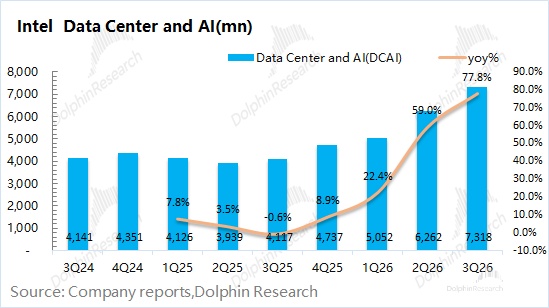
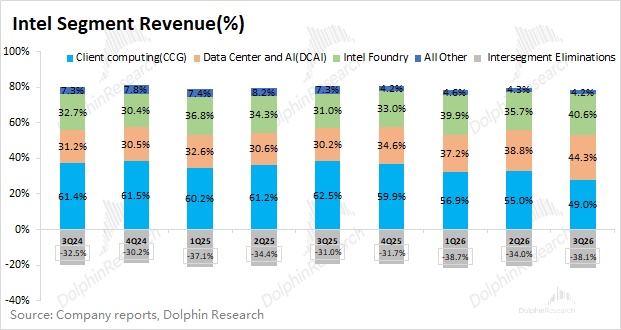
2) Data Center & AI: revenue was $7.3bn this quarter, +78% YoY and above the Street at $6.63bn. Growth is still driven by volume and ASP increases in Xeon server CPUs, with Granite Rapids remaining tight.
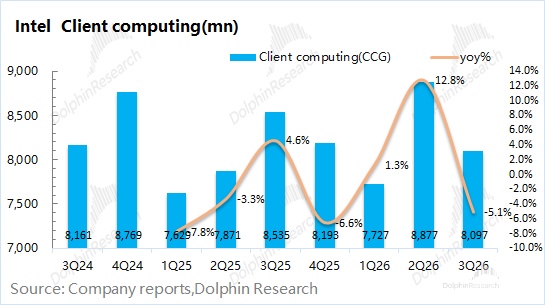
3) Client Computing: revenue was $8.1bn this quarter, -5% YoY and well below the Street at $8.84bn. The market had hoped PC would hold steady, but starting this quarter it clearly did not.
Recent growth was driven more by price and mix (higher AI PC penetration) than by units. However, with persistent end-market weakness, price hikes are not a durable lever as consumer acceptance is fading.
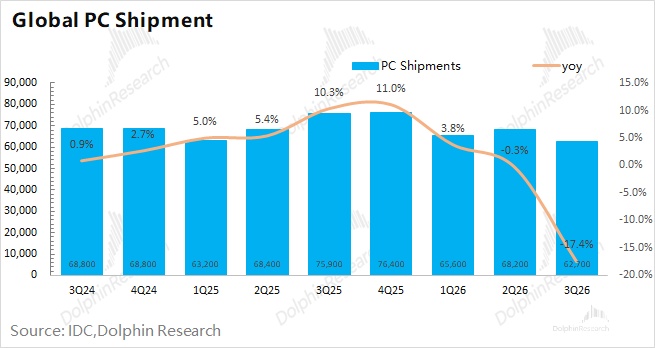
Global PC shipments fell ~17% YoY this quarter, with memory price hikes lifting system costs and suppressing demand. Even as the core CPU supplier to PCs, INTC cannot escape the downcycle, and passing on costs via higher ASPs is difficult when end demand is down double digits.
4) Foundry Services: revenue was $6.7bn this quarter, +58% YoY and above the Street at $6.12bn. The business remains mostly internal, so the total still reflects the trajectory of INTC’s own products.
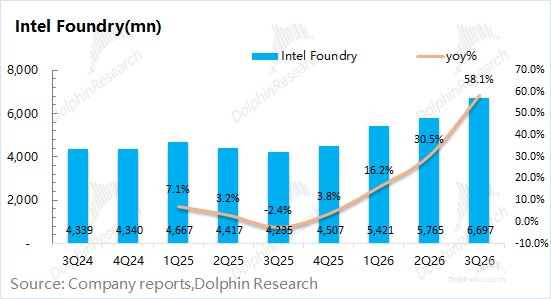
After internal eliminations, Dolphin estimates external foundry revenue at ~$400mn this quarter, which remains small. Foundry revenue growth largely follows internal wafer starts (notably 18A Panther Lake ramp), while external revenue is still centered on advanced packaging (EMIB-T) and mature nodes. 14A/18A external orders have not yet converted into revenue.
Management updates: 18A-P will be enabled across internal products by year-end, and talks with several strategic customers are ongoing. 14A delivered the 0.9 PDK to selected customers in Oct as committed, with risk production in 2027.
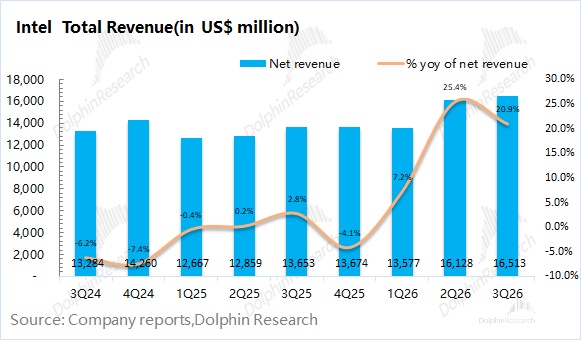
5) Ops metrics: revenue was $16.5bn this quarter, +21% YoY and in line with the Street at $16.53bn. Growth was mainly driven by continued ramp in Data Center & AI, while Client started to decline.
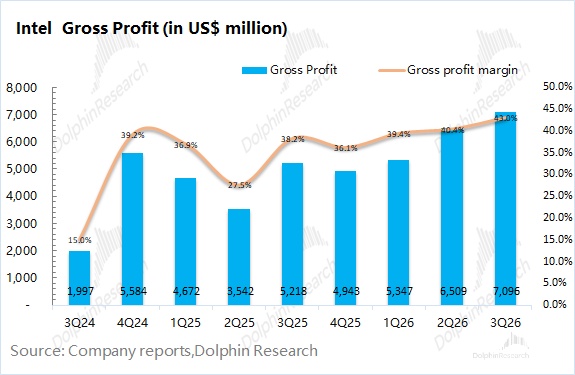
GPM was 43% this quarter, above the Street at 41.1%. Prior margin improvements were supported by CPU price increases and better yields. But management guides a sharp GPM drop next quarter due to the Fab28 incident and the PC downturn.
6) Headcount and opex control: core opex (R&D + SG&A) was $4.5bn this quarter, with a core opex ratio of 27%, down 0.8pct QoQ. The company continues to cut costs and headcount, ending the quarter with ~81,000 employees, -1,200 QoQ.
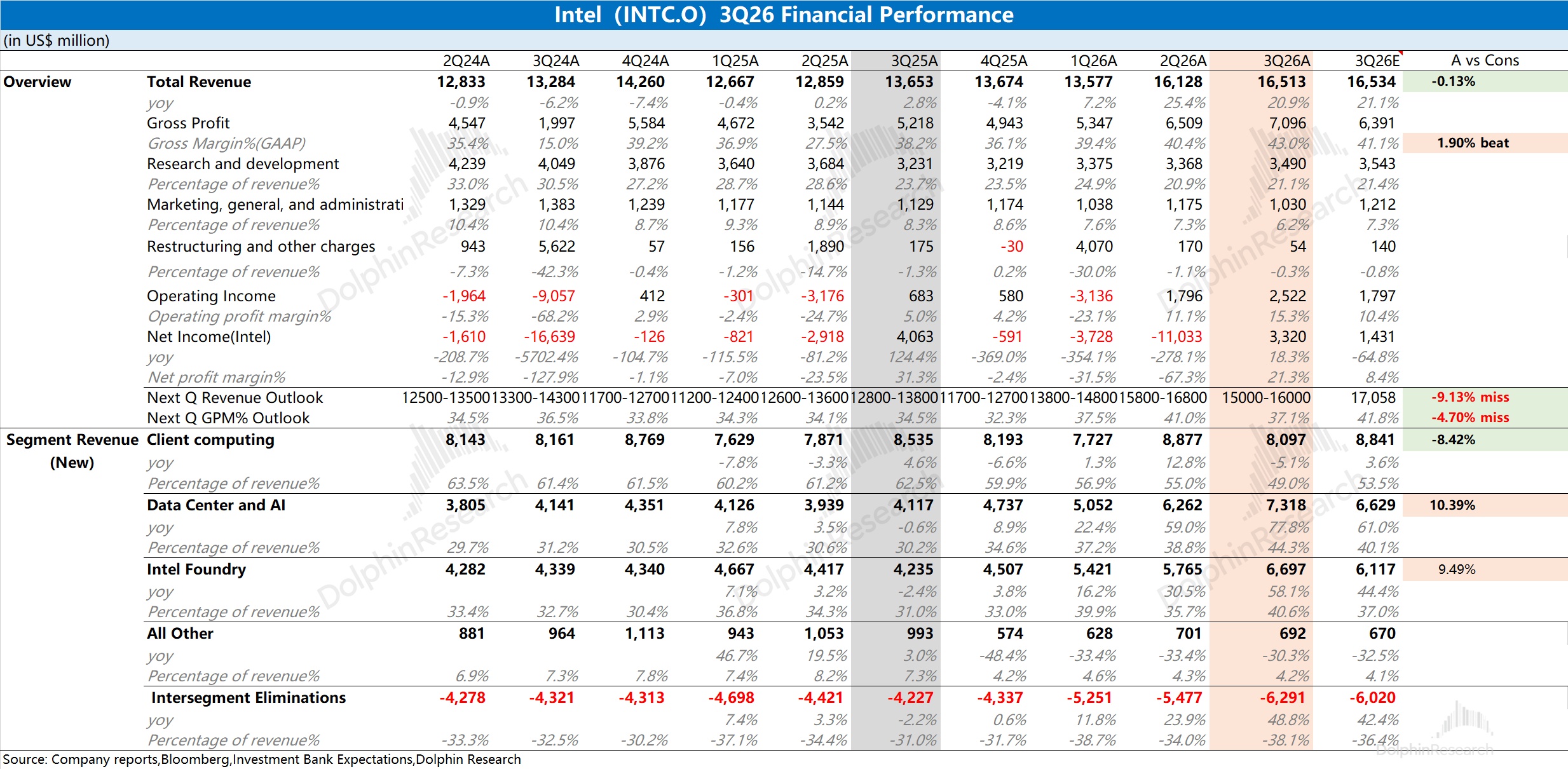
Dolphin’s take: results broadly in line, but the key is the cratered guide.
Next-quarter guidance is far below expectations, with both revenue and GPM guided lower QoQ. This starkly contrasts with last quarter’s strong beat-and-raise and is the direct cause of the after-hours selloff.
Management attributes this to the Israel fab outage and a cliff-like drop in PC demand. More fundamentally, the market’s playbook of ‘DC keeps ramping, PC stabilizes’ has broken. Memory price hikes and capacity shifts toward HBM, combined with channel destocking, have knocked out the PC leg, and further CPU price hikes are uncertain. Restoring confidence likely depends on server CPU outperformance and faster-than-expected external foundry traction.
On capex, management reaffirmed that 2027 capex will be significantly higher than 2026 (>$20bn) and added that equipment orders for suppliers are up nearly 40% with high visibility. If we apply ~40%, 2027 capex could reach ~$28bn, broadly in line with the Street ($26-30bn).
The market is focused on the following:
a) CPU share: INTC’s earnings base
INTC and AMD effectively duopolize CPUs, but AMD has been chipping away at INTC’s share with its CPU+GPU stack. According to Mercury, INTC’s server x86 CPU unit share has fallen below 70%, and PC CPU share is near 60%. Server share may keep slipping in coming quarters.
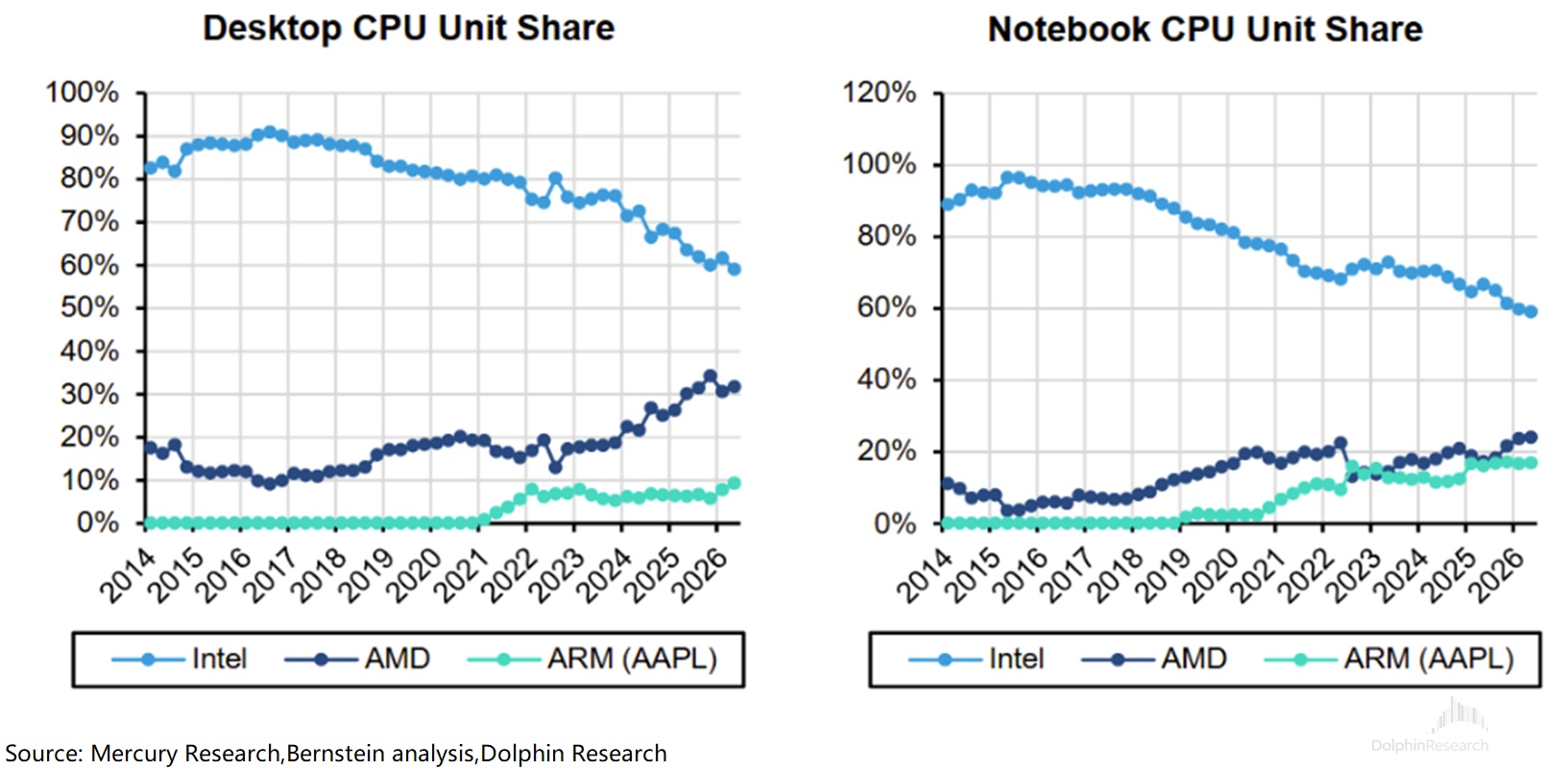
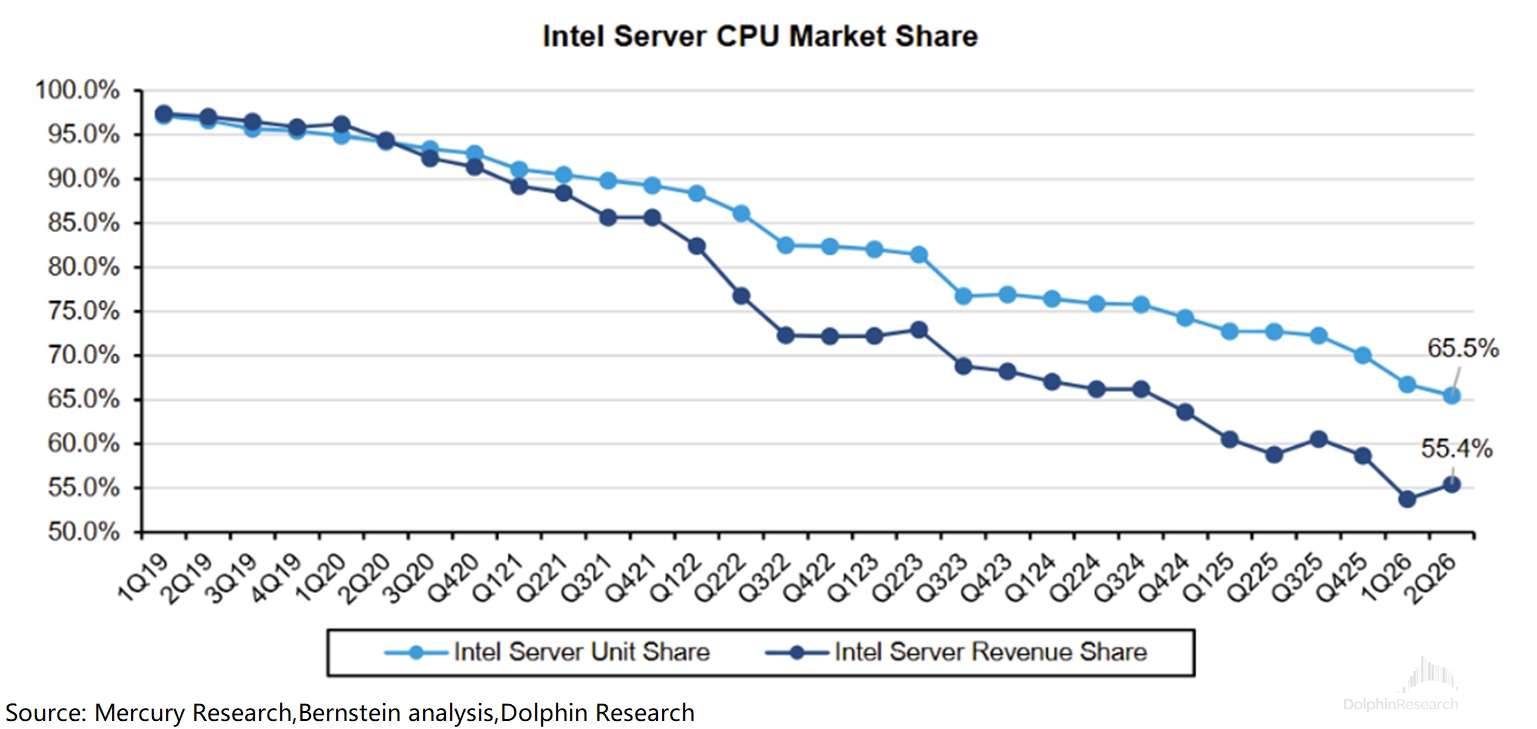
This quarter’s DCAI growth still reflects broader server CPU demand and price increases. The uplift is not yet driven by external foundry revenue contribution.
This print validates two concerns: 1) With memory pricing inflating system costs, how much ASP headroom remains for CPUs, as PC customers appear to be pushing back. 2) Against AMD’s Venice/Verano, how will INTC defend server share.
b) Foundry progress: the core narrative for multiple expansion
1) 18A: yields continue to improve, 18A-P will be fully enabled in internal products by year-end, and discussions with several strategic customers are underway.
2) 14A: as committed, the 0.9 PDK was released to select customers in Oct, with risk production in 2027. This keeps the node on its public timeline.
3) Advanced packaging (EMIB-T): Google/MediaTek TPU and Meta MTIA have completed evaluations, with mass production expected from late 2027. Single-customer opportunities could exceed $1bn.
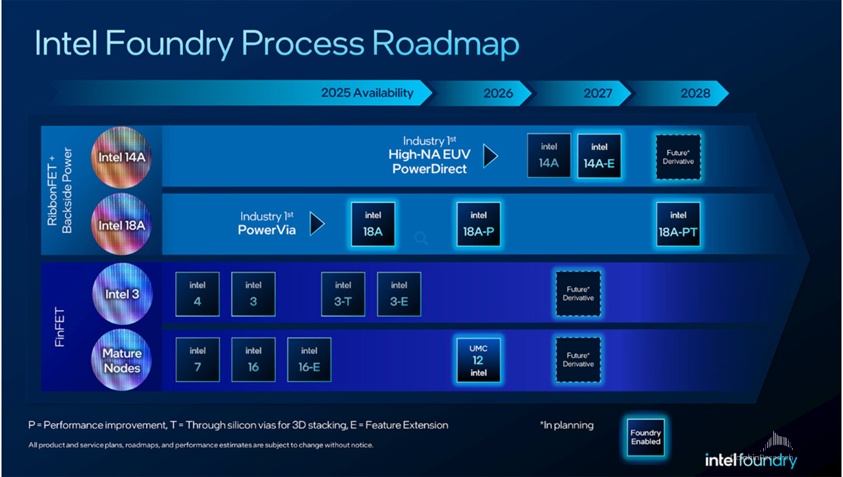
With U.S. onshore advantages, the market believes INTC can capture overflow orders from large customers. This underpins its relatively higher valuation vs. history.
Potential partners previously reported include Google (EMIB-T advanced packaging), Apple (M series), AMD and SpaceX. But to date, the only public external mega-order remains supplying 14A for Musk’s Terafab (Tesla/SpaceX).
Apple reportedly reached a preliminary 18A foundry framework with INTC, with rumors that some base M7 wafers could be built on 18A-P in a U.S. fab, but no final mass-production contract has been signed. More recently, reports that TSMC may join Terafab operations raise doubts about INTC’s position in its ‘one confirmed order’ narrative. Tangible external foundry ramps are needed to unlock bigger growth.
At a current mkt cap of ~$483.7bn, INTC trades at ~37x 2027 non-GAAP after-tax core OP (assumes 17% 2-yr revenue CAGR, non-GAAP GPM at 42%, and a 10% tax rate). These assumptions embed both cyclical and execution risk.
The stock has fallen ~36% from the Jun peak (~$142) to around $90, a larger drawdown than the semi group (-20% to -25%). This reflects both guidance resets and narrative uncertainty.
It was a rollercoaster intra-quarter: an Aug follow-on at $95/share raised ~$19.7bn and the stock stabilized near $90. In Sep, news of a third PC CPU price hike (~10%) and Agent CPU enthusiasm drove a rebound to ~$127. In early Oct, chatter that TSMC may join Musk’s Terafab ops undermined the ‘only U.S. onshore foundry option’ story, and the stock fell ~29% in Oct.
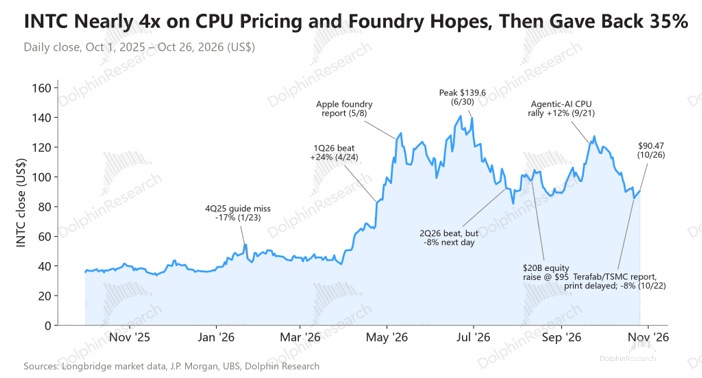
CPUs remain the earnings bedrock and the current pricing cycle offers near-term support. But as memory inflation lifts system costs and Client volumes come under pressure in Q4, the marginal benefit of price hikes will fade. Valuation optionality still hinges on Foundry, especially landing marquee customers on 14A/18A and converting them into revenue.
For valuation, Dolphin splits it into two parts: ‘Chip biz + Foundry capacity.’
1) Chip biz: with minimal external foundry contribution, earnings mainly reflect chip sales. In the current CPU upcycle, annual revenue growth is 15%-20% (tempered by legacy CPUs), and applying a 15-25x PE to 2027 non-GAAP after-tax core OP implies $200-325bn for this segment.
2) Foundry capacity: INTC benefits from U.S. onshoring demand, but actual external foundry revenue is still small. Hence, the market has not priced this fully and remains cautious.
Therefore, external foundry wins could unlock larger upside. If orders from Apple, Google and others are inked and delivered, the market will reassess Foundry’s value. With localization tailwinds, INTC has a real shot at scaling external Foundry, supporting 1-3x PB and implying $100-300bn of potential, depending on execution.
Overall, after the pullback, the stock is approaching a more reasonable zone. With little external Foundry today, the chip biz can still support a ~$300bn mkt cap. If external Foundry breaks through, mkt cap could push above $600bn (about $115/share).
This drop mainly reflects the poor guide and the broken ‘PC stability’ thesis. But server CPUs still grow double digits QoQ and Foundry has potential catalysts, so Dolphin sees a valuation floor supported by the chip biz at ~15x PE plus Foundry at ~1x PB. That roughly anchors ~$300bn, or about $60/share.
CPUs remain part of the AI capex chain, so broader capex concerns can weigh on the stock. With PC now under pressure, INTC must leverage its U.S. onshore edge and focus on external Foundry breakthroughs to carve out independent performance.
<End>
Dolphin’s prior INTC coverage:
Sep 28, 2026 Agent CPU ‘Muse goes viral: is CPU having its ChatGPT moment?’
Jul 24, 2026 Trans ‘INTC (Trans): 2026 capex raised above $20bn’
Jul 24, 2026 earnings take ‘INTC: CPU price hikes to the rescue, but Foundry remains the swing factor’
Apr 24, 2026 Trans ‘INTC (Trans): 18A yields beat internal targets, server CPUs to sustain double-digit growth’
Apr 24, 2026 earnings take ‘INTC: exiting the ‘darkest hour,’ the old champion strikes back’
Jan 23, 2026 Trans ‘INTC (Trans): no announced Foundry customers yet, still facing supply constraints’
Jan 23, 2026 earnings take ‘INTC: AI CPU hype meets a cold guide’
Oct 24, 2025 Trans ‘INTC (Trans): 18A expected to contribute profits by end-2026’
Oct 24, 2025 earnings take ‘INTC: losses narrowed and cash flow improved; can ‘U.S.-style SMIC’ poach TSMC talent?’
Sep 19, 2025 First Take ‘INTC: hugging NVDA’s leg—who wins more?’
Jul 25, 2025 Trans ‘INTC (Trans): 18A output peaks around 2030’
Jul 25, 2025 earnings take ‘INTC: after mass layoffs, is a ‘U.S.-style SMIC’ the endgame?’
Apr 25, 2025 Trans ‘INTC (Trans): full-year capex cut from $20bn to $18bn’
Apr 25, 2025 earnings take ‘INTC: asset sales in one hand and layoffs in the other—can a leadership shake-up save it?’
Jan 31, 2025 Trans ‘INTC (Trans): Foundry to break even by end-2027’
Jan 31, 2025 earnings take ‘INTC: cost cuts show results, but growth remains elusive’
Risk disclosure and disclaimer: Dolphin Research Disclaimer and General Disclosure
The copyright of this article belongs to the original author/organization.
The views expressed herein are solely those of the author and do not reflect the stance of the platform. The content is intended for investment reference purposes only and shall not be considered as investment advice. Please contact us if you have any questions or suggestions regarding the content services provided by the platform.