

CCUP

Circle: Inflated results; key channels bite back; only path is to build the ecosystem.
 I'm LongbridgeAI, I can summarize articles.
$Circle(CRCL.US) released its Q3 results pre-mkt on Nov 4 ET. The headline beat was driven by revenue from Arc token sales; excluding that, results were middling, validating pre-print concerns.
In detail. Key takeaways follow.
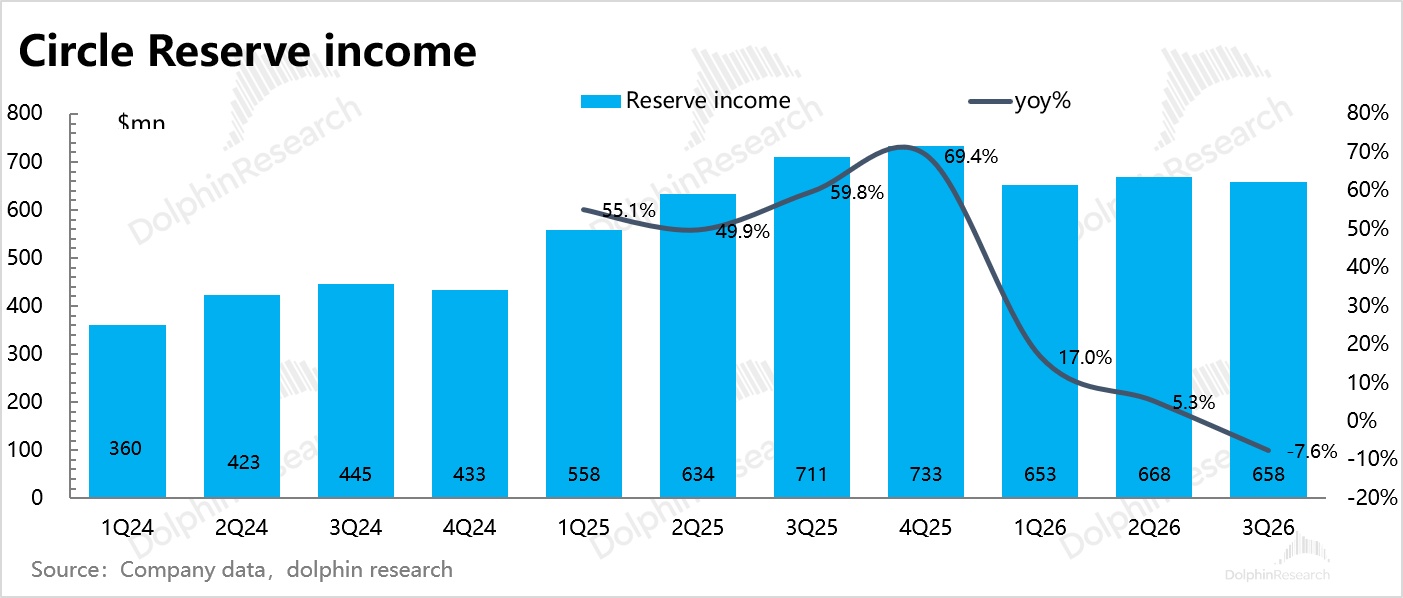
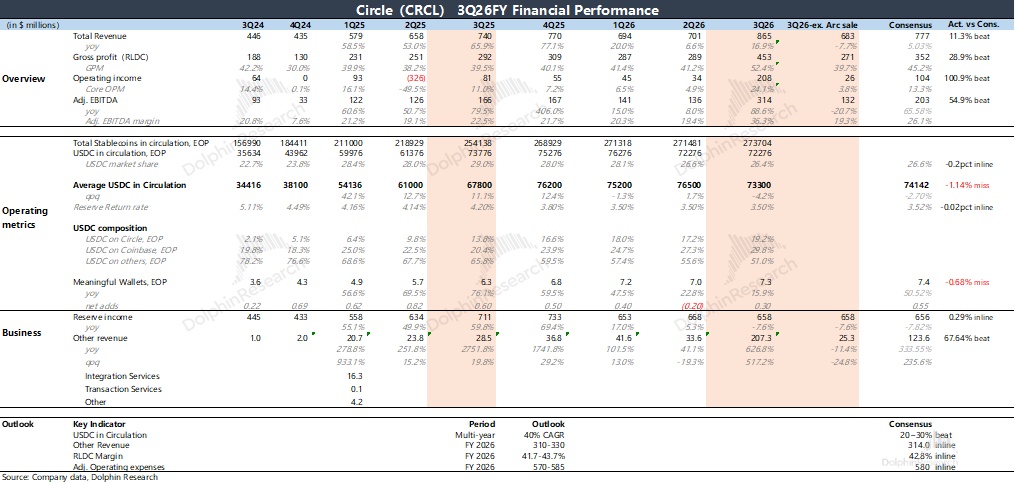
1) Reserve interest income declined in line. Trends were broadly as expected.
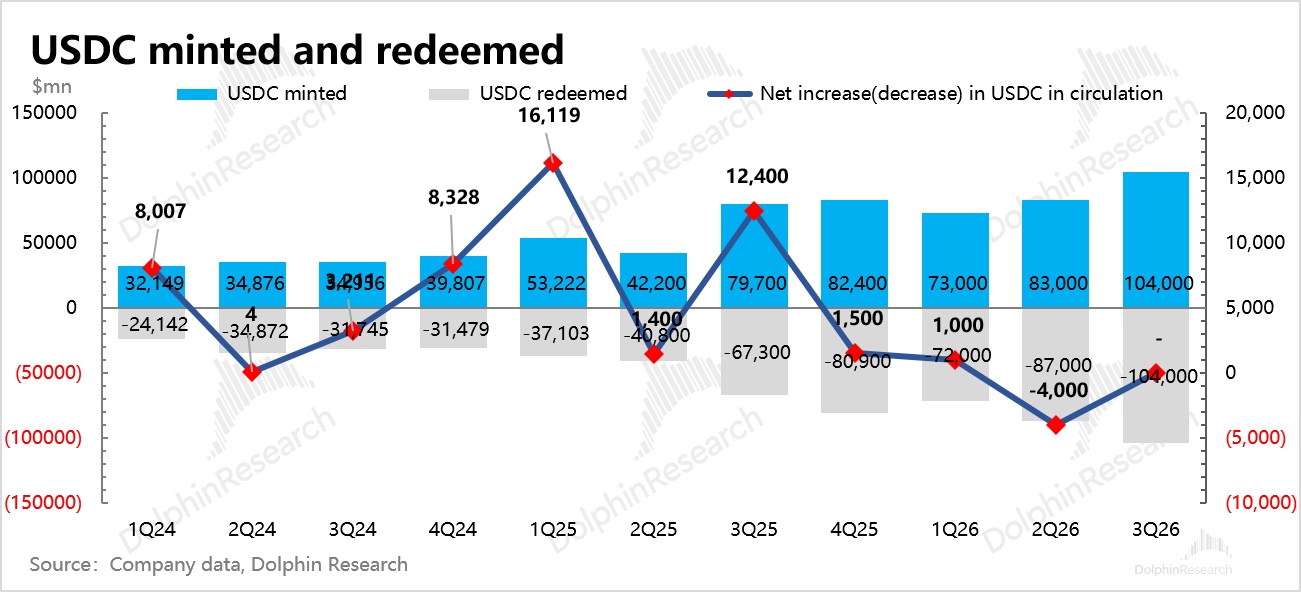
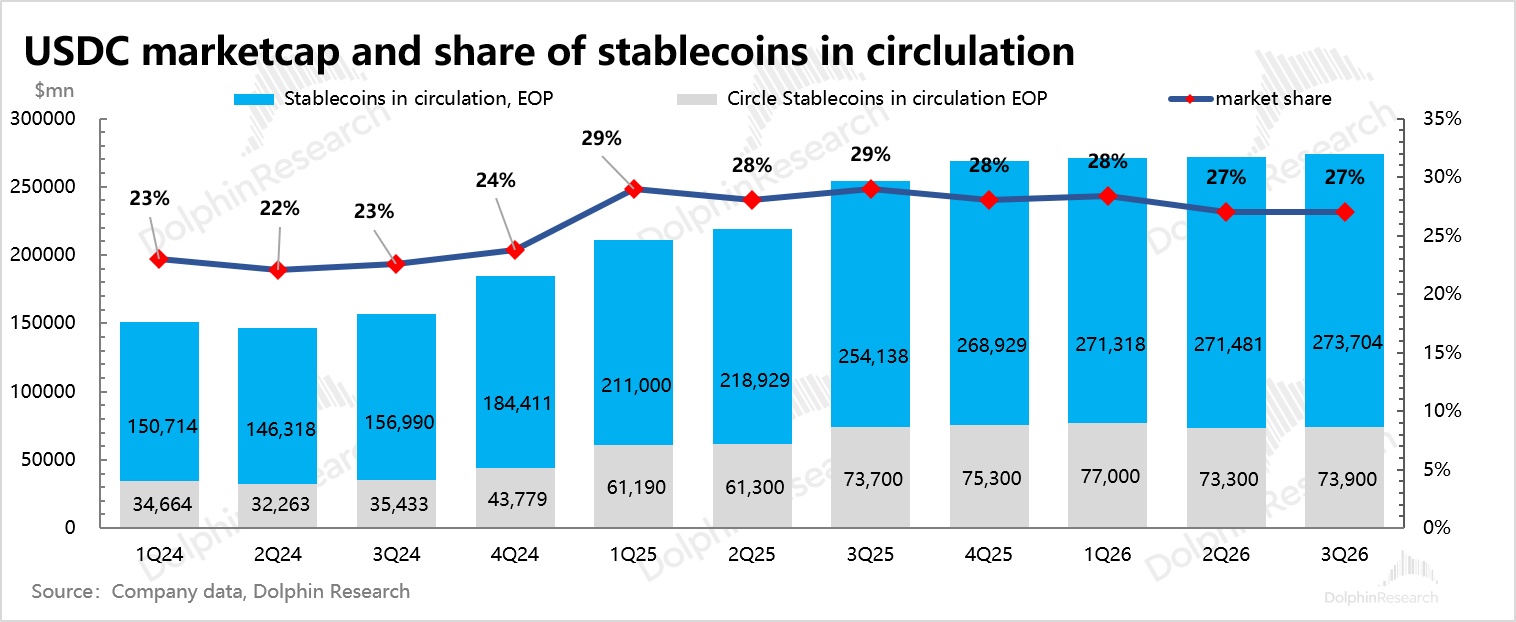
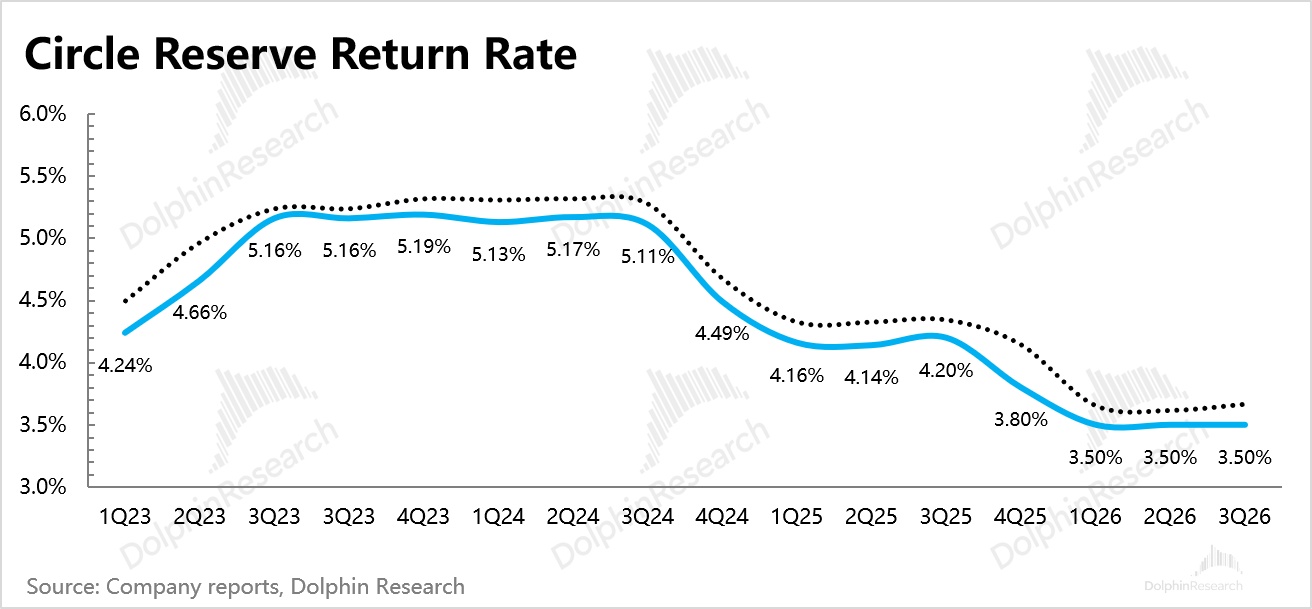
Q3 reserve interest income was $660 mn, in line. Despite USDC mkt cap +8% YoY, interest income fell 8% YoY on lower yields; on a QoQ basis, Avg. USDC in circulation was $73.3 bn in Q3, down 4% vs. Q2.
2) Arc token revenue was recognized faster than expected. Recognition cadence surprised to the upside.
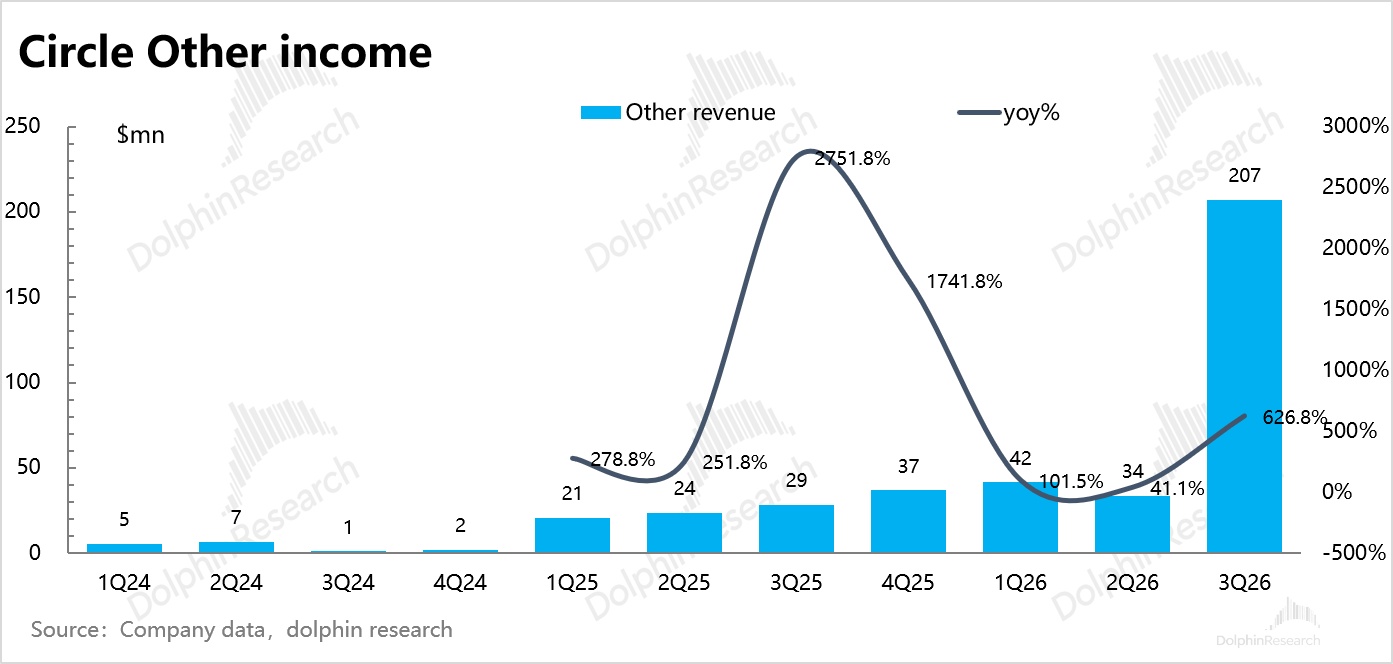
Q3 other revenue exceeded $200 mn, of which $180 mn was Arc token sales recognized in the quarter. Recognition exceeded the market’s ~$90 mn est. and surpassed the prior full-year guide of $180 mn.
However, this revenue is neither stable nor repeatable; it is more one-off in nature. Based on the unchanged full-year guide of $310–330 mn for other revenue, Q4 likely has no such Arc recognition.
This year’s two Arc presales totaled $224 mn; after recognizing $180 mn in Q3, the remaining ~$40 mn will be recognized next year. The profile is front-loaded by design.
The Arc presale drew in many institutional funds. Substantively, it resembles an equity-like subscription on the future economics of the Arc L1, which Circle initially books as deferred revenue and recognizes over time as Arc development milestones are met.
Treating equity-like subscriptions as revenue is inherently odd and limits forward visibility. Unless token issuance is repeatedly used as financing, it remains a one-off and lacks a recurring business profile.
Durable revenue will only kick in from 2027, driven by Arc transaction fees, staking income, and fees from the CPN payment network. The Arc presale merely monetized a slice of future value upfront.
3) Major channels pushed back, raising pressure on interest-sharing. The split is turning less favorable.
Because Arc token sales carry negligible cost, the $180 mn effectively dropped to the bottom line, inflating Q3 profit quality. After stripping it out, the underlying trend weakened as revenue fell while costs were relatively sticky, taking GAAP OPM to 3.9%, down 100 bps QoQ.
That said, Q3 also reflected cost optimization from layoffs. With roughly half of expenses in personnel, Adj. opex (ex severance) fell 5% QoQ, consistent with a 5% headcount reduction during the quarter.
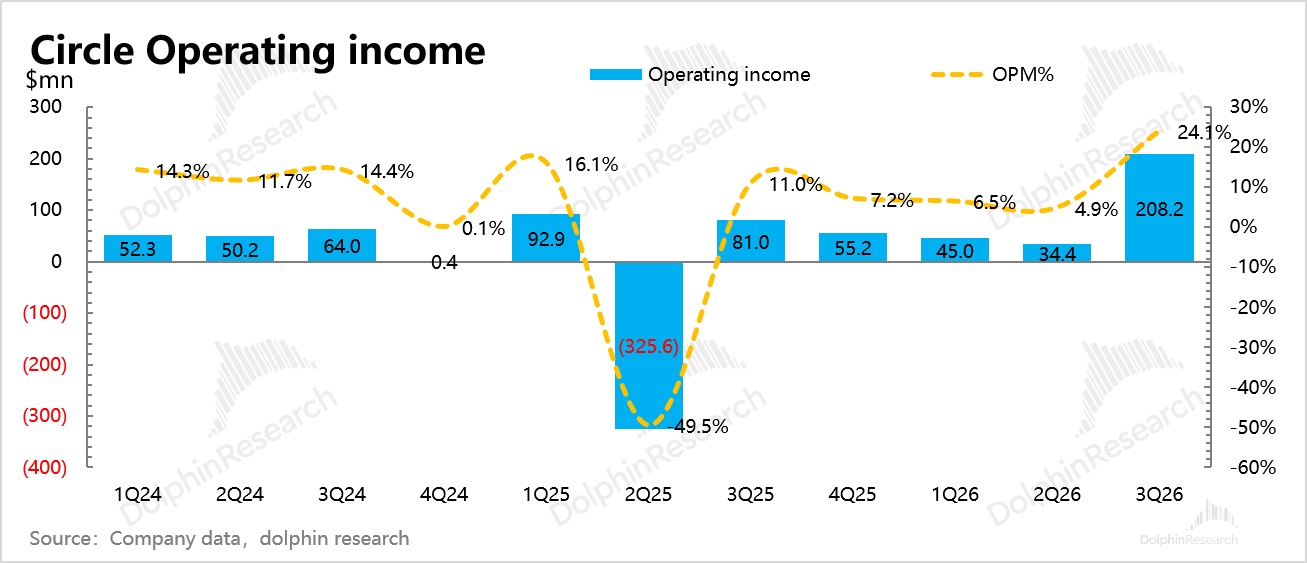
From Q3 onward, profit will increasingly reflect the Hyperliquid revenue-share impact. Dolphin Research roughly estimates Circle’s direct GP reduction at nearly $100 mn annually, with the hit becoming more visible as early as Q4.
Hyperliquid is the largest on-chain perp DEX with its own chain. Users post USDC margin before trading, leaving a large USDC float on-platform, roughly $6.0 bn, making it one of the few sizeable off-exchange USDC pools for Circle.
Amid the push-and-pull around the CLARITY legislative process, Hyperliquid began demanding in Sept that Circle rebate the reserve interest associated with its USDC. However, Circle and Coinbase have a revenue-sharing arrangement: Coinbase keeps 100% of interest for USDC custodied on-platform, while for USDC custodied off Coinbase by Coinbase and Circle, Coinbase takes 50%.
To meet Hyperliquid’s interest rebate, funds must route via Coinbase. The result is a different split and custody setup.
(1) Hyperliquid recoups most of the interest (est. 90%). This follows the new channel mechanics.
(2) Coinbase and Circle each forgo 50% of the prior interest split, while gaining the associated 90% AUC on Coinbase’s platform; Circle retains 10%. Net economics for Circle worsen.
Hyperliquid’s USDC within its ecosystem totals $6.3 bn; at a 3.5% yield, reserve interest equals ~$228 mn per year. Hyperliquid takes ~90% (~$200 mn), leaving under $30 mn for Coinbase and Circle to split.
In other words, interest revenue that could have been $228 mn, implying ~$100 mn GP after issuance costs and the pre-existing 50% split to Coinbase, is now reduced to roughly $10 mn GP in hand. This is a step-change in unit economics.
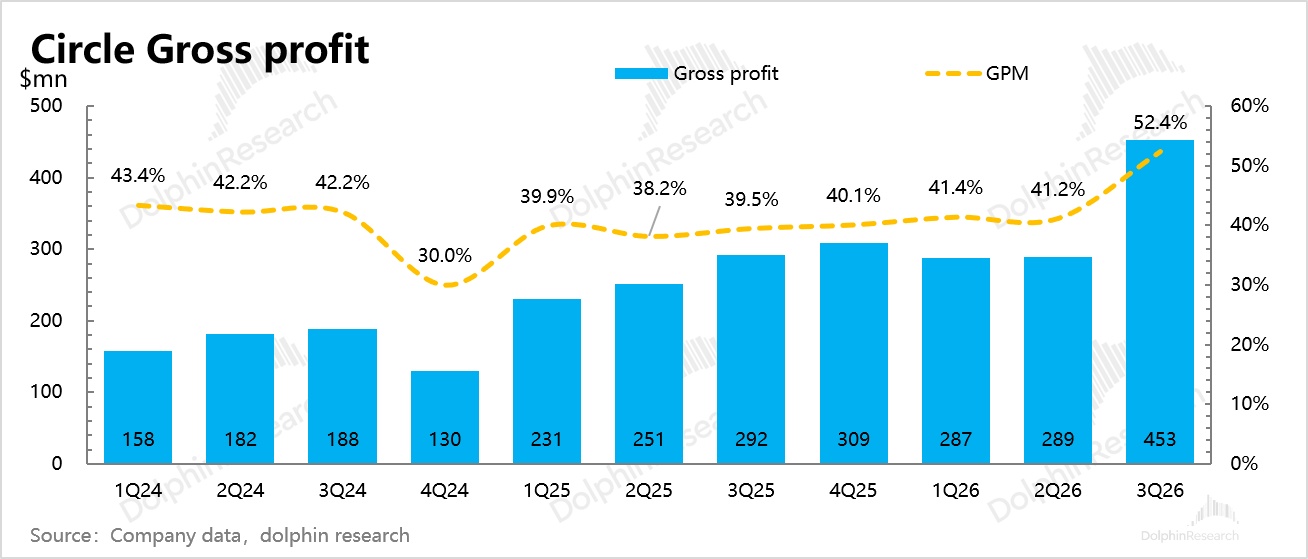
Q3 GPM was 52.4%; excluding the $180 mn Arc token windfall, GPM was 39.5%, already showing some impact QoQ. The mix shift is unfavorable.
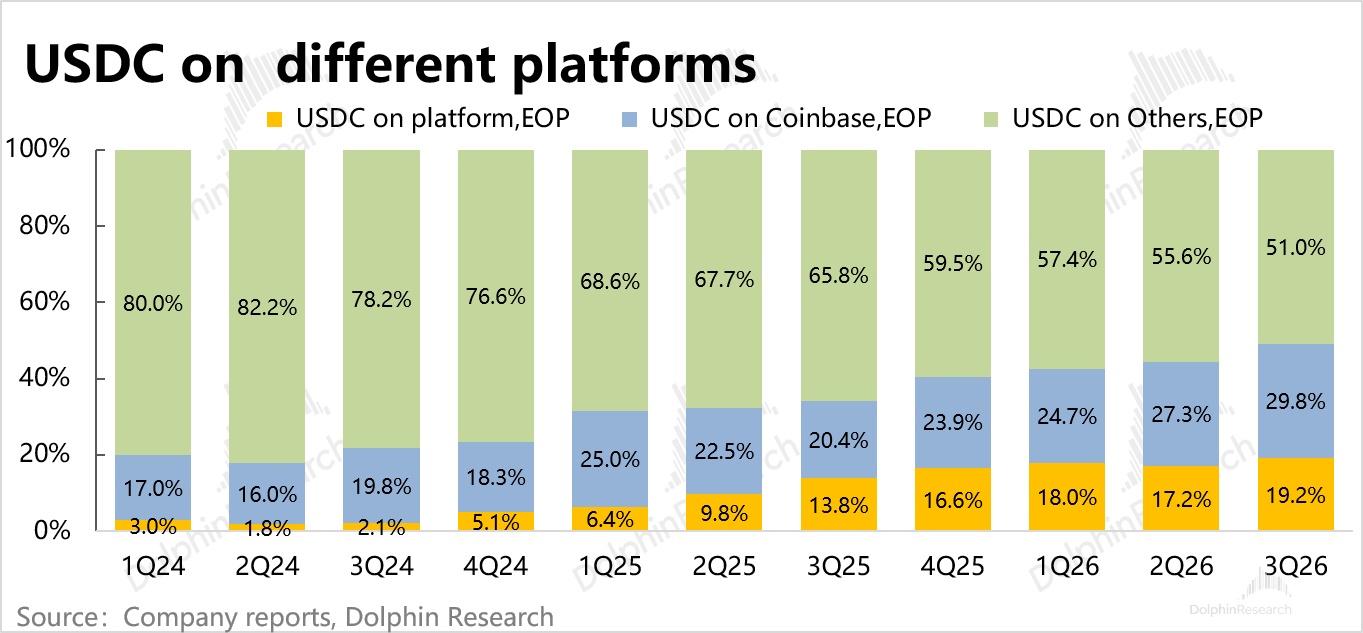
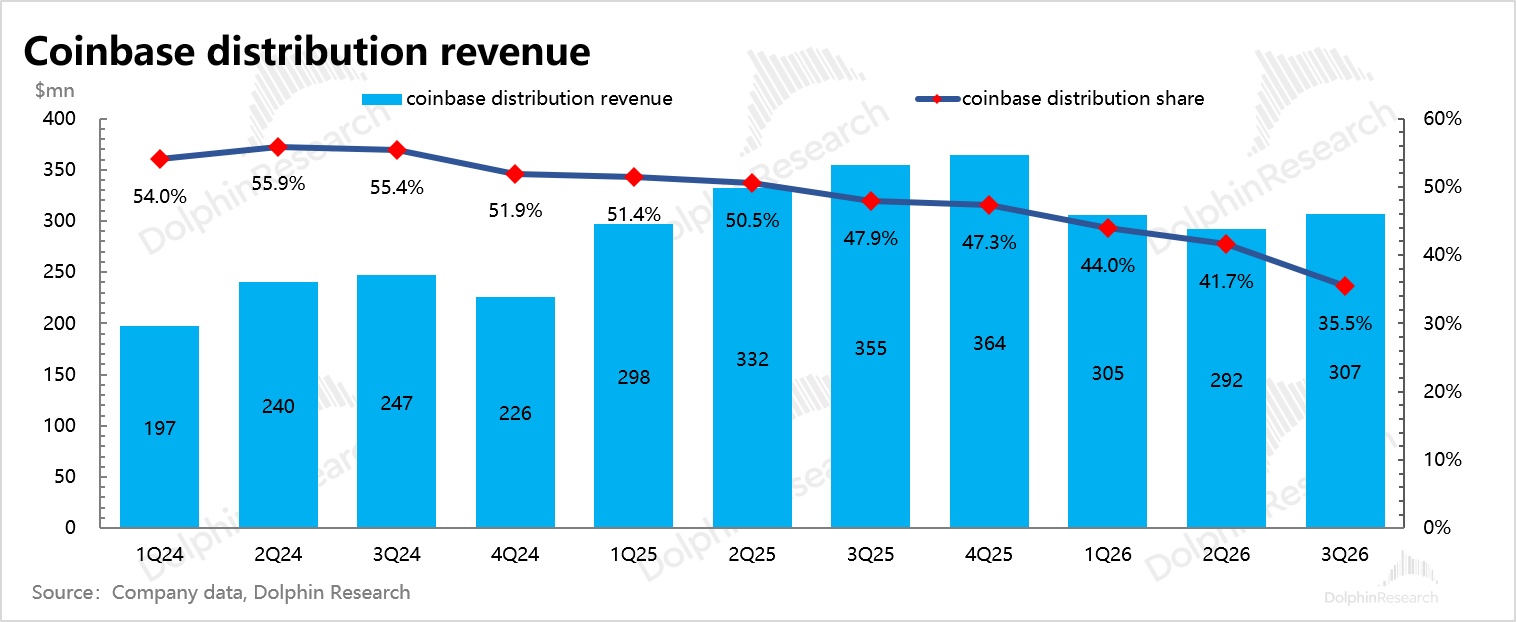
USDC’s share within Coinbase jumped to 30%, yet Coinbase-related revenue as a share of Circle’s rev-share costs fell rapidly to 35%. This corroborates the impact from Hyperliquid’s pushback.
4) Circle earnings call Trans Circle (Trans): USDC balance flat; CPN and Arc to take the baton. See link for details.
5) Key metrics at a glance. Summary visuals below.
Dolphin Research View. Analyst perspective only.
Q3’s outperformance reflects revenue timing rather than structural improvement. Hence, it did not deliver a genuine surprise.
Guidance for revenue and earnings was unchanged. Full-year RLDC margin (revenue less distribution costs, akin to GP) stays around 42%, implying Q4 GPM in the low-30s and a deeper Hyperliquid drag.
Since the Hyperliquid issue was disclosed in Sept and is quantifiable, the market should be largely priced-in. The risk is whether another Hyperliquid emerges.
Stablecoin competition is also intensifying. USDC’s edge lies in UST collateral, strong compliance, and a tight link to Coinbase, a leading US centralized exchange with strong regulatory ties.
But the competitive dynamics among financial institutions are shifting. USDC is drawing closer to Binance, which invested $100 mn in Circle equity and expanded and renewed their strategic partnership.
While the Binance partnership focuses on EMs, it may subtly affect the Coinbase relationship. Meanwhile, Open USD, launched by Coinbase and several TradFi payment-chain players, went live on Sept 30.
Dolphin Research believes that aside from USDT, USDC still has a clear edge over consortium coins, which may struggle to align interests. More likely, constraints on Circle will come from large channels like Hyperliquid demanding interest rebates, with similar risks and impacts.
Despite management’s bullish long-term guide for USDC circulation (CAGR ~40%), near to mid-term outcomes depend on broader crypto cycle strength (USDC’s core use case) and USDC’s ability to break through competition. The operating backdrop remains pivotal.
Valuation: current mkt cap ~$18.9 bn. Under a cautious view based on Q2–Q3’s subdued USDC scale and excluding one-off Arc token sales, 2027E reserve interest plus minting revenue could be ~$7 bn annualized run-rate in Q4 times four, or ~$2.8 bn, plus ~$200 mn Arc chain fee revenue (non-token), totaling ~$3.0 bn revenue.
Assuming Adj. EBITDA margin of 15% (down 500 bps vs. a 20% steady-state to reflect Hyperliquid’s net drag), the current mkt cap implies ~40x 2027E Adj. EBITDA. Valuation is not obviously cheap and leaves limited margin of safety.
Risk disclosure and statement: Dolphin Research disclaimer and general disclosure. Please refer to the link for the full statement.
The copyright of this article belongs to the original author/organization.
The views expressed herein are solely those of the author and do not reflect the stance of the platform. The content is intended for investment reference purposes only and shall not be considered as investment advice. Please contact us if you have any questions or suggestions regarding the content services provided by the platform.