
TGT
----
D
19 hours ago
GOOGL (Trans): Betting on Gemini 4, capex set to jump again next year
Below is Dolphin Research's recap of the $Alphabet(GOOGL.US) $Alphabet - C(GOOG.US) 2Q26 earnings call. For commentary, cf. '谷歌:AI 要崩盘?大救星来了'.
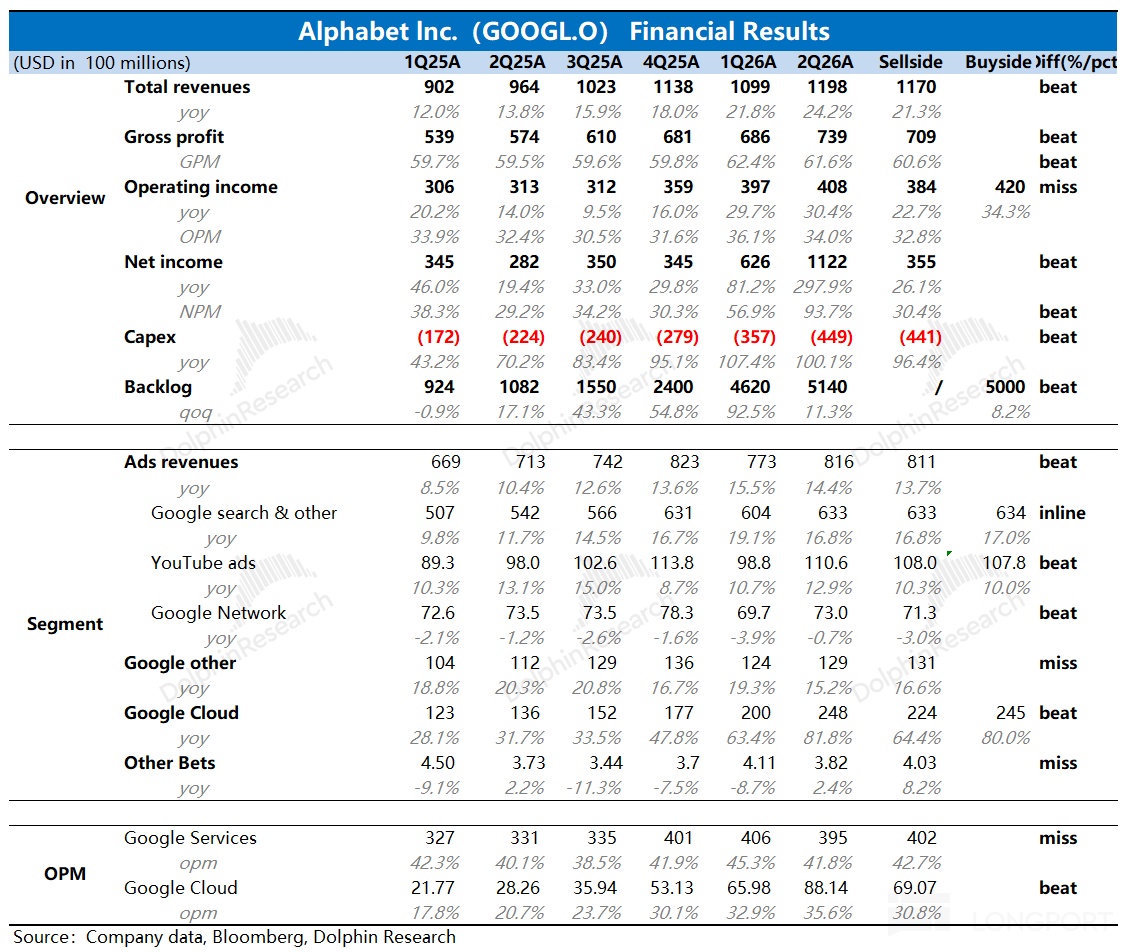
I. Core Results Recap
1. Capital return: The BOD approved a 5% increase to the quarterly dividend. This underscores ongoing shareholder payout discipline.
2. Outlook: FY CapEx guidance raised to $195–205bn (vs. $180–190bn prior), primarily to accelerate capacity delivery against demand. The ramp reflects stronger growth needs.
3. CapEx in 2027 is expected to be significantly above 2026. The Wiz acquisition will create low single-digit percentage-point headwinds to Cloud OPM for the rest of 2026. In Q3, Alphabet plans to expand third-party compute as a bridge, adding modest near-term margin pressure.
4. Key metrics: Consolidated revenue +24% YoY. Search and Other topped $63bn (+17% YoY). YouTube ads +13% YoY. Google Services revenue was $95bn (+15% YoY). OP rose strongly, and Cloud revenue grew +82% YoY.
5. Cash flow and CapEx: Q2 CapEx was approx. $45bn. Operating cash flow remains very healthy, while FCF stays pressured by tech infra investment. Recent equity and debt raises expanded the debt stack from ~$16bn to ~$100bn, and cash and marketable securities remain ample.
6. Cloud: Cloud backlog surpassed $514bn (+11% QoQ), with just over 50% expected to convert to revenue within 24 months. Cloud OPM continued to expand. GenAI model–driven product revenue remained robust.
II. Call Details
2.1 Management Highlights
1. AI infrastructure and models
- a. Launched new-generation models: Gemini 3.6 Flash and 3.5 Flashlight, offering strong cost efficiency and performance. Flash demand is high given the performance-to-cost balance.
- b. Released Gemini 3.5 Flash Cyber with a core supplier agent to find and fix vulnerabilities, delivering performance on par with larger cyber models. This targets automated security workflows.
- c. Gemini 3.5 Pro is in testing, while the team builds the next generation. Training for Gemini 4 has begun with the most ambitious pretraining run yet, and management is excited about frontier progress.
- d. Over 9mn developers build monthly on Alphabet models. Model APIs process ~22bn tokens per minute vs. ~16bn last quarter.
- e. Rolled out Omni to create content from any input starting with video. Since the May I/O launch, daily video creators on the Gemini app are up 40%.
- f. Gemini open-source model downloads exceeded 900mn in aggregate, with the latest GM4 topping 300mn downloads since release. Adoption continues to scale rapidly.
- g. Antigravity agent dev platform has over 2.4mn weekly actives. Chrome used model-driven development to compress a 2-year roadmap to 3 months, boosting delivery speed 8x.
2. Search
- a. Search and Other revenue exceeded $63bn (+17% YoY), with retail and financials contributing the most. Strength was broad-based.
- b. Query volumes hit all-time highs, with World Cup usage peaking to record levels. This underscores reliance on Google during key moments.
- c. AI Overviews and AI Mode continued to drive overall Search growth. Users are asking more specific, detailed questions.
- d. Gemini is being deployed across the entire ads infrastructure, lifting ad quality, advertiser tools and AI UX. This is a full-stack integration.
- e. In Shopping ads, Gemini drove a 20% increase in high-relevance ad impressions. This helps shoppers find the best matches immediately.
- f. AI Max exited beta, with 500k advertisers onboarded. Advertisers using AI Max or PMax saw >15% avg. conversion uplift on Search.
- g. Over half of SMBs globally use AI to create or optimize creatives. Adopting AI tools is becoming standard.
3. Google Cloud
- a. Cloud revenue rose +82% YoY, driven by strong demand for AI infra and AI solutions, with backlog at $514bn. Momentum remains broad.
- b. Nearly 90% of Fortune 100 use Gemini Enterprise. Enterprise AI solution demand stays strong.
- c. New logo momentum is strong, with $100mn–$1bn deals doubling YoY and multiple $1bn+ contracts signed. Deal size is scaling up.
- d. Existing customers exceeded initial commitments by 45%, an acceleration vs. last quarter. Expansion continues to improve.
- e. In the past 12 months, 330 customers each processed over 1 trillion tokens, and 35 reached 10 trillion. Token throughput is ramping fast.
- f. Began delivering TPU hardware into certain customers' own data centers (e.g., Blackstone) to expand TAM. This complements hyperscale deployment.
- g. Testing new ad formats in AI Mode: text ads add contextual loops via conversation to lift performance. Direct Offers with partners like IHG show positive feedback. Highlight answers in list responses are seeing early user acceptance.
- h. Universal Commerce Protocol (UCP) positioned as an open standard for agentic commerce, now live with Target and Steve Madden. Hundreds of tech, payments and retail partners have expressed integration interest.
- i. Launched Universal Card, letting shoppers add items from multiple retailers and checkout once within Google services. This streamlines purchase flows.
4. YouTube
- a. Ad revenue rose +13% YoY, driven by both performance and brand. Growth is balanced across formats.
- b. As FIFA's preferred platform partner, over 1.7bn unique viewers watched World Cup content, with 550mn+ on TV. It was YouTube's most-watched World Cup ever.
- c. Introduced an exclusive creator slate to make it easier for brands to reach fan communities. This expands premium inventory.
- d. Living-room viewing continues to grow, and shopping formats on TV are set to drive retail. CTV remains a key tailwind.
- e. Demand Gen and insurance remain highly attractive opportunities. Both verticals show strong advertiser intent.
- f. Subscription revenue growth continues to outpace ads. The mix is shifting toward subs.
5. Subscriptions and other
- a. Total paid subs keep rising, led by YouTube and Google One. Growth remains solid.
- b. Consumer AI paid plans are strong, mainly via the Gemini app. Uptake is robust.
- c. Network ads revenue fell 1% YoY. Headwinds persisted in network demand.
6. Other Bets
- a. Waymo launched its latest vehicle for public riders, the first with the 6th-gen Waymo Driver. More riders will be added in coming months.
- b. Wing safely completed 1mn+ home deliveries and continues to expand through partnerships with Walmart, DoorDash and Papa Johns. Operational scale is increasing.
- c. Isomorphic Labs raised $2bn+ to fund its AI drug-design engine, global expansion and pipeline advancement. Capital will support R&D and growth.
7. Ads and commerce ecosystem
- a. Partnered with retailers to build the open-source UCP standard as a new rail for agentic commerce. This aims to standardize workflows.
- b. UCP Shopping and Food Tech councils added new members to help guide the roadmap. Industry governance is broadening.
- c. Launched Universal Card to let shoppers add items from different retailers and check out once within Google services. This reduces friction in multi-merchant carts.
- d. Ad monetization in AI Mode remains encouraging, even as AI Overviews extends to more commercial queries. Early signals are positive.
2.2 Q&A
Q: After a year of heavier GenAI product and tool investment, how do you size and time the GenAI ROIC opportunity?
A (Sundar): We are still in the very early phases of long-term shifts across several core information businesses. From consumers to enterprises, the opportunity is extraordinary. Enterprise AI adoption remains early, with a small share of workloads truly AI-native or AI-enabled today. We take a full-stack approach and see momentum across consumers, enterprises and developers, and we are more optimistic about these opportunities than a year ago.
Q: With compute constrained, how are you planning forward CapEx? How much spend is needed in 2027 to close capacity gaps?
A (Anat): We remain in a supply-constrained environment, and this has persisted for several quarters, with very strong demand from external cloud customers and across the biz. We will keep investing where we see attractive returns, taking a multi-year view while also addressing near-term needs and building aggressively to meet demand. Despite significant capacity adds over the past three years, demand still outstrips investment, and we are driving operational and technical efficiency across the stack to deliver more compute.
Q: Confidence in keeping Gemini at the frontier? How do you close the coding gap?
A (Sundar): The frontier is extremely dynamic and highly competitive. We remain at the frontier on many attributes, and we acknowledge we need to improve on coding and agentic coding. 3.6 Flash improves by 10+ points on Deep benchmarks vs. 3.5 Flash, with better token efficiency. We are using it internally and testing coding with many customers. At the next frontier, we need larger base models, and we are training Gemini 4, which is very ambitious; we are excited by internal progress and confident people will be pleased at launch.
Q: Optimal capital structure? How do the costs of debt vs. equity compare?
A (Anat): We start with how much operating cash flow can support, and we continue to generate very healthy OCF. Then debt: over the past 12 months we expanded the stack from ~$16bn to ~$100bn. We also issued equity to ensure a resilient, healthy balance sheet.
We do not plan to return to equity markets except for ATM issuance to address tax on equity awards. We balance OCF, debt and equity to maintain a strong balance sheet. That remains our framework.
Q: Key learnings from scaling TPUs? How do you balance internal vs. external TPU demand?
A (Sundar): We are pleased with the TPU roadmap and performance advantages. Our first priority is allocating enough TPU for frontier AGI development, which underpins everything. For external cloud demand, we serve customers using both TPUs and GPUs, and we place TPUs in customer data centers (e.g., Blackstone) to balance allocation and maximize capacity for frontier model dev and core consumer and enterprise services.
Q: Share of TPUs in Cloud backlog? How do rev. recognition and margins look?
A (Anat): TPU system sales are reflected in Cloud backlog. The vast majority of the $514bn backlog is GCP agreements, but it does include TPU systems. We began building inventory for these systems, which affects OCF. Recognized revenue this quarter was small and will build through 2026, with the majority in 2027.
Q: How do you accelerate Gemini release cadence? Third-party compute deals like SpaceX? Is Flash the right market position?
A (Sundar): We focus on the Pareto frontier to deliver the best models at each price point. We aim to lead across the full spectrum of frontier models, and cadence is accelerating: after I/O we shipped 3.5 Flash, then 3.6 Flash, and more iterations are coming. We are putting significant compute and focus into Gemini 4 to compete at the frontier. Third-party deals (e.g., SpaceX) serve very large cloud customers at the margin; while near-term costs can be higher, multi-year contracts offer attractive returns.
Q: Has compute allocation across units changed, and how do you weigh Search, model training and Cloud?
A (Sundar): The baseline is what frontier AGI development needs. On top of that, we prioritize core products like Search and YouTube, and Cloud. Within Cloud, we prioritize serving models for Vertex AI, Gemini Enterprise and core solutions such as data analytics and cybersecurity, with most capacity going to core consumer and enterprise services.
Q: How are Search and YouTube monetizing, and what drove all-time-high query volumes?
A (Sundar/Philipp): The 17% YoY Search growth was driven by multiple parts of the business. Gemini is deeply integrated across the ad stack, and all major verticals contributed—retail led, followed by financials, tech and media & entertainment. Gemini improves our ability to understand user intent and match the right ad, and AI Max unlocked billions of previously unmonetized queries. For YouTube, both direct-response and brand drove growth, with living-room viewing still climbing.
Q: Are AI tools shortening the consumer purchase journey and improving conversion? How much of Search growth is behavior change vs. new ad tools?
A (Sundar): We are at an expansionary moment for Search. AI is fundamentally changing how the world searches and consumes information, with query volumes at all-time highs. From ten blue links to AI Overviews and AI Mode, to Lens, Circle to Search and Search Live—which is now available in all countries and languages that support AI Mode—AI ads let SMBs reach customers at a scale impossible a few years ago. Taken together, we feel well positioned.
Q: What drives Cloud margin expansion? Are AI revenues lower-margin?
A (Anat): Strong revenue growth in Cloud and Google Services is providing leverage across the P&L. We have been driving operational productivity and scientific process innovation in tech infra. Google Cloud margins expanded significantly vs. a year ago, largely from strong top-line growth and highly efficient operations under Thomas and team. Higher CapEx will add depreciation headwinds, but we will keep pushing for higher efficiency.
Q: How does vertical integration help with a complex supply chain? Do 2026–27 CapEx plans factor in supply-chain price inflation?
A (Anat/Sundar): Our long-term planning and ROIC framework let us plan forward effectively. We are indeed navigating a complex supply-chain environment and have baked that into guidance. Our scale and ability to partner across layers—suppliers see the strength of our diversified biz, the demand we drive, our frontier tech and full-stack investments—enable deeper partnerships across the chain, with scale economies working in our favor.
Q: Will some Search use cases monetize better via subscriptions than ads?
A (Sundar): We think carefully about capability and cost boundaries to serve users at scale while invoking the most powerful models for the most challenging queries. As we serve higher-value use cases, some users want access to the most capable models. We offer tiered subscriptions to access more powerful Gemini models, and AI subs grew strongly this quarter on user interest. This lets us serve broad needs across all scenarios.
Q: How big is the TPU sales opportunity? How much of backlog growth is TPUs vs. Cloud?
A (Anat): We see huge demand for AI solutions and infra, with significant demand for both GPUs and TPUs. We are proud to offer a broad and diversified portfolio. TPU hardware agreements are included in the $514bn Cloud backlog, though the majority remains GCP contracts, and just over half will convert within 24 months. For TPU hardware, we expect small revenue later this year, with the majority recognized in 2027.
Q: Margins on large AI contracts with GenAI companies—can they match overall Cloud levels?
A (Anat): We will not comment on specific deals. Broadly, in a compute-constrained environment, we allocate resources across opportunities under a robust ROIC framework. That discipline guides contract selection.
Risk disclosure and statement: Dolphin Research Disclaimer and General Disclosure
Login to unlock15,016characters for free
This content is only available to signed-in users. Sign in to your Longbridge account to read the full post.

InterContinental Hotels
USIHG

Alphabet - C
USGOOG

Alphabet
USGOOGL

Target
USTGT

Blackstone
USBX

Alphabet Inc Pref Shares GOOGN 6.25 05/15/2029
USGOOGN