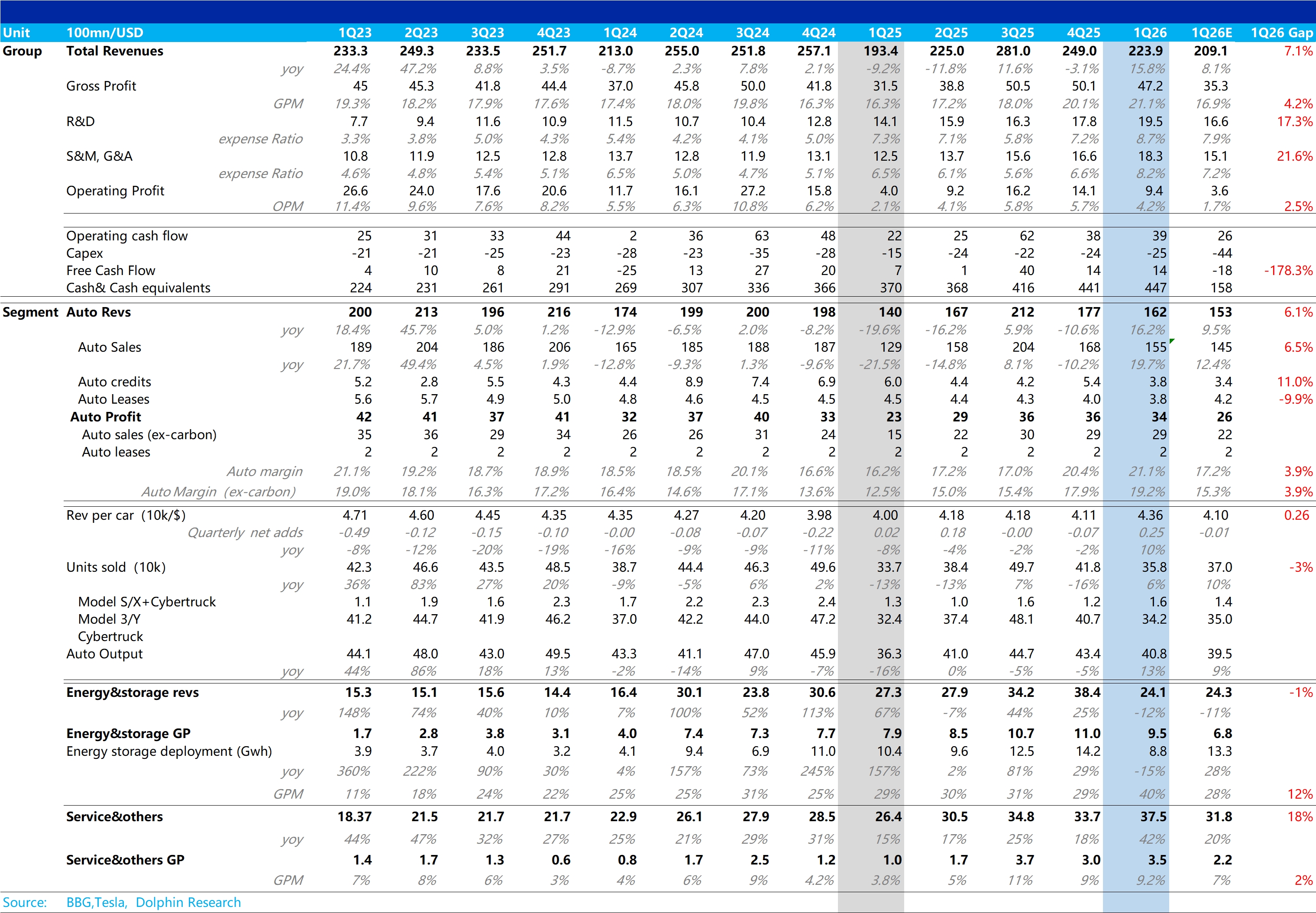

TSLA 1Q26 First Take: Headline-strong print, with revenue, GPM, and net income beating consensus by a wide margin.
However, multiple one-off factors contributed to the beat.Even after stripping them out, the core auto biz still outperformed the Street’s low bar.
① Revenue: Beat ex-FX, driven by higher ASPs
Q1 revenue was $22.4bn (+16% YoY), well ahead of the $20.7–20.9bn consensus.There was an estimated ~$0.9bn positive FX impact; ex-FX, adj. revenue was $21.5bn, still above expectations.
The outperformance was mainly driven by an auto ASP rebound QoQ after several quarters of declines.Services & other revenue also grew 42% YoY.
② Margin: Headline print flattered by multiple one-offs
GPM was 21.1%, well above the 16.9% consensus, led by upside in auto and energy storage.Below the line, autos booked a ~$230mn warranty reserve reversal and storage recognized ~$250mn in tariff subsidies, with an additional ~$200mn FX gain.
Ex these items, underlying GPM was 18.7%.That is down 140bps vs. last quarter’s 20.1% peak but still above consensus.
Core auto GPM ex-regulatory credits printed at 19.2% vs. 15.3% expected.Ex one-offs, underlying core auto margin was ~17.5%, slightly below last quarter’s 17.9% yet meaningfully above expectations.
Dolphin Research believes a QoQ ASP uptick and higher recognition of high-margin FSD were key supports.These offset higher per-unit depreciation from lower volumes and rising upstream raw material costs.
③ Cash flow: Growth covered spend; FCF turned positive
Despite elevated AI spend (in-house AI chips, Optimus, FSD) and higher SBC pushing up S&M and R&D QoQ, top-line and margin beats, coupled with no spike in capex, drove Q1 FCF to +$1.4bn.This net inflow was far better than the expected outflow.
That said, autos are increasingly a cash-flow support rather than the core narrative.The market’s real focus is whether AI milestones are slipping and whether cash flows are sustainable amid heavy investment.
① Optimus: The V3 debut shifted from the prior 1Q timeline to mid-2026.Elon Musk said small-batch production could start in late Jul or Aug in Fremont, but the ramp will be slow, with meaningful volumes only next year.
② Robotaxi: The company remains cautious on launching unsupervised Robotaxi service.It has expanded to Dallas and Houston and aims to operate in ~10 states by year-end, but Musk noted this year’s related revenue will not be ‘super meaningful’.He expects it to become meaningful and significant next year.
③ FSD: Unsupervised features are expected to begin rolling out to the customer fleet in Q4 2026.Deployment will proceed only where specific geographies are deemed demonstrably safe.
Capex and cash flow pressure:
The 2026 capex guide was raised from ‘over $20bn’ to ‘over $25bn’, to support six new facilities (incl. lithium refining, Cybercab, Optimus) and AI compute infrastructure.
While cash and investments remain ample at >$44bn, at a >$25bn/yr capex run-rate current cash covers less than two years of high-intensity spend.The ambitious AI roadmap must translate into tangible revenue and cash flow soon, or the company could face financing pressure. $Tesla(TSLA.US)