US stocks rose (SPX +0.4%, NDX +1.0%) as a global chipmakers’ rebound led by SK Hynix (+30%) and Samsung (+21%) lifted South Korea’s Kospi by an unprecedented 18%. In addition, $Amazon(AMZN.US) ‘s strong earnings last night (+12% pre-mkt) eased AI spending concerns. Apple fell -7% on weak guidance, while $Alphabet - C(GOOG.US) and $Meta Platforms(META.US) gained. $Tesla(TSLA.US) +1.5% after the WSJ reported that TSLA is considering a potential separation of its China business to pave the way for a possible merger with $SpaceX(SPCX.US). $Rivian Automotive(RIVN.US) +4% after beating 2Q rev and EBITDA estimates and guiding to stronger FY’26 results on the initial strength of R2 SUV sales, RIVN’s cheaper $45K SUV that started deliveries in June. The chip rally followed Citadel buying discounted positions from the giant Situational Awareness hedge fund, which lost half its assets. Hyperscaler FY’26 AI CapEx guidance rose only modestly to ~$730B from $700B previously.
[Mou Zhou's Notes] Cheapness is not the reason for you to buy in (Week 31 of 2026 | Issue No. 281)
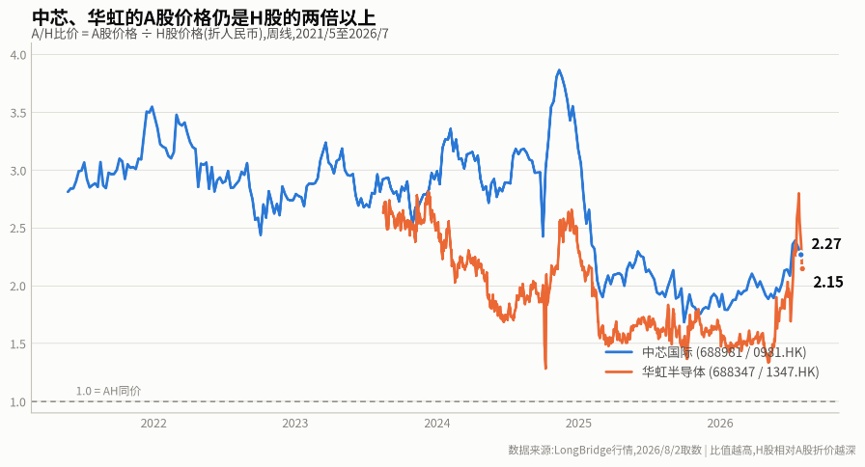
In 1992, the Shanghai and Shenzhen exchanges listed a strange type of stock: B-shares. The same company, with identical equity and dividends, had two different prices. A-shares were denominated in RMB and sold only to domestic investors; B-shares were priced in US dollars or HKD and sold exclusively to foreign investors. Two groups of buyers, separated by a wall of foreign exchange controls, bought independently. The result was: same shares, same rights, but B-shares traded at a long-term discount of 30% to 50% compared to A-shares. This wasn't because the companies were worse; it was simply because the pool of money able to buy B-shares did not interoperate with the pool able to buy A-shares. This discount persisted for nearly ten years...